

Hello technical audience, network engineers, and O&M professionals! Welcome back to our ongoing deep dive into optical communication hardware.
We are continuing our mission to thoroughly expose the hardware supporting our interconnected world, focusing on grounded language and real cases, skipping the boring theory.
Today, we discuss the "connection experts" in optical communications-Fiber Connectors. We will specifically focus on the square-faced "twins" dominating modern switches: LC vs. SC.
Quick Summary Box: LC vs. SC Pros & Cons
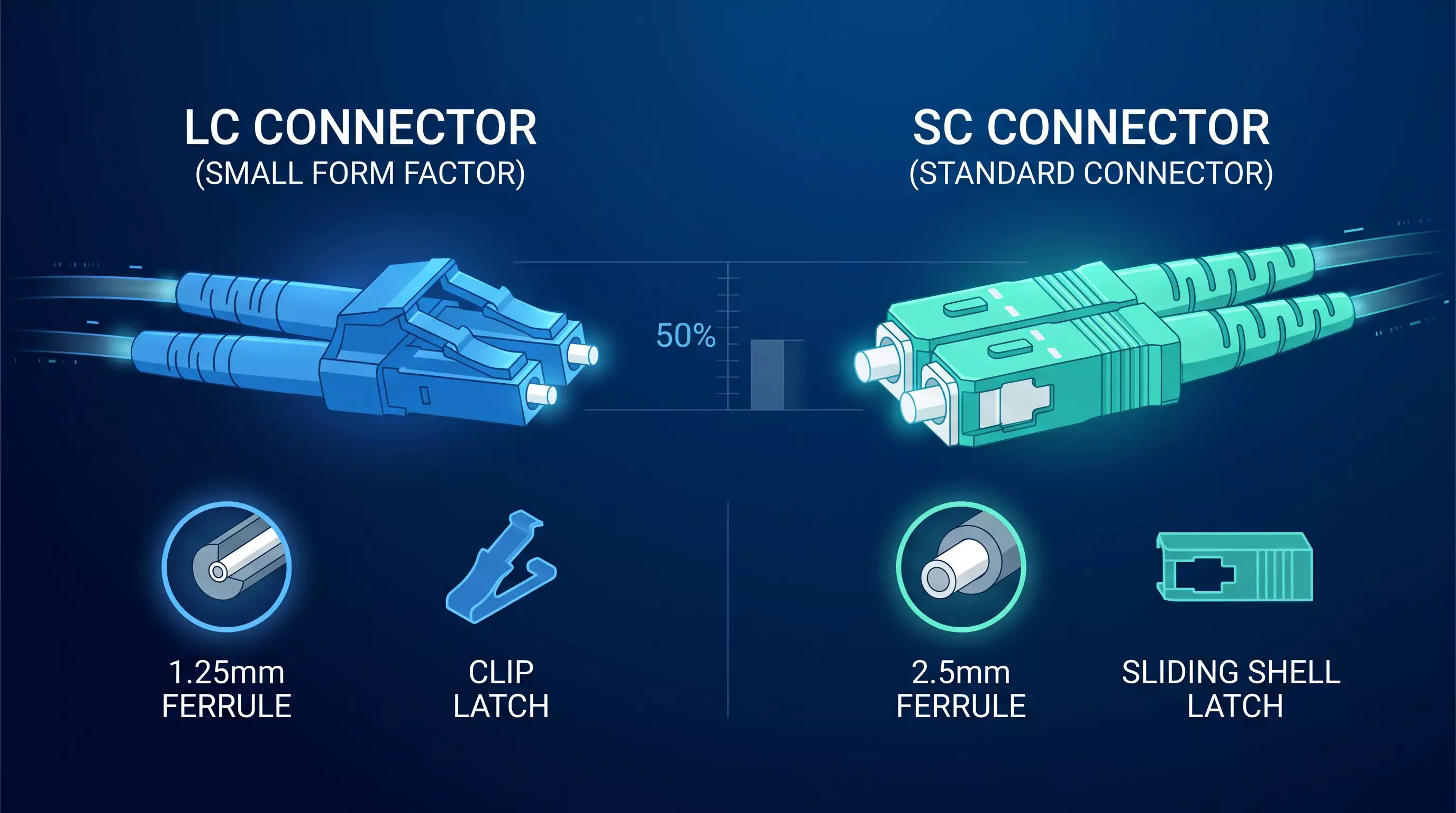
Before we look at the physical details, here is a quick-reference summary framework for both form factors:
LC Connector (Small Form Factor):
Pros: Extremely high-density layout, saves 50% cabinet space, precision alignment, standard for high-speed SFPs.
Cons: Slightly higher unit cost, smaller components require care when cleaning.
SC Connector (Standard Subscriber Connector):
Pros: Robust, lower cost, exceptionally easy to grip, ideal for simple FTTH / wall boxes.
Cons: Bulky footprint, entirely unsuitable for modern high-density network switches.
Learning to "Recognize Faces" in the Server Room
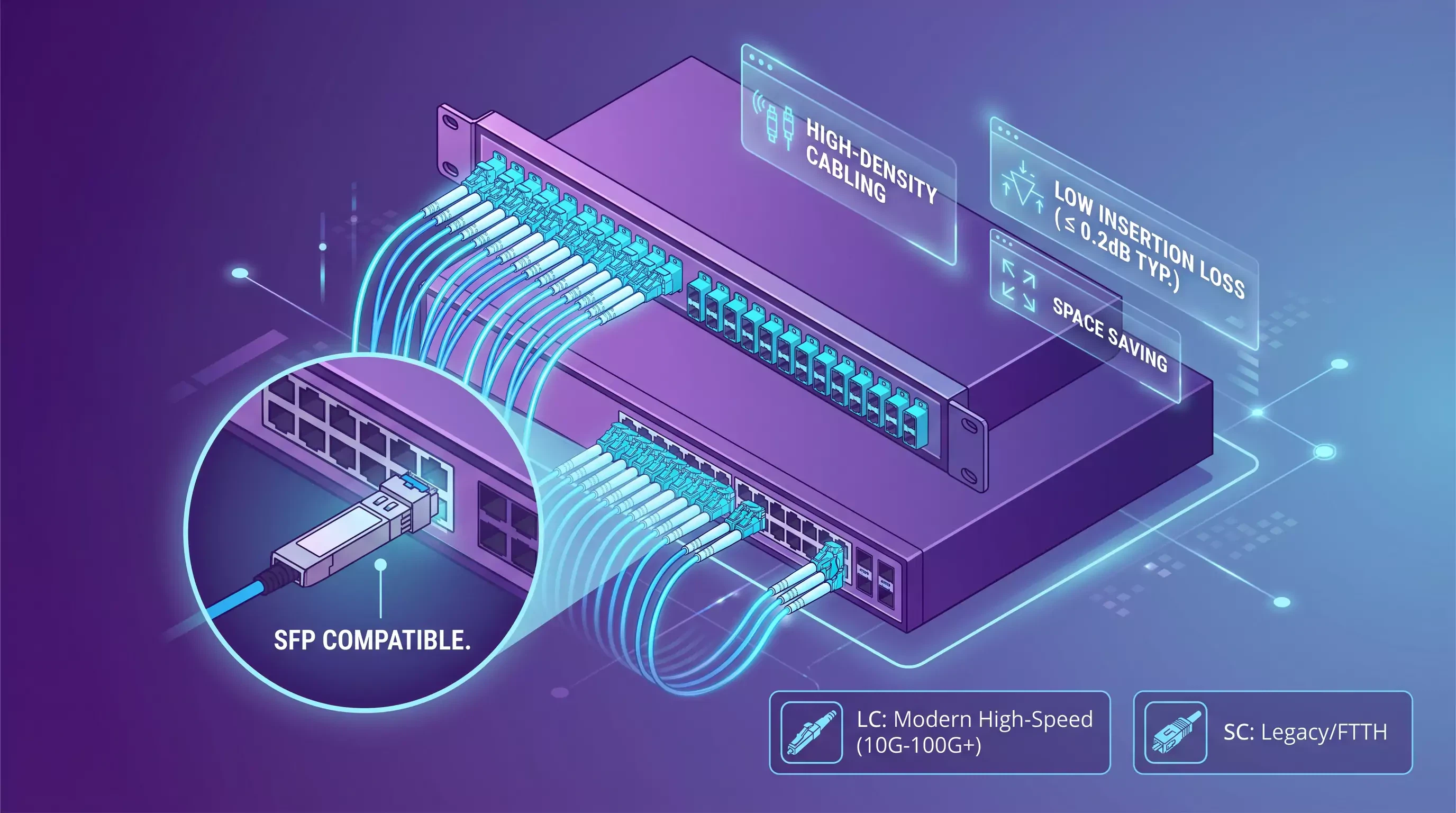
When entering an equipment room, you need to be able to identify connectors by sight, or things get embarrassing quickly. Luckily, distinguishing LC and SC is easy using three clear metrics.
1. Look at Ferrule Size
The absolute core difference is the diameter of the internal ceramic ferrule. The LC connector is the "small guy" with a ferrule diameter of only 1.25mm. The SC connector is "medium-sized" and thicker, featuring a 2.5mm ferrule. Think of the LC connector as a AA battery and the SC connector as a chunky D-cell battery.
2. Look at the Latch Mechanism
Both utilize a push-pull insertion design, but their structural latches are completely different. The LC connector uses a small, built-in elastic clip on top of its body. When inserting or removing, you feel and hear a clear, reassuring "click." The SC connector uses a large, sliding external plastic outer shell housing. You have to firmly grip the outer sleeve to pull the locking teeth back out of the coupler.
3. Look at Application Scenarios
LC connectors are the undisputed kings of modern high-speed transceivers (10G, 25G, 100G, and above) and high-density enterprise distribution frames. SC connectors are primarily found on lower-speed legacy links (1G and below), passive optical networks like Fiber-to-the-Home (FTTH), and industrial control boxes.
Technical Performance Breakdown
Zirconia Ceramic Ferrule Precision
High-quality LC and SC connectors both use zirconia ceramic ferrules to achieve ultra-precise fiber core alignment. However, because the LC ferrule is so small, its structural tolerances are much tighter.
Premium connectors engineered by manufacturers like Spring Optical maintain a strict concentricity error of ≤0.3μm.
💡 O&M Pro-Tip: I learned this lesson the hard way early in my career. Buying cheap, unbranded LC patch cords with poor ferrule precision leads to massively erratic insertion losses. Don't compromise on ferrule quality just to save pennies.
Insertion Loss Performance
Insertion loss is your most critical connector metric-the smaller the loss, the stronger your link.
Premium LC Connectors: Insertion loss ≤0.2dB (Ordinary variants: ≤0.3dB)
Premium SC Connectors: Insertion loss ≤0.25dB (Ordinary variants: ≤0.3dB)
While the fractional gap is negligible in short campus networks, when dealing with high-speed links (100G and above), the tighter tolerances and lower losses of high-end LC connectors ensure a much cleaner signal across the link lifecycle.
Step-by-Step Connector Handling and Best Practices
To prevent signal degradation, follow these four operational steps on-site:
Step 1: Clean the Ferrule -> Step 2: Push Until the "Click" -> Step 3: Manage Bend Radius -> Step 4: Label Immediately
1. Clean the Ferrule Before Docking: Dust or body oils on a tiny 1.25mm ferrule will cause massive insertion loss or complete signal block. Always wipe the end face using a dedicated fiber cleaning pen, wiping in one direction only. Never rub it back and forth, which scratches the face.
2. Operate with a Gentle Touch: When handling an LC connector, pinch the main housing with your thumb and index finger, pushing straight into the transceiver until you hear the crisp "click." For SC connectors, verify you are pressing the outer latch properly before attempting extraction.
O&M Pitfall: I once witnessed a panicked technician yank an SC patch cord out of a rack without unlocking the outer sleeve. He snapped the adapter's structural internal clip, destroying the port and dropping the link. Don't make that low-level mistake!
3. Prevent Tight Bends: Leave a small loop of slack behind the patch panel. The minimum bend radius of a standard fiber jumper should never be less than 30mm. Tight bends pinch the light path, causing severe macrobending loss.
4. Label Every String Immediately: Save yourself hours of late-night tracing. Use crisp naming templates like: [Connector Type]-[ID]: [Source Cabinet]-[Device]-[Port].
FAQ
How do LC and SC fiber connectors visually differ?
The main visual difference is size. The LC connector is a "Small Form Factor" (SFF) connector with a 1.25mm ferrule, while the SC connector is bulky with a 2.5mm ferrule. The LC uses a small push-pull elastic clip locking mechanism, whereas the SC uses a large external push-pull outer shell housing.
Which connector is better for high-density network cabling, LC or SC?
The LC connector is much better for high-density environments. Because it is roughly half the size of an SC connector, LC allows you to double the number of fiber ports within the same cabinet space.
What type of fiber connector do standard SFP transceivers use?
Standard high-speed optical transceivers, such as SFP, SFP+, and QSFP28 modules (10G to 100G+), universally utilize the small footprint LC connector. SC connectors are too large for these modern modules.
Do LC and SC connectors have different performance in insertion loss?
The performance difference is minimal, but high-quality LC connectors often have slightly better tolerances due to their precision ferrule. Premium LC connectors reach ≤0.2dB insertion loss, compared to premium SC connectors at ≤0.25dB.
What happens if I yank an SC fiber connector without pulling the outer sleeve?
If you yank an SC connector from the cable itself rather than gripping the sliding outer sleeve, you can easily snap the adapter's internal structural locking clip. This destroys the port, drops the link, and requires adapter replacement.
Summary
LC wins on high density, precision, and high speed; SC stands firm on ease of use and low cost in home or simple office networks.
However, the connector world doesn't stop with square options. If you deal with industrial facilities, older telecommunication hubs, or outdoor setups, you will encounter round form factors. Learn how to handle them in our guide on ST vs. FC Connectors and Mating Sleeves: Legacy and Rugged Fiber Links.