

Hello, technical audience, network engineers, and O&M professionals! Welcome back to our ongoing deep dive into optical communication hardware.
We continue our mission to thoroughly expose the hardware supporting our interconnected world, focusing on grounded language and real cases, skipping the boring theory.
We previously discussed the square "twin" connectors, LC and SC. Today, we turn our attention to the round-bodied heavyweights of the fiber family: ST and FC, alongside their critical connection bridges-Flange Plates (Adapters).
Quick Summary Box: ST vs. FC Mechanical Features
To distinguish these two round form factors, look at their mechanical locking designs:
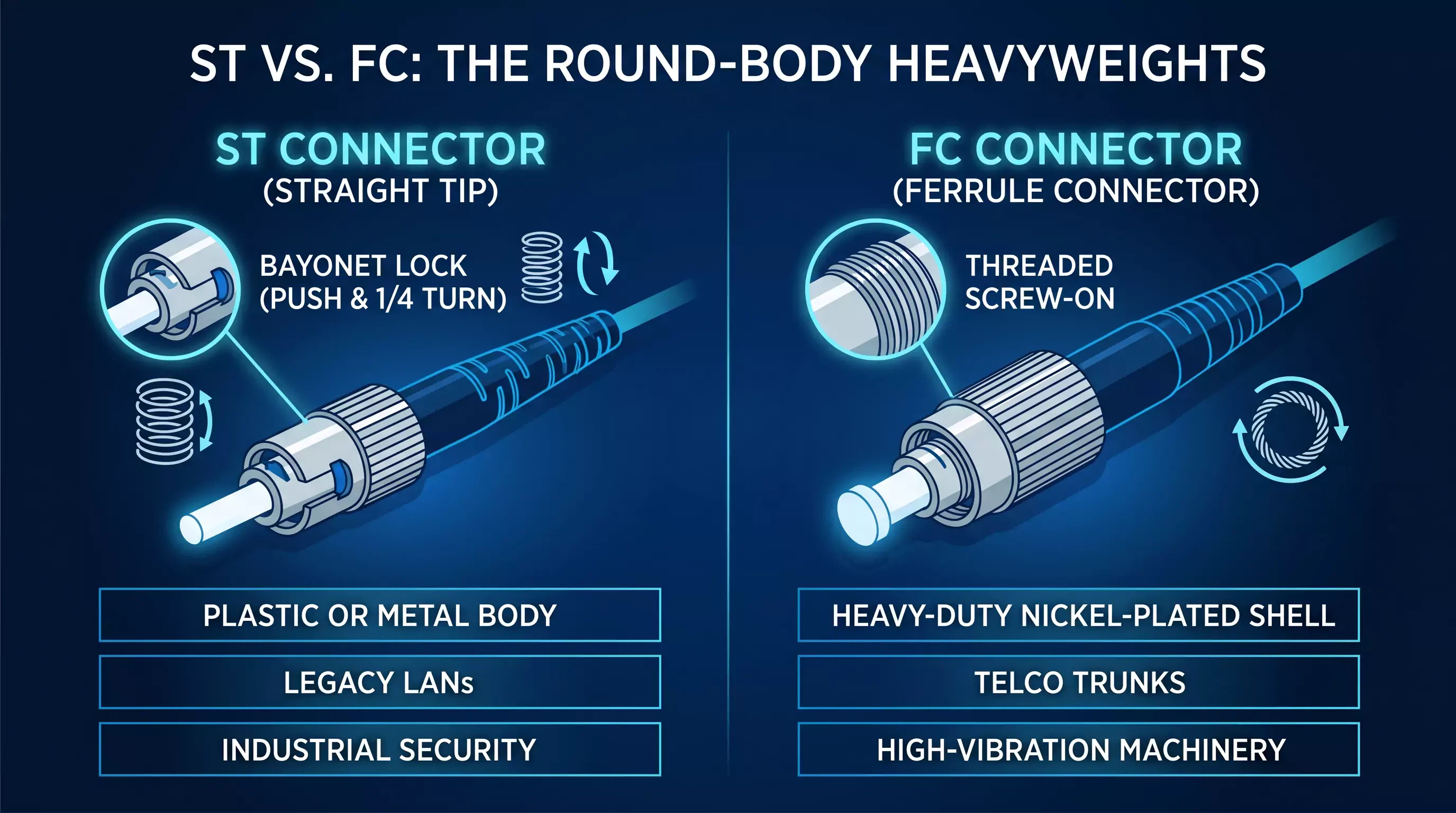
ST Connector (Straight Tip): Uses a spring-loaded Bayonet Lock mechanism. It requires a quick push and a 1/4 turn to lock into place, exactly like twisting a pill bottle cap.
FC Connector (Ferrule Connector): Uses a heavy-duty Threaded Screw-on mechanism. It must be turned clockwise multiple times until the threads pull the ferrule flush against the opposing interface.
ST vs. FC: Identifying the Round Connectors
Apart from their distinct locking rings, there are two key identifiers to keep in mind:
1. Material Composition
ST connectors are frequently found with plastic bodies, making them lightweight and simple. FC connectors are almost universally constructed with heavy-duty nickel-plated metal shells, giving them a rugged feel, substantial weight, and incredible immunity to corrosion and impact.
2. Main Target Applications
ST connectors are primarily found in legacy Local Area Networks (LANs), building security systems, and old industrial manufacturing floors. FC connectors are the standard for telecom operator long-haul trunks, rugged outdoor cellular base stations, and high-vibration machinery networks.
The Critical Role of Flange Plates (Fiber Adapters)
Connectors cannot transmit signals in a vacuum; they require a high-quality Flange Plate (more commonly referred to by engineers as a Fiber Adapter or Mating Sleeve).
A Fiber Optic Flange Plate (Adapter) is a highly precise mechanical alignment sleeve designed to hold two opposing fiber connectors perfectly flush, ensuring their microscopic glass cores line up without spatial error.
Key Adapter Specifications Box
When sourcing adapters for your panel layouts, verify these core internal tolerances:
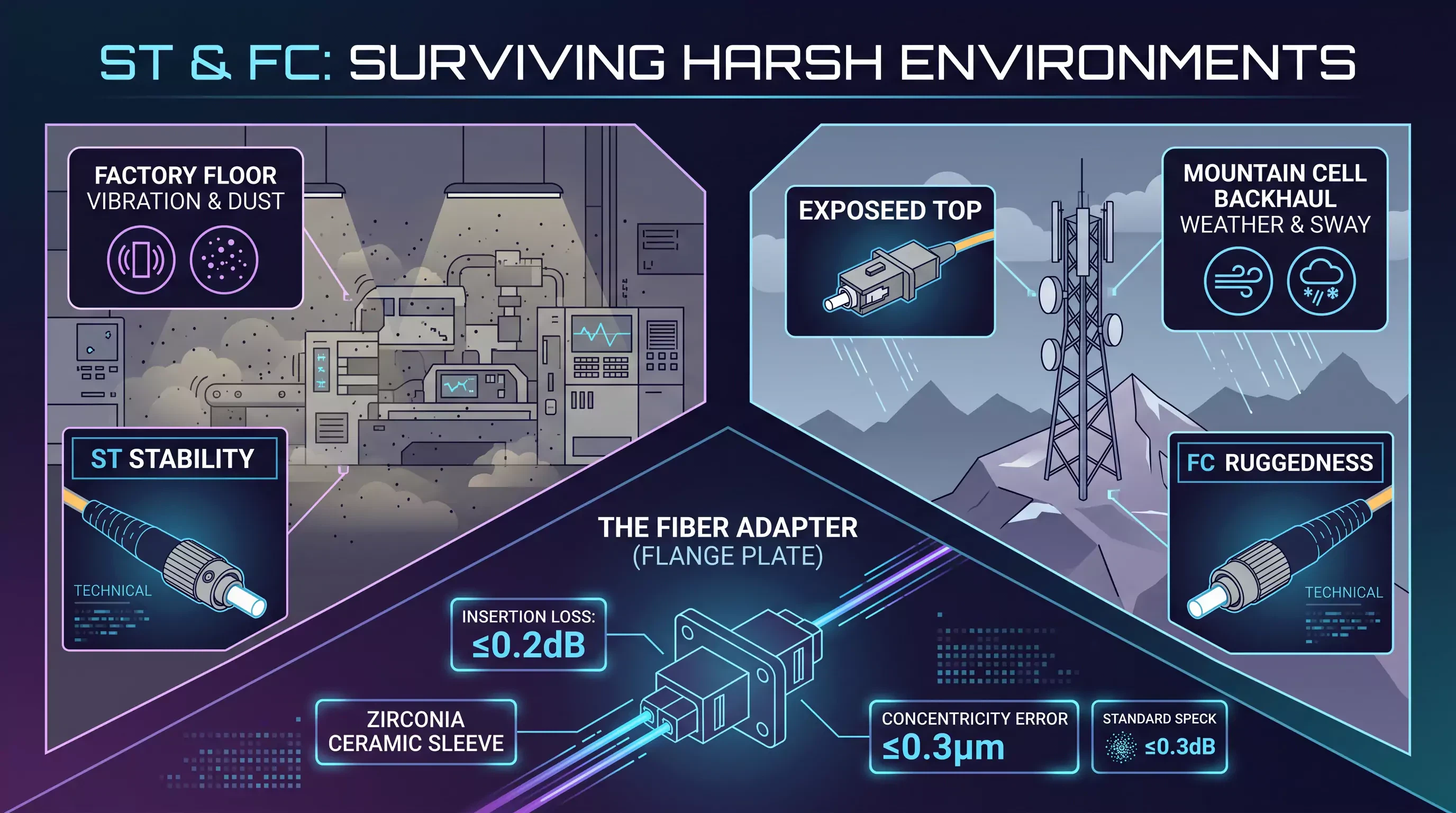
Insertion Loss contribution: ≤0.2dB for high-quality units (≤0.3dB standard).
Internal Alignment Sleeve Material: Must be high-grade Zirconia Ceramic (avoid cheap phosphor bronze sleeves for high-performance networks).
Concentricity Error: ≤0.3μm to maintain strict core center alignment.
Real-World Case Studies: Surviving Harsh Environments
While modern datacenters lean toward LC density, ST and FC are the clear choices when deploying networks in challenging environments.
Case Study 1: The High-Dust Factory Floor (ST Stability)
An industrial plant in our region operated a legacy automation system over older programmable logic controllers (PLCs) with ST optical interfaces at 100Mbps. The workshop floor suffered from continuous mechanical vibration and heavy airborne dust. While a consultant suggested migrating everything to square SC adapters, doing so meant replacing every expensive PLC module.
Instead, we sourced premium Spring Optical ST patch cables with rubber dust boots and industrial-grade steel bayonets. The spring-loaded bayonets absorbed the floor's vibration perfectly without backing out, keeping the machinery reporting data flawlessly.
Case Study 2: Mountainous 4G/5G Cell Backhaul (FC Ruggedness)
Cell towers built on exposed mountain tops face extreme weather, freezing rain, intense winds, and constant structural sway. For these critical backhaul links, we universally deploy FC connectors on single-mode fiber.
The threaded screw-on mechanism of the FC connector exerts immense clamping pressure that wind vibration cannot loosen. Furthermore, its thick metal body prevents rain and snow erosion from compromising the ceramic alignment ferrule, keeping rural cellular infrastructure connected year-round.
Crucial Maintenance Rules to Prevent Adapter Failure
Mount the Flange Plates Rigidly: When installing adapters into an ODF rack or distribution enclosure, verify the locking screws or clips are completely tight. If an adapter wobbles inside its cutout, the opposing ferrules will drift out of alignment, causing insertion loss to spike.
Clean the Internal Mating Sleeve: Engineers remember to clean their patch cords but frequently forget the adapter itself. Use a dedicated fiber cleaning stick to wipe the internal ceramic sleeve in one direction only.
O&M Failure: We once tracked a major link dropout on an outdoor run. After cleaning the patch cords three times to no avail, we checked the adapter with a scope and found a tiny clump of dust wedged deep inside the mating sleeve. One pass with a cleaning stick resolved the problem instantly.
FAQ
What is the difference between ST and FC fiber connectors?
The primary difference is the locking mechanism. The ST (Straight Tip) connector uses a spring-loaded Bayonet Lock that requires a push and 1/4 turn to secure. The FC (Ferrule Connector) utilizes a heavy-duty Threaded Screw-on mechanism that must be tightened clockwise.
Why is the FC connector preferred for rugged outdoor or high-vibration environments?
The FC connector is preferred because its threaded screw-on mechanism creates immense clamping force that wind, structural sway, and machinery vibration cannot loosen. Its heavy-duty metal body also provides high impact and corrosion resistance.
What is a fiber optic flange plate or adapter?
A fiber optic flange plate, commonly called a fiber adapter or mating sleeve, is a precise alignment sleeve designed to hold two opposing fiber connectors perfectly flush. It ensures their microscopic glass cores line up exactly for light to pass through.
Can I use ST connectors in environments with mechanical vibration?
Yes, ST connectors are suitable for many industrial manufacturing environments. The quick-action spring-loaded bayonet lock absorbs moderate vibration without the connector backing out of the port.
Why is zirconia ceramic preferred for the internal sleeve of fiber adapters?
Zirconia ceramic is the preferred material because it maintains exceptionally strict mechanical tolerances and concentricity (≤0.3μm). Unlike cheaper phosphor bronze sleeves, ceramic ensures the opposing fiber cores are perfectly centered, keeping insertion loss consistently low.
Summary
Use ST connectors for legacy industrial layouts requiring spring-loaded speed. Choose FC for heavy-metal, high-vibration, outdoor telco links. Ensure your adapters match your connector types perfectly, and always inspect before you connect.
But physical shape is only half the battle. To ensure the light signal reflects cleanly without bouncing back into the laser core, you must understand end-face geometry. Continue to our final guide: Optical Fiber Polish Matching Rules: Why You Must NEVER Connect APC to PC.