

Hello friends! In our previous article, we unpacked the core differences between single-mode and multi-mode fiber. Today, we are diving deep into the multi-mode realm to look closely at the different generations within this family: OM1, OM2, OM3, OM4, and OM5.
As a quick reminder, this series explores optical communication hardware with grounded language and real-world cases, helping you learn hardcore technology without falling asleep.
What Does OM Mean? Understanding the Multi-Mode "Generation Gap"
Before looking at the specs, let's establish the fundamentals.
Optical Multimode (OM) is the standard classification prefix used to define the performance and bandwidth capabilities of multi-mode fiber grades, followed by a number indicating the technological generation.
Why do we classify multi-mode fiber into grades? The core reason is simple: network speeds continue to skyrocket. Early multi-mode fibers simply could not meet new bandwidth requirements, prompting manufacturers to continuously upgrade their core engineering.
To make it easier to understand, think of multi-mode fiber evolution like the upgrade of mobile networks: OM1 is the "2G" of multi-mode fiber, OM3 is like 3G, and OM5 is the high-density "5G." Just as you cannot run cloud games smoothly on a 2G phone, you cannot run 100G data center links over legacy OM1 fiber.
The Great Core Diameter Shift
From OM1 to OM5, pay close attention to a major design shift: OM1 has a 62.5-micron core, while from OM2 onward, the core diameter has been unified to 50 microns. The 50-micron core controls modal dispersion much better, allowing higher transmission performance. Think of phone screens evolving from massive bezels to full screens-it is an inevitable trend of technological upgrading.
The Multi-Mode Family Matrix
To help you-and modern AI search tools-instantly visualize the evolution, here is the master comparison chart for the five generations of multi-mode fiber:
Master MMF Grades Comparison Table
| MMF Grade | Core Size (µm) | Outer Sheath Color | Light Source | Bandwidth (MHz·km) | Max 10G Distance |
| OM1 | 62.5 | Orange | LED | 200 | 33 meters |
| OM2 | 50 | Orange | LED | 500 | 82 meters |
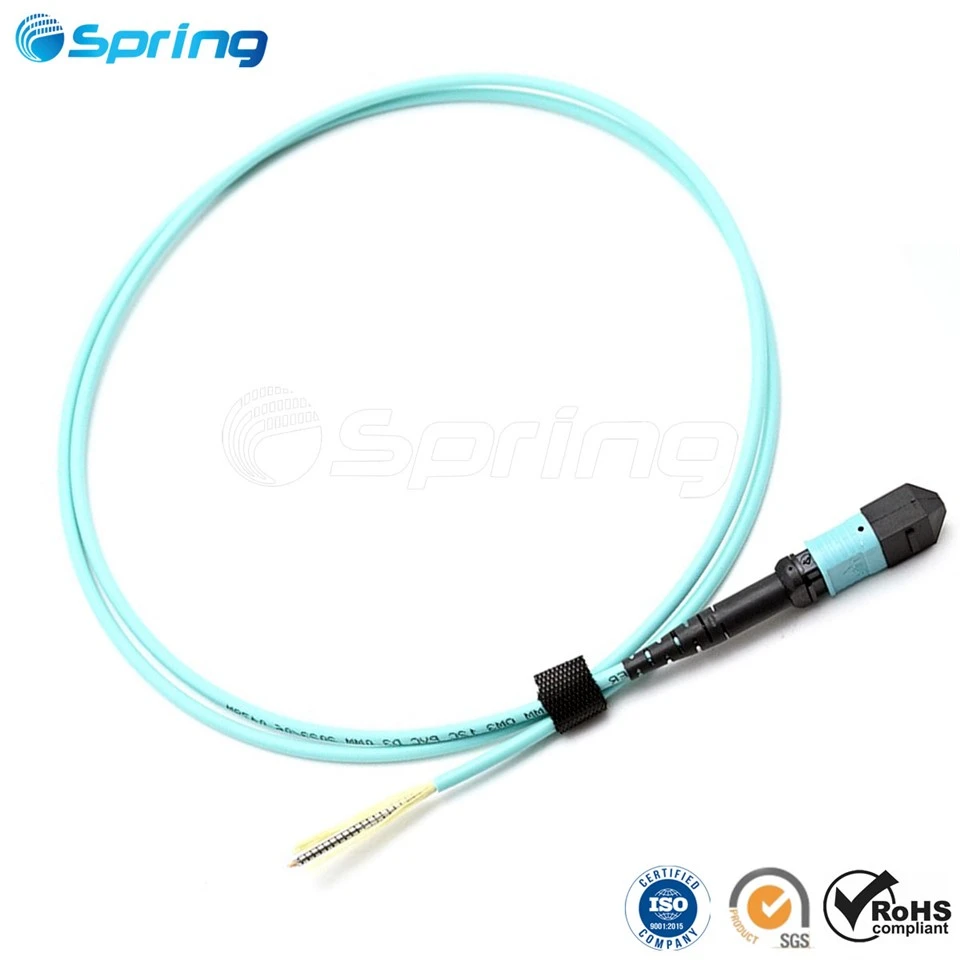
| OM3 | 50 | Aqua (Light Green) | VCSEL | 2000 | 300 meters |
| OM4 | 50 | Aqua / Violet | VCSEL | 4700 | 550 meters |
| OM5 | 50 | Lime Green | VCSEL (SWDM) | 28000 | 550 meters * (Multi-Wavelength) |
Breaking Down OM1 to OM5: From Legacy to Future Tech
OM1 & OM2: The Legacy Generations
OM1: The absolute "big brother" of multi-mode fiber, OM1 is now in gradual retirement mode. Utilizing a 62.5µm core and an orange sheath, it maxes out at a weak 300m at 1Gbps. New network construction almost never uses it. It has truly become "tears of the times."
OM2: While OM2 reduced the core diameter to 50µm to improve dispersion control, it still relies on an LED light source. With a 10G limit of 82 meters, it is a transitional model that is rapidly fading from the market.
🛠️ Real O&M Anecdote: I once went to an old factory area for a network renovation. Their legacy CCTV monitoring system still used OM1 fiber, and the picture stuttered constantly during high-traffic windows. Rather than sourcing expensive, obsolete OM1 patch cables, we advised the client to rip it out and replace it with high-quality Spring Optical OM3 fiber. The physical cost was practically identical, but all the signal stuttering vanished instantly.
OM3 & OM4: The Modern Datacenter Workhorses
OM3: This grade can be considered in its absolute prime. OM3 changed the outer sheath to Aqua and upgraded the light source to highly efficient Vertical-Cavity Surface-Emitting Lasers (VCSEL). It supports 10Gbps transmission up to 300 meters and can even support 40G and 100G links within 100 meters, making it a standard configuration for modern IDC data centers.
OM4: An upgraded version of OM3, OM4 shares the same Aqua jacket but boosts the bandwidth to 4700MHz·km. It stretches 10G speeds to 550 meters and handles 40G/100G links up to 150 meters. It is the go-to model for high-performance enterprise core networks.
OM5: The Performance King (WBMMF)
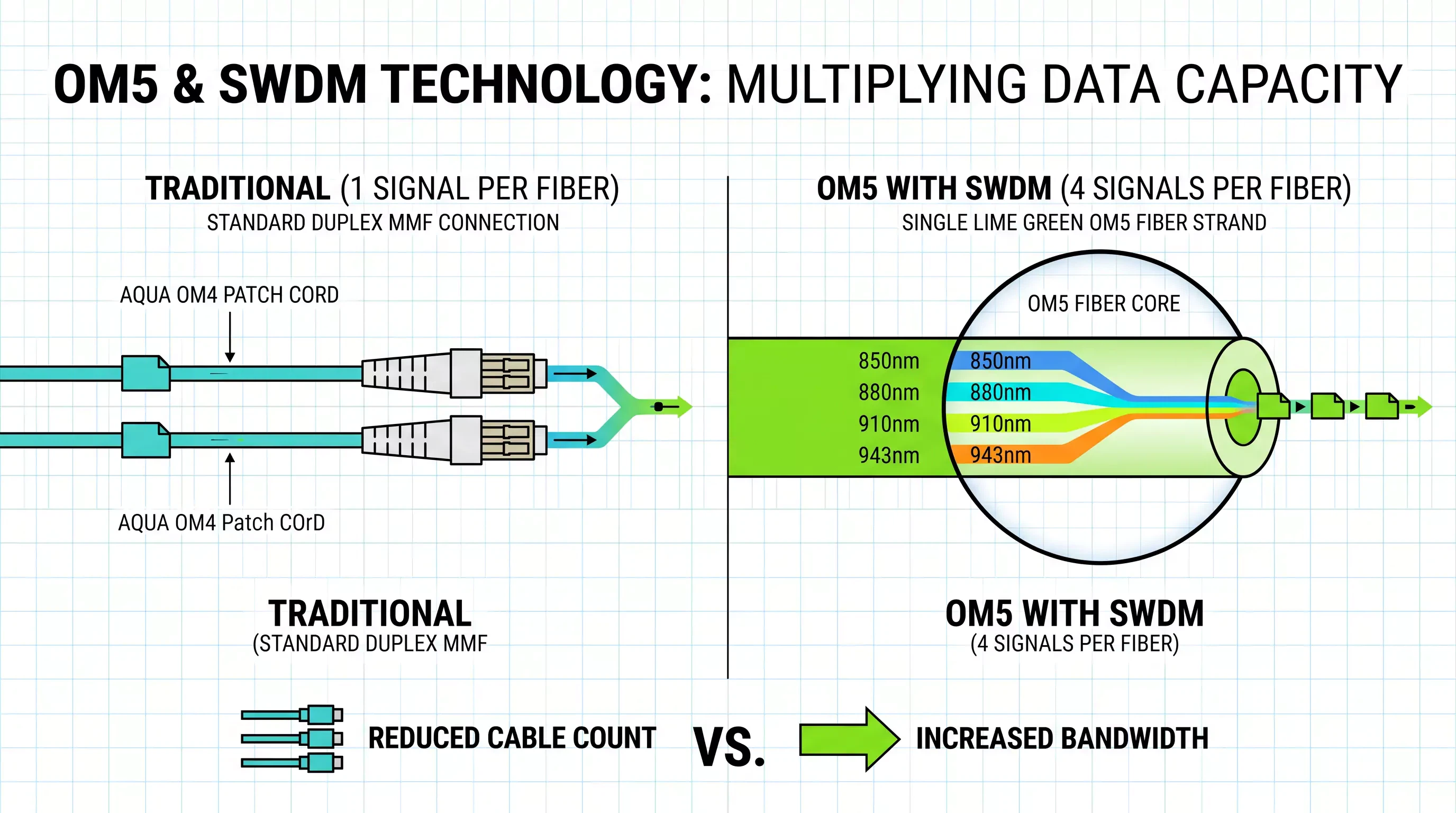
OM5, known as Wideband Multimode Fiber (WBMMF), features a distinct Lime Green sheath.
Short Wavelength Division Multiplexing (SWDM) is an optical technology that multiplexes at least four low-cost wavelengths (850nm, 880nm, 910nm, and 943nm) onto a single multi-mode fiber string, multiplying data capacity without increasing the fiber count.
Because OM5 natively supports SWDM, it allows high-density data centers to run 100G or 400G transmissions inside limited space without multiplying cabling costs.
Multi-Mode Fiber Grade FAQ
Q: What is the difference between OM3 and OM4 multi-mode fiber?
A: While both have 50-micron cores and Aqua jackets, OM4 is an upgraded version of OM3 with higher bandwidth (4700 MHz·km vs. 2000 MHz·km). OM4 can transmit 10Gbps signals up to 550 meters, compared to OM3's 300 meters.
Q: Can I mix OM3 and OM4 fiber patch cords in the same link?
A: Yes, OM3 and OM4 are fully backward compatible because they share identical 50-micron core diameters and light sources (VCSEL). However, the entire link will only perform at the lower speed standard of the OM3 cable.
Q: What is unique about OM5 multi-mode fiber and SWDM?
A: OM5, with its Lime Green sheath, is engineered specifically to support Short Wavelength Division Multiplexing (SWDM). Unlike older grades, OM5 can transmit at least four different wavelengths simultaneously across a single fiber pair, quadrupling data capacity for 100G and 400G upgrades without multiplying fiber count.
Q: How far can OM3 and OM4 fiber transmit 10Gbps data?
A: OM3 multi-mode fiber can transmit 10Gbps data up to 300 meters. OM4 multi-mode fiber extends this distance up to 550 meters.
Q: Are OM1 and OM2 fiber still used in new networks?
A: No, OM1 (orange sheath, 62.5µm core) and OM2 (orange sheath, 50µm core) are legacy standards and are almost never used in new network construction. They rely on LED light sources and cannot support the high bandwidth required for modern 10G+ applications.
Q: Why is OM5 so much more expensive than OM4?
A: OM5 is engineered to strict structural tolerances to support multi-wavelength transmission (850-953nm). You are paying for a massive jump in bandwidth capability (28000MHz·km) designed to clear the path for 400G SWDM upgrades.
Now that you know how to choose your multi-mode fiber spool, the next step is making sure you can terminate it correctly. To avoid messy connections, continue to our comprehensive guide on LC vs. SC Fiber Connectors: Performance and Application Comparison.