

Author: Alisa alisa@springoptic.com
Introduction: Why Fiber Patch Panels Matter in Modern Networks
In today's high-speed fiber optic networks, choosing the right fiber patch panel is essential for ensuring efficient cable management, scalability, and long-term network performance.
Whether you're deploying FTTH, enterprise LAN, or data center infrastructure, the right fiber patch panel can simplify installation, reduce maintenance costs, and improve overall network reliability.
One of the most common questions network planners face is:
👉 Should you choose a wall mount or rack mount fiber patch panel?
This guide provides a clear comparison, real-world applications, and expert recommendations to help you make the right decision.
Wall Mount vs Rack Mount Fiber Patch Panel: Key Differences
| Feature | Wall Mount Fiber Patch Panel | Rack Mount Fiber Patch Panel |
|---|---|---|
| Installation | Mounted on wall | Installed in 19-inch rack |
| Capacity | Low to medium (up to 48 fibers) | Medium to ultra-high (up to 144+ fibers) |
| Space Requirement | Minimal | Requires rack space |
| Scalability | Limited | Highly scalable |
| Cable Management | Basic | Advanced (with routing accessories) |
| Best Application | FTTH / Small office | Data center / ISP / enterprise |
What Is a Wall Mount Fiber Patch Panel?

A wall mount fiber patch panel is a compact fiber distribution unit designed to be installed directly on a wall. It is widely used in environments where space is limited and fiber counts are relatively low.
Advantages of Wall Mount Fiber Patch Panels
Space-saving design
Ideal for small telecom rooms, FTTH access points, and office environments
Easy installation
No rack required, reducing deployment complexity
Cost-effective solution
Lower initial investment compared to rack mount systems
Limitations
Limited fiber capacity (typically 12–48 cores)
Restricted scalability
Less suitable for high-density fiber management
👉 Best for:
FTTH networks, small offices, and low-density distribution points
What Is a Rack Mount Fiber Patch Panel?
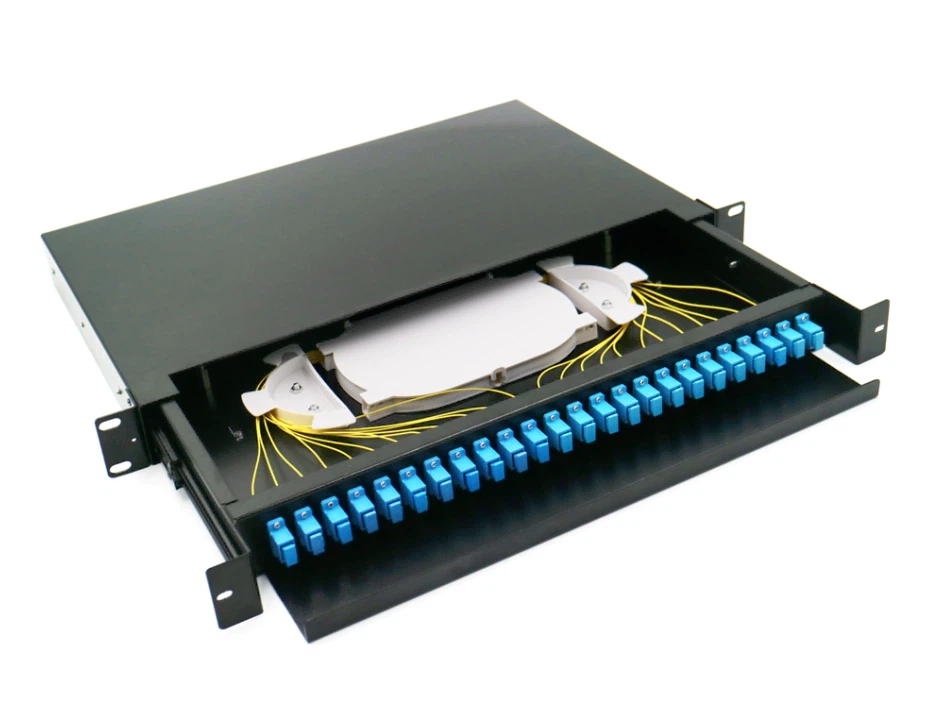
A rack mount fiber patch panel is designed to be installed in a standard 19-inch rack, making it the preferred choice for structured cabling systems and high-density fiber environments.
Advantages of Rack Mount Fiber Patch Panels
High-density fiber management
Supports 24, 48, 96, 144 cores or more
Excellent scalability
Easy to expand using modular cassettes or adapter panels
Advanced cable management
Integrated cable routing, labeling, and protection systems
Professional data center solution
Supports structured and standardized installations
Limitations
Requires rack infrastructure
Higher upfront cost
👉 Best for:
Data centers, telecom rooms, ISPs, and enterprise networks
How to Choose the Right Fiber Patch Panel
When selecting the right fiber patch panel, consider the following key factors:
1. Available Installation Space
Limited wall space → Choose wall mount fiber patch panel
Dedicated rack cabinet → Choose rack mount fiber patch panel
2. Fiber Count & Network Size
≤48 fibers → Wall mount is sufficient
≥48 fibers or future expansion → Rack mount is recommended
3. Future Scalability
Fixed or small network → Wall mount
Growing network → Rack mount (modular design preferred)
4. Budget Consideration
Lower budget → Wall mount solution
Long-term investment → Rack mount (better ROI over time)
Loaded vs Unloaded Fiber Patch Panel: Which One Is Better?
Loaded Fiber Patch Panel
Pre-installed with adapters (LC/SC/MPO) and sometimes pigtails
✔ Faster deployment
✔ Plug-and-play installation
✔ Reduced labor cost
👉 Ideal for: FTTH fast deployment / turnkey projects
Unloaded Fiber Patch Panel
Empty panel allowing customization
✔ Flexible configuration
✔ Supports mixed connector types
✔ Easier future upgrades
👉 Ideal for: data centers and customized networks
Fiber Patch Panel Types by Connector & Design
To meet different network requirements, fiber patch panels are available in multiple configurations:
By Connector Type
LC fiber patch panel – High-density applications
SC fiber patch panel – Traditional telecom networks
MPO/MTP fiber patch panel – 40G/100G/400G data centers
By Structure
Sliding Fiber Patch Panel – Easy maintenance
Fixed type – Cost-effective
Cassette-based panel – Modular and scalable
Applications of Fiber Patch Panels
A high-quality fiber patch panel is essential across various network scenarios:
FTTH (Fiber to the Home)
Used in distribution points and access terminals
Often paired with wall mount panels
Data Centers
High-density rack mount fiber patch panels
Supports high-speed transmission (40G/100G/400G)
Enterprise Networks
Structured cabling systems
Centralized fiber management
ISP & Telecom Networks
Backbone fiber distribution
ODF and cross-connect systems
Best Practices for Fiber Patch Panel Management
To maximize the performance of your fiber patch panel, follow these best practices:
Maintain proper cable routing
Avoid bending radius issues and signal loss
Use clear labeling systems
Simplify troubleshooting and maintenance
Perform regular inspection
Check connectors, adapters, and cable conditions
Keep panels organized
Use cable managers and accessories to reduce clutter
Why Choose a Professional Fiber Patch Panel Supplier?
Choosing the right supplier is just as important as selecting the right fiber patch panel.
At Spring Optical, we provide:
Full range of fiber patch panels (wall mount & rack mount)
Customizable configurations (LC / SC / MPO)
High-density solutions for data centers
Pre-terminated solutions for fast deployment
Strict quality control for global telecom standards
👉 Whether you're building an FTTH network or upgrading a data center, we deliver reliable and scalable fiber connectivity solutions.
Conclusion: Wall Mount or Rack Mount Fiber Patch Panel?
Choosing between a wall mount and rack mount fiber patch panel ultimately depends on your network size, space availability, and future growth plans.
Choose wall mount fiber patch panel for compact, low-density setups
Choose rack mount fiber patch panel for scalable, high-performance networks
By making the right choice today, you ensure a more efficient, organized, and future-proof fiber network.
FAQ
Q: What is a fiber patch panel used for?
A: A fiber patch panel is used to organize, manage, and distribute fiber optic cables in a structured network
Q: Which is better: wall mount or rack mount fiber patch panel?
A: It depends on your network size. Wall mount panels are ideal for small setups, while rack mount panels are better for high-density environments.
Q: What is the difference between LC and SC patch panels?
A: LC panels offer higher density, while SC panels are larger and easier to handle, often used in traditional telecom networks.
Q: Can I customize a fiber patch panel?
A: Yes, unloaded fiber patch panels allow full customization based on connectors, adapters, and fiber count.