

Selecting between simplex and duplex fiber optic cables is a fundamental decision in modern network design. It affects not only physical cabling layers, but also transmission architecture, optical transceiver selection, installation budgets, and long-term infrastructure scalability.
At a basic level, simplex fiber contains one optical fiber strand, while duplex fiber contains two. However, real-world engineering deployments are far more nuanced. Technologies such as BiDi (Bidirectional transceivers) and WDM (Wavelength Division Multiplexing) allow simplex fiber to support simultaneous two-way communication, while duplex fiber remains the absolute standard for enterprise Ethernet, data centers, and storage area networks (SAN).
Simplex vs Duplex Fiber Optic Cable: Quick Summary

The primary difference between simplex and duplex fiber optic cables is the fiber count and transmission design:
Simplex Fiber: Contains one single strand of glass. It is traditionally used for one-way communication but can achieve simultaneous bidirectional (full-duplex) traffic when paired with BiDi (Wavelength Division Multiplexing - WDM) transceivers.
Duplex Fiber: Consists of two fibers joined together in a zip-cord or round structure. One fiber is dedicated to transmitting (Tx) data, and the other is for receiving (Rx) data, offering native full-duplex communication without complex wavelength management.
What Is a Simplex Fiber Optic Cable?
A simplex fiber optic cable contains a single strand of optical fiber used to transmit optical signals between two endpoints. Transmission behavior depends heavily on the optical transceiver optics rather than the cable itself.
Simplex fiber is widely used in Fiber-to-the-Home (FTTH) networks, passive optical networks (PON), industrial telemetry, and monitoring applications where maximizing fiber efficiency and reducing material costs are top priorities.

Structure of Simplex Fiber
A professional-grade simplex fiber cable typically includes:
Core & Cladding: One optical fiber strand (available in Single-mode OS2 or Multimode OM3/OM4/OM5).
Buffering: A tight-buffered coating (typically 900μm) for excellent mechanical protection.
Strength Members: Aramid yarn (Kevlar) layer to protect the glass during pulling.
Outer Jacket: Protective jacket optimized for application environments (PVC, LSZH for indoor safety compliance, or PE for outdoor UV resistance).
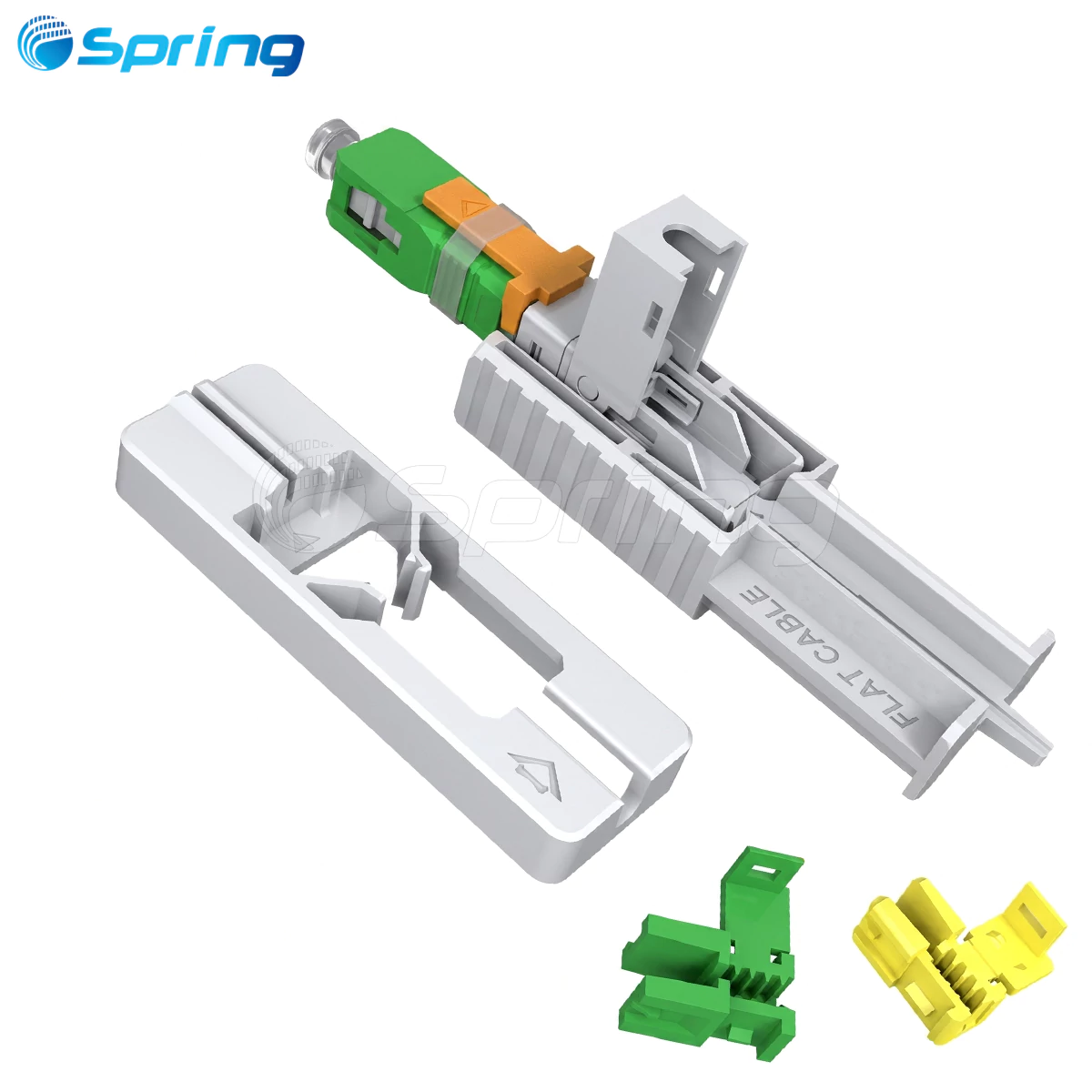
Standard single-fiber connector configurations include:
LC Simplex
SC Simplex
FC (Common in testing and industrial setups)
ST (Legacy networks)
LC is widely utilized in high-density fiber patch panels, while SC remains the dominant standard for FTTH drop cables due to its durability and ease of field installation.
How Simplex Fiber Works
Simplex fiber supports two distinct transmission models depending on active equipment:
1. One-Way (Unidirectional) Transmission
Data flows strictly in one direction (from transmitter to receiver). This setup is ideal for:
Industrial sensor networks
CATV distribution systems
Closed-loop surveillance feeds
2. Bidirectional Transmission (BiDi + WDM)
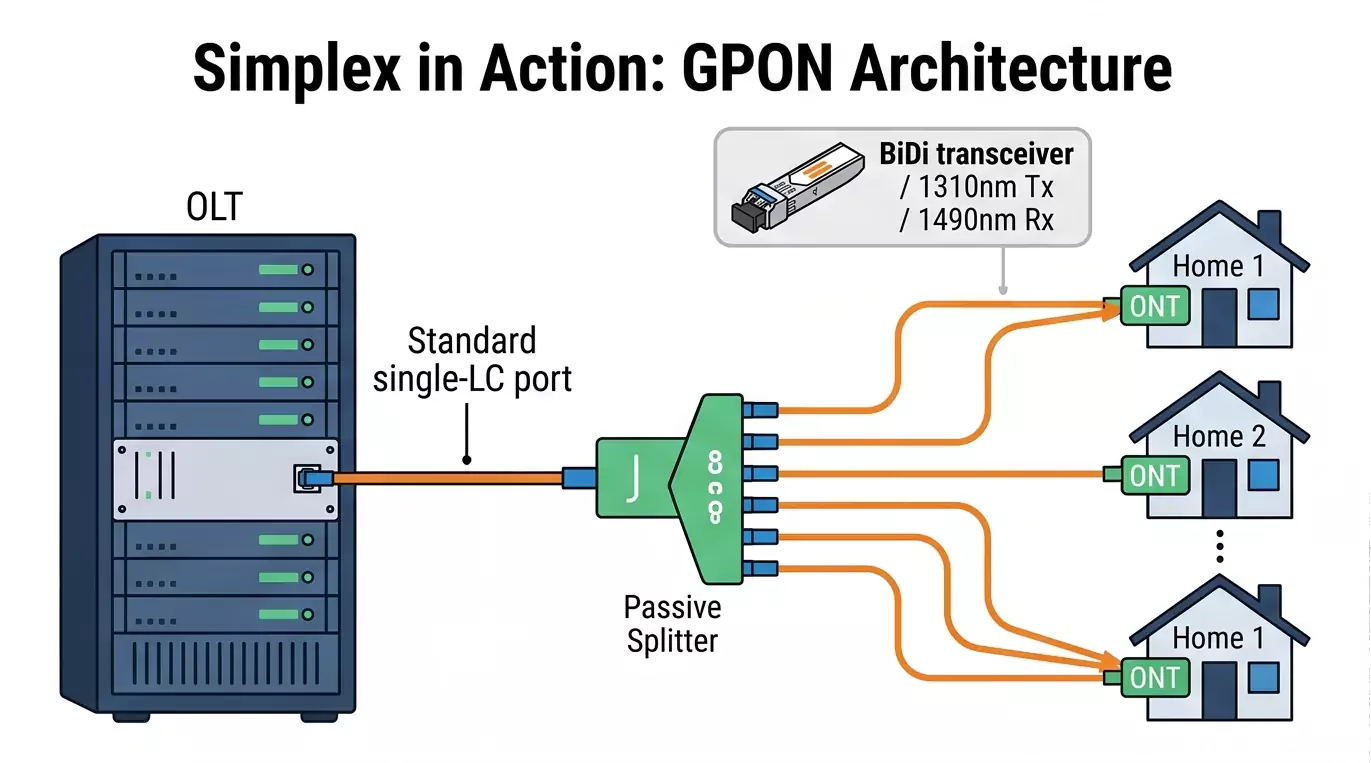
Modern optical networks break the "one-way" limitation using BiDi transceivers and Wavelength Division Multiplexing (WDM) technology. By using two separate wavelengths over a single strand of glass, data can travel in both directions simultaneously without collision.
Typical Wavelength Pairing: 1310 nm for Upstream → 1490 nm / 1550 nm for Downstream.
✔ Engineering Conclusion: Simplex fiber cables can seamlessly support full-duplex communication when paired with the correct BiDi optics.
Advantages of Simplex Fiber
Maximum Fiber Efficiency: Doubles the capacity of existing conduit space.
Reduced Footprint: Smaller cable diameters make it ideal for tight micro-ducts.
Cost Efficiency: Lower material costs per foot/meter compared to duplex.
PON Optimization: Perfectly matches GPON/EPON architectures to serve high subscriber densities via passive optical splitters.
Limitations of Simplex Fiber
Requires specialized, more expensive BiDi or WDM-compatible transceivers.
Not universally compatible with standard off-the-shelf dual-port Ethernet switches.
Requires careful wavelength planning and matching pairs of optics at both ends.
What Is a Duplex Fiber Optic Cable?
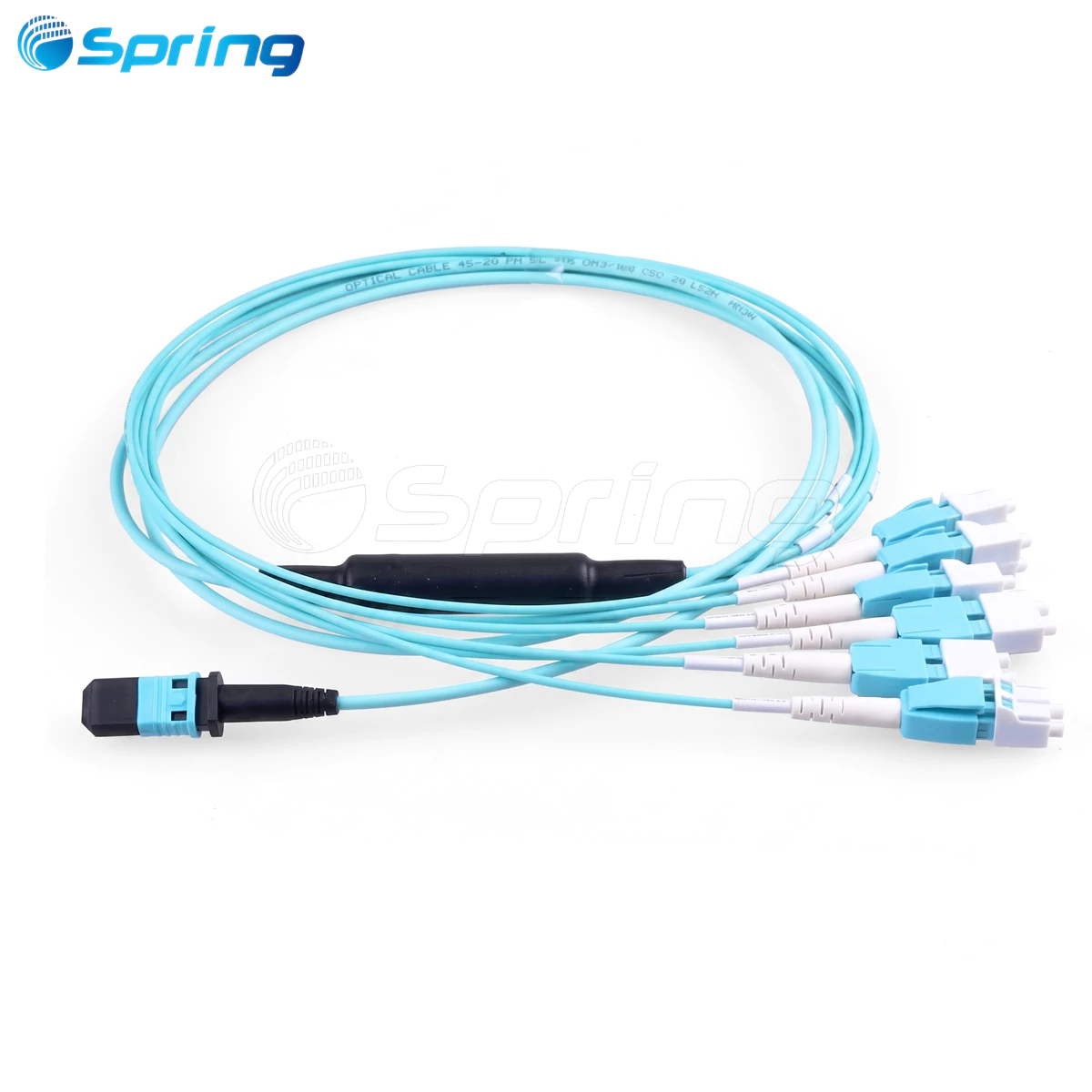
A duplex fiber optic cable consists of two optical fibers running parallel, enabling simultaneous, independent transmission and reception channels.
Fiber Strand 1: Dedicated Transmit (Tx) path.
Fiber Strand 2: Dedicated Receive (Rx) path.
This dual-channel architecture forms the foundational backbone of enterprise local area networks (LANs), cloud data centers, high-speed storage networks, and telecom aggregation points.
Structure and Polarity of Duplex Fiber
Duplex cables are typically manufactured in two distinct form factors:
Zip-cord Design: Two simplex jackets joined by a thin web, easily separated for individual termination (similar to standard household electrical cords).
Round Duplex Cable: Two tight-buffered fibers enclosed within a single round outer jacket, optimizing space and airflow in high-density network racks.
⚠️ Critical Technical Note: Polarity Management
In duplex networks, strict polarity management (A-to-B layout) is mandatory. The transmit (Tx) signal at End A must precisely align with the receive (Rx) port at End B. Standard duplex clips and color-coded boots (typically blue/beige for single-mode/multimode, or red/black markers) are utilized to prevent cross-connection errors during deployment.
Common connectors include LC Duplex (the reigning standard for data centers) and SC Duplex.
How Duplex Fiber Works

Duplex fiber uses dedicated physical infrastructure for traffic separation. Because the transmit and receive lines are physically separate, the network achieves native full-duplex communication with standard wavelengths. No wavelength management is required, ensuring predictable, plug-and-play Ethernet interoperability.
Advantages of Duplex Fiber
Native Full-Duplex: Immediate, high-throughput communication with low latency.
Universal Compatibility: Works out of the box with standard dual-port SFP, SFP+, QSFP, and GBIC transceiver modules.
Simplified Design: Eliminates the complexity of matching upstream and downstream optical wavelengths.
Structured Cabling Friendly: Easy integration into standard enterprise patch panels and network racks.
Limitations of Duplex Fiber
Requires double the fiber infrastructure, increasing total material usage.
Larger physical footprint inside tight conduit pathways or cable trays.
Simplex vs Duplex Fiber: Comprehensive Technical Comparison
| Technical Feature | Simplex Fiber Cable | Duplex Fiber Cable |
| Fiber Count | 1 strand | 2 strands (Zip-cord / Round) |
| Data Transmission Channel | Single channel (Shared Tx/Rx via WDM) | Dual independent channels (Dedicated Tx & Rx) |
| Core Architecture | FTTH, PON (GPON/EPON), Access Networks | Enterprise LAN, Core Backbone, Data Center SAN |
| Required Optics | BiDi Transceivers (e.g., BiDi SFP/SFP+) | Standard Transceivers (e.g., Dual LC SFP+, QSFP) |
| Wavelength Management | Required (e.g., 1310nm Tx / 1490nm Rx) | Not Required (Same wavelength on both fibers) |
| Physical Footprint | Extremely low (Ideal for tight conduits) | Standard footprint |
| Cost Profile | Lower cable cost, higher transceiver cost | Higher cable cost, lower transceiver cost |
Engineering Myths vs. Facts
❌ Myth: Simplex always means single-mode fiber.
Fact: Fiber type (Single-mode OS2 vs Multimode OM3/OM4) refers to core size, whereas simplex/duplex refers to the physical cable structure. You can have a Multimode Simplex cable or a Single-mode Duplex cable.
❌ Myth: Duplex fiber is inherently faster than simplex.
Fact: Network speed is determined by the active optical transceivers and network switches (e.g., 10G, 25G, 100G), not by whether the glass is bundled as a single or double cord.
❌ Myth: High-density FTTH rollouts should use duplex for future-proofing.
Fact: FTTH and PON architectures are intentionally optimized for simplex configurations to maximize subscriber density and reduce passive splitting costs.
How to Choose Between Simplex and Duplex Fiber

To determine the optimal cable layout for your network design, follow this 4-step engineering checklist:
Step 1: Check Your Active Equipment & Optical Modules
Are your switches deploying standard dual-LC SFP+ modules? Choose Duplex.
Are you utilizing single-port BiDi SFP modules? Choose Simplex.
Step 2: Define the Application Environment
Building out FTTH, GPON, or smart-city outdoor surveillance nodes? Simplex provides the most cost-effective outdoor deployment.
Interconnecting top-of-rack switches in a data center or setting up an enterprise corporate LAN? Duplex structured cabling is the industry standard.
Step 3: Analyze Pathway and Conduit Space
If you are retrofitting older buildings with highly congested, narrow conduits, Simplex reduces physical friction and maximizes available space.
Step 4: Factor in Total Cost of Ownership (TCO)
Balance the price difference: Simplex reduces fiber cable material costs but requires higher-tier BiDi optics. Duplex increases cable material costs but works with standard, entry-level optical transceivers.
Final Thoughts
Simplex and duplex fiber optic cables are not competing technologies-they are complementary architectural tools tailored for different network layers.
Whether you need rugged standard OS2 simplex fiber patch cords for an FTTH rollout, or high-density OM4 duplex LC fiber assemblies for a core data center upgrade, your choice should always align with your transceiver strategy and physical space limitations.
Need Help Choosing the Right Fiber Infrastructure?
We support global telecom operators, regional ISPs, broadband installers, and data center integrators with fully optimized, premium fiber solutions. All our assemblies are 100% factory-tested for ultra-low insertion loss (<0.2dB) to ensure maximum network reliability.
FAQ
What is the primary difference between simplex and duplex fiber optic cables?
It all comes down to the fiber count and the pathway. A simplex cable has a single optical fiber strand inside the jacket, while a duplex cable has two fibers joined together. Simplex is built for saving space and single-fiber bidirectional systems, while duplex provides two independent, dedicated lanes-one for transmitting (Tx) and one for receiving (Rx).
Is simplex fiber only capable of one-way communication?
Absolutely not! While the physical cable has only one strand, you can absolutely achieve full-duplex (two-way) traffic. All you need to do is pair the simplex cable with BiDi (Bidirectional) transceivers and WDM (Wavelength Division Multiplexing) technology. This allows data to travel in both directions at the same time using different wavelengths (like 1310nm for uploading and 1490nm for downloading).
Which type of fiber cable is better for FTTH and PON deployments?
Simplex fiber is the undisputed champion here. In Fiber-to-the-Home (FTTH) and Passive Optical Networks (PON), using a single fiber per subscriber maximizes infrastructure efficiency and slashes project budgets. Plus, simplex cables have smaller diameters, making them much easier to pull through tight outdoor micro-ducts or drop into residential walls.
Is duplex fiber inherently faster than simplex? A: No, this is a common myth.
The speed of your network (whether it's 10G, 25G, or 100G) is determined by your active equipment-like your switches and optical transceiver modules-not by the number of glass strands inside the cable jacket. A simplex line using high-end BiDi optics can easily run at the same high speed as a traditional duplex setup.
Can a duplex fiber optic cable be split and used as a simplex?
Yes, it can! Since standard duplex cables (like a zip-cord structure) are just two simplex lines joined by a thin central web, you can easily separate or "zip" them apart. In fact, if one fiber lane in a duplex cable gets damaged, engineers often run a single-fiber BiDi transceiver over the remaining functional strand to keep the network alive without running a whole new cable.