

As network traffic continues to grow and data centers evolve from 10G to 100G, 400G, and even higher-speed architectures, choosing the right fiber optic infrastructure has become more important than ever. While single-mode fiber dominates long-distance telecommunications networks, multimode fiber cables remain the preferred solution for many enterprise, campus, and data center environments due to their cost-effectiveness and high bandwidth capabilities over short distances.
However, not all multimode fibers are the same. Network designers often face questions such as:
What is multimode fiber?
What is the difference between OM3, OM4, and OM5 fiber?
Is multimode fiber better than single-mode fiber?
Which multimode fiber type is best for a 100G or 400G network?
This guide explains how multimode fiber works, compares OM1 through OM5 fiber types, explores common applications, and provides practical recommendations for selecting the right multimode fiber cable for your network.
What Is Multimode Fiber?

Multimode fiber is a type of optical fiber designed to transmit multiple light signals simultaneously through a relatively large core. Unlike single-mode fiber, which carries a single light path through a 9 μm core, multimode fiber typically has a core diameter of 50 μm or 62.5 μm, allowing multiple light modes to propagate simultaneously.
Because multiple light paths can travel through the fiber simultaneously, multimode fiber can support high data transmission rates while simplifying optical alignment and reducing system costs. This makes it particularly suitable for short-distance communication links in data centers, enterprise networks, educational campuses, healthcare facilities, and industrial environments.
Today, multimode fiber is widely used in high-speed Ethernet applications, storage area networks (SANs), and high-density data center cabling systems where performance, scalability, and cost efficiency must be balanced.
How Multimode Fiber Works
A multimode fiber cable consists of three primary components: Core, Cladding, and Protective coating. The optical signal travels through the core, while the cladding reflects light into the core through total internal reflection.
Because the core diameter is significantly larger than that of single-mode fiber, multiple light rays can travel through the fiber simultaneously. A simple way to visualize this is to imagine a multi-lane highway. Instead of forcing all traffic into a single lane, multimode fiber allows multiple light modes to carry data simultaneously.
The most common light sources used with multimode fiber are:
LED transmitters (OM1 and OM2)
VCSEL (Vertical-Cavity Surface-Emitting Laser) transceivers (OM3, OM4, and OM5)
VCSEL technology enables higher bandwidth, faster speeds, and greater transmission distances compared to traditional LED-based systems.
Multimode Fiber Structure
Although multimode and single-mode fibers share a similar physical structure, their dimensions differ significantly.
| Component | Multimode Fiber | Single Mode Fiber |
| Core Diameter |
50 μm or 62.5 μm |
9 μm |
| Cladding Diameter |
125 μm |
125 μm |
| Light Paths |
Multiple |
Single |
| Typical Wavelength |
850 nm / 1300 nm |
1310 nm / 1550 nm |
| Typical Application |
Short-distance networks |
Long-distance transmission |
The larger core size of multimode fiber simplifies connector alignment and installation, making it easier to deploy and maintain in enterprise environments.
Why Multiple Light Modes Matter
The ability to carry multiple light paths provides several practical advantages. First, multimode fiber supports high bandwidth transmission rates that meet the requirements of modern data centers and enterprise networks. Second, multimode optical transceivers are generally less expensive than their single-mode counterparts, helping organizations reduce infrastructure costs. Third, multimode cabling systems are easier to install and manage, especially in high-density environments where thousands of fiber connections may be deployed.
For these reasons, multimode fiber continues to be the preferred choice for short-reach applications where distances typically remain within a few hundred meters.
Key Features of Multimode Fiber Cables
Larger Core Diameter
One of the defining features of multimode fiber is its larger core diameter. Traditional OM1 multimode fiber uses a 62.5 μm core, while OM2 through OM5 fibers generally use a 50 μm core. In comparison, single-mode fiber uses a much smaller 9 μm core.
This larger core offers several benefits:
Easier optical alignment
Simplified connector termination
Reduced installation complexity
Lower maintenance requirements
For organizations deploying large-scale cabling systems, these advantages can significantly reduce installation time and operational costs.
High Bandwidth Capacity
Modern multimode fiber supports the high-speed requirements of today's digital infrastructure. Depending on the fiber category, multimode cabling can support 10G, 25G, 40G, 100G, and 400G Ethernet. OM3, OM4, and OM5 fibers are specifically optimized for laser-based transmission using VCSEL technology, enabling significantly higher effective modal bandwidth than earlier generations. This capability makes multimode fiber a strong candidate for data centers that require fast and reliable server-to-switch and switch-to-switch connections.
Lower System Cost
Cost is one of the primary reasons many organizations continue to choose multimode fiber. While fiber cable pricing may vary depending on the project, multimode systems often achieve lower overall deployment costs because:
VCSEL transceivers are generally less expensive
Short-distance links require simpler optical components
Installation is typically faster
Cable management is easier
For enterprise networks and data centers operating within a limited transmission range, multimode fiber often provides the best balance between performance and investment.
Easy Network Expansion
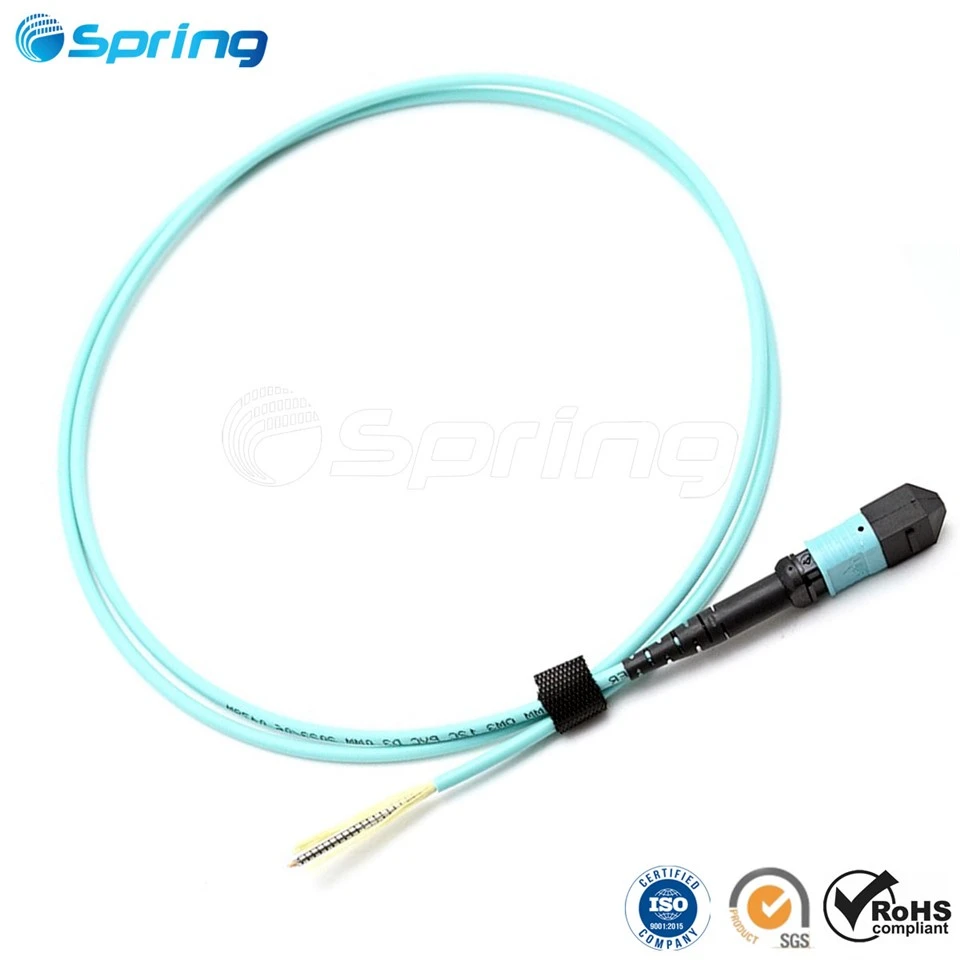
Modern networks must be designed with future growth in mind. Multimode fiber supports scalable architectures through high-density cabling solutions such as MPO and MTP trunk systems. These pre-terminated assemblies enable rapid deployment while simplifying future upgrades.
For example, an OM4 MPO trunk cable can support current 100G Ethernet deployments while providing a migration path toward higher-speed architectures. As organizations continue to adopt virtualization, cloud computing, AI workloads, and edge computing, scalable multimode infrastructure remains a valuable asset for network expansion.
Types of Multimode Fiber: OM1 to OM5

Understanding the performance levels of OM1 through OM5 is essential when designing a new network or upgrading an existing data center infrastructure.
OM1 Fiber
OM1 is the earliest generation of multimode fiber and features a 62.5/125 μm core/cladding structure. Originally designed for lower-speed applications, OM1 commonly uses LED light sources and is typically found in legacy enterprise networks.
Core Size: 62.5 μm
Jacket Color: Orange
Light Source: LED
Typical Ethernet Support: 100 Mbps to 1G
Typical Applications: Legacy LAN installations, older campus networks, existing building infrastructure.
Selection Advice: Although OM1 remains operational in many facilities, it is rarely selected for new installations because it cannot efficiently support today's high-bandwidth requirements. If an existing network already uses OM1 fiber, migration planning should be considered when upgrading to 10G or higher-speed Ethernet services.
OM2 Fiber
OM2 improved upon OM1 by introducing a smaller 50 μm core, enabling higher bandwidth and better performance.
Core Size: 50 μm
Jacket Color: Orange
Light Source: LED and VCSEL
Typical Applications: Enterprise LANs, campus backbone links, small data centers.
Selection Advice: OM2 may still be suitable for budget-conscious upgrades where transmission distances are short and future bandwidth growth is limited. However, most new projects benefit from moving directly to OM3 or OM4.
OM3 Fiber
OM3 is the first laser-optimized multimode fiber (LOMMF) and remains one of the most widely deployed fiber types in data centers worldwide. Designed specifically for use with VCSEL transceivers, OM3 supports significantly higher bandwidth than OM1 and OM2 while maintaining cost efficiency.
Core Size: 50 μm
Jacket Color: Aqua
Effective Modal Bandwidth: 2000 MHz·km
Typical Applications: Data centers, enterprise backbone networks, Storage Area Networks (SANs), high-density structured cabling systems.
When to Choose OM3: OM3 is often a good choice when transmission distances are relatively short, budget is a major concern, and 10G/40G deployments dominate the network.
OM4 Fiber
OM4 is currently considered the mainstream multimode fiber choice for many modern data centers. Compared with OM3, OM4 provides higher bandwidth and longer transmission distances, making it particularly attractive for 40G and 100G Ethernet applications.
Core Size: 50 μm
Jacket Color: Aqua or Violet
Effective Modal Bandwidth: 4700 MHz·km
Typical Applications: Hyperscale data centers, enterprise data centers, cloud computing environments, high-performance computing networks.
When to Choose OM4: Many organizations view OM4 as the ideal balance between performance, future scalability, and cost. OM4 is highly recommended when planning 100G deployments, designing new data center infrastructure, or building high-density MPO/MTP cabling systems.
Expert Manufacturing Insight :
As an OEM manufacturer, we have observed that over 80% of current high-density data center structured cabling projects specify OM4 fiber. Its capability to handle extended distances simplifies network architecture without the premium price tag of single-mode optical transceivers.
OM5 Fiber
OM5 is the newest multimode fiber category and was developed to support Shortwave Wavelength Division Multiplexing (SWDM). Unlike previous multimode fibers, OM5 supports multiple wavelengths between 850 nm and 950 nm, enabling greater capacity over a single fiber pair.
Core Size: 50 μm
Jacket Color: Lime Green
Key Feature: Wideband Multimode Fiber (WBMMF) designed for future high-capacity networks.
Typical Applications: Advanced data centers, AI computing environments, high-performance cloud infrastructure.
Is OM5 Always Better? Not necessarily. While OM5 provides additional flexibility, many organizations find that OM4 already meets their current performance requirements at a lower cost. For this reason, OM5 is often selected when future SWDM adoption is anticipated rather than for immediate performance gains alone.
OM1 vs OM2 vs OM3 vs OM4 vs OM5 Comparison Table
| Fiber Type | Core Size | Jacket Color | Typical Light Source | 10G Distance | 40G/100G Distance | Main Application |
| OM1 |
62.5 μm |
Orange |
LED |
33 m |
Not Recommended |
Legacy Networks |
| OM2 |
50 μm |
Orange |
LED / VCSEL |
82 m |
Limited |
Enterprise LAN |
| OM3 |
50 μm |
Aqua |
VCSEL |
300 m |
100 m |
Data Centers |
| OM4 |
50 μm |
Aqua / Violet |
VCSEL |
550 m |
150 m |
High-Speed Data Centers |
| OM5 |
50 μm |
Lime Green |
VCSEL / SWDM |
550 m |
150 m+ |
Future-Ready Networks |
Multimode Fiber vs Single Mode Fiber

Choosing the wrong fiber type can lead to unnecessary costs, limited scalability, or performance constraints. Understanding the physical and practical differences ensures your network aligns with long-term goals.
Core Size & Alignment Tolerance
The most fundamental difference is the core diameter. Multimode fiber uses a 50 μm or 62.5 μm core, while single-mode fiber uses a much smaller 9 μm core that supports only a single light path. Because of its larger core, multimode fiber offers higher alignment tolerance and simpler installation, making it easier to deploy in enterprise environments where thousands of fiber connections are terminated. Single-mode fiber minimizes modal dispersion, enabling light signals to travel much longer distances with minimal loss.
Distance Comparison
Transmission distance is often the deciding factor. Because multiple light signals travel simultaneously within a multimode fiber core, modal dispersion gradually limits transmission distance as speed increases. Single-mode fiber avoids this issue completely.
OM3: Up to 300 m at 10G
OM4 / OM5: Up to 550 m at 10G
OS2 Single Mode: Several kilometers to hundreds of kilometers
Selection Rule: If most links remain below 300–500 meters, multimode fiber is often the most cost-effective option. If transmission distances extend beyond several kilometers, single-mode fiber (OS2) is the only practical choice.
Total System Cost
Many people assume that multimode fiber is always cheaper than single-mode fiber. In reality, the answer depends on the entire system rather than the cable alone. While the price difference between the raw cables is now relatively small, the true savings come from optical transceivers. Multimode systems use VCSEL-based optics, which are significantly more economical than the high-precision laser modules required for single-mode transmission (e.g., 10G SR vs 10G LR, or 100G SR4 vs 100G LR4).
Common Applications of Multimode Fiber Cables
Data Centers: Data centers are by far the largest users of multimode fiber technology. Modern backbone architectures require thousands of optical links connecting servers, switches, and storage systems. Since most of these connections are under 100 meters, OM4 fiber works seamlessly with MPO/MTP connectivity systems to deliver the lowest total cost of ownership.
Enterprise LAN & Campus Networks: Used to connect building-to-building links, floor distribution systems, and network aggregation layers. Multimode fiber helps organizations increase backbone bandwidth while reducing electromagnetic interference (EMI).
Healthcare & Industrial Facilities: Crucial for environments with high electrical noise. Unlike copper cables, multimode fiber is 100% immune to electromagnetic interference (EMI) generated by MRI systems, factory automation, and heavy industrial machinery.
Multimode Fiber for 10G, 40G, 100G and 400G Networks
Understanding how different multimode fiber types support various Ethernet speeds is critical when planning high-density network infrastructure.
10G Applications: OM3 remains a highly cost-effective choice for server access up to 300 meters, while OM4 offers additional distance flexibility up to 550 meters.
40G & 100G Applications: These speeds commonly utilize parallel optics through MPO/MTP connectivity systems. While OM3 can support 100G up to 70-100 meters, OM4 has become the industry standard, extending 100G transmission up to 150 meters.
400G Applications: Driven by the rapid growth of AI clusters and hyperscale cloud infrastructure. 400G deployments require strict optical loss management and high-density fiber management solutions. Organizations building next-generation infrastructure increasingly evaluate OM5 fiber to leverage SWDM technology, allowing higher throughput with fewer fibers.
MPO/MTP Multimode Fiber Solutions
As network speeds migrate from 40G to 100G, 400G, and beyond, traditional duplex LC connections become highly inefficient in high-density environments. This is where MPO/MTP technology becomes a critical component of modern multimode infrastructure.
Why High-Density MPO/MTP Is Essential
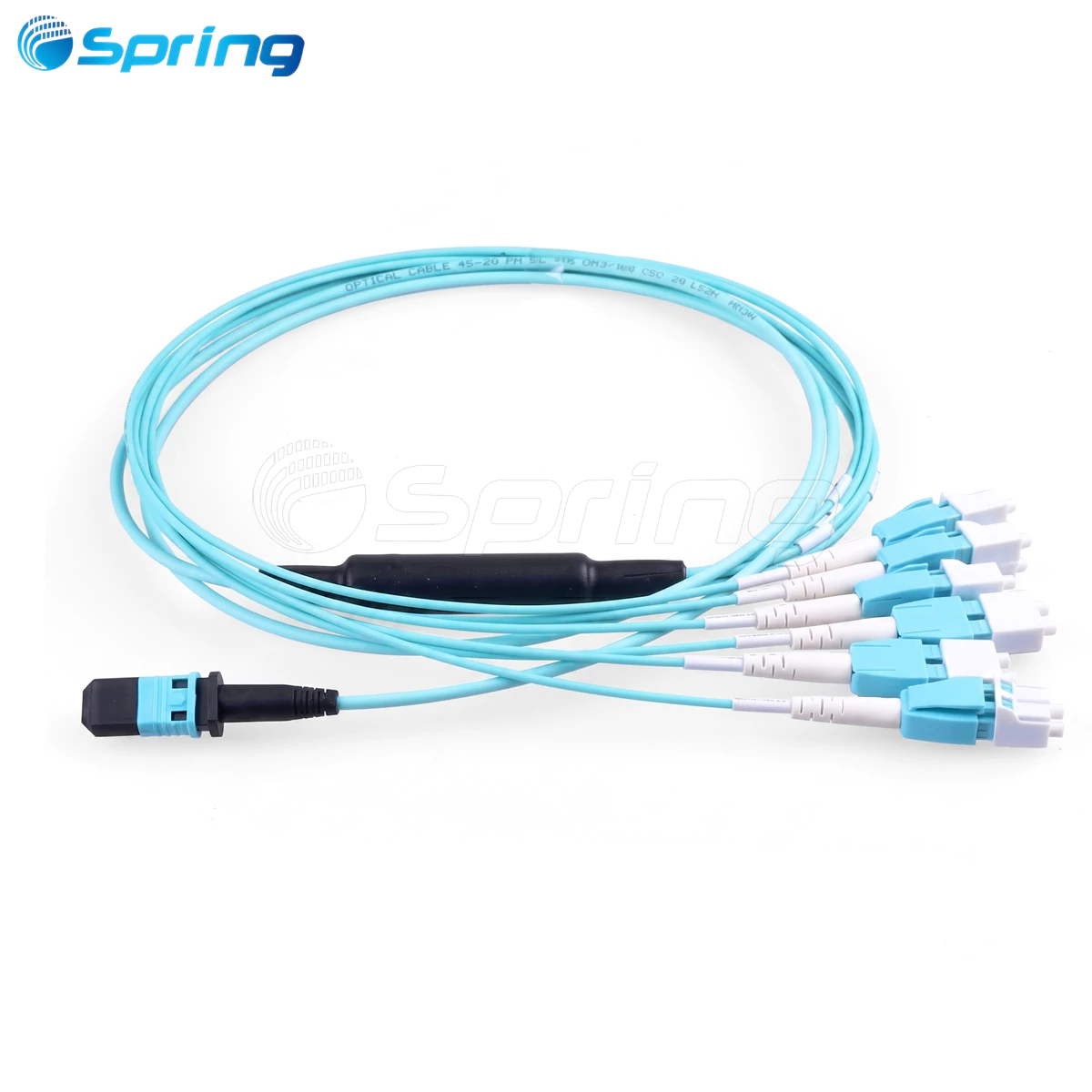
Instead of managing hundreds of individual duplex patch cords, network administrators can deploy a single MPO/MTP trunk cable containing 8, 12, 24, or 16 fibers in a single interface. This design offers higher port density, faster deployment, reduced cable congestion, and improved airflow inside server cabinets.
Practical MPO/MTP Architecture Breakdown
A standard enterprise or cloud data center migration typically follows this physical layer roadmap:
Core Switch links to high-performance transceivers.
MPO Trunk Cable runs through the backbone pathways.
High-Density Patch Panels securely house the modular connections.
MPO Cassettes break down the multi-fiber connection into standard LC duplex outputs.
LC Fiber Patch Cords connect directly to individual servers or leaf switches.
Engineering Tip on MPO Polarity :
When deploying parallel optics, understanding MPO polarity (Method A, B, or C) is critical to ensuring the transmit (TX) signal matches the receive (RX) end. During factory manufacturing, we rigorously perform 3D interferometry and polarity testing on every MPO trunk cable to prevent optical link failure during live deployment.
Frequently Asked Questions
What is the maximum distance OM4 fiber can transmit 100G Ethernet?
OM4 fiber can support 100G Ethernet transmission distances up to approximately 150 meters when using standard SR4 transceivers.
Can I mix OM3 and OM4 fiber cables in the same link?
While both OM3 and OM4 share the same 50 μm core diameter and can technically be spliced or connected, it is not recommended. The overall link performance will be limited to the lower capabilities of the OM3 fiber, which can cause unpredictable attenuation and modal dispersion issues in high-speed 40G/100G networks.
What makes OM5 fiber different from OM4?
OM5 is a Wideband Multimode Fiber (WBMMF) specifically designed to support Shortwave Wavelength Division Multiplexing (SWDM). It can transmit multiple wavelengths (850nm to 950nm) over a single fiber pair, whereas OM4 is optimized for single-wavelength (850nm) VCSEL transmission.
Why are multimode transceivers cheaper than single-mode transceivers?
Multimode systems utilize VCSEL light sources, which feature a wider emission area and are much easier to align with the larger 50 μm core of multimode fiber. Single-mode transceivers require high-precision, tightly focused laser modules to target a tiny 9 μm core, making the manufacturing and calibration process significantly more costly.
Conclusion
Multimode fiber cables remain one of the most practical and cost-effective solutions for high-speed, short-distance networking. While OM1 and OM2 are relegated to legacy environments, OM3, OM4, and OM5 provide the backbone for modern cloud computing, enterprise LANs, and high-density server architectures.
Equally important is the strategic adoption of MPO/MTP pre-terminated cabling, which streamlines cable management and provides a clear migration path to 100G, 400G, and future 800G optical frameworks.
Need Expert Help with Your Fiber Infrastructure Design?
At Spring Optical, we manufacture a complete line of high-performance OM3, OM4, and OM5 fiber solutions. From custom-length MPO/MTP trunk cables and MPO to LC breakout assemblies to high-density patch panels, our engineering team ensures your physical layer is built for next-generation scalability.