

Author: Hayden

Introduce of Guide to MPO/MTP High-Density Fiber Optic Cabling
In the rapidly evolving world of data centers, where AI-driven workloads, cloud expansions, and hyperscale services are pushing bandwidth demands to new heights, efficient cabling solutions are more critical than ever. According to recent market reports, the global data center cabling market is projected to grow from USD 7.7 billion in 2025 to USD 18.1 billion by 2035, at a CAGR of 8.9%. Similarly, the MPO fiber optic connector market is expected to expand from around USD 2.1 billion in 2024 to USD 3.2 billion by 2030, with a CAGR of 6.5%. This surge underscores the need for high-density fiber optic systems like MPO/MTP to handle 40G, 100G, and beyond Ethernet deployments efficiently. 012 futuremarketinsights.com strategicmarketresearch.com
MPO/MTP cabling has emerged as the go-to standard for modern data centers, offering unparalleled density, scalability, and ease of migration. As MPO cabling systems are the preferred choice for 40G/100G Ethernet, many users have shifted from traditional single-channel fiber solutions to MPO multi-core, multi-channel high-density cabling solutions. This guide explores why it's essential, how it works, and best practices for implementation-helping network engineers and data center operators optimize their infrastructure for the future. A comprehensive understanding of the characteristics and structure of MPO plug-and-play systems helps users select the most suitable cabling products, making initial design and planning, as well as future upgrades to 100G, more flexible. This enhances the efficiency of data centers and creates greater user value.
Why MPO/MTP High-Density Fiber Optic Cabling Dominates
Traditional duplex fiber setups fall short in scaling to 40G and higher speeds, especially with rack space at a premium. MPO/MTP systems address this by bundling multiple fibers into one connector, supporting parallel optics for high-speed links.
Key benefits include:
Higher Density: Up to 72 fibers in a single connector, maximizing rack unit efficiency.
Faster Deployment: Pre-terminated components reduce installation time by up to 75% compared to field splicing.
Seamless Upgrades: Easy transitions from 40G to 100G or 400G without major overhauls.
Industry forecasts highlight explosive growth in fiber optic components, with the market reaching USD 36.69 billion in 2025 and growing to USD 58.65 billion by 2030. For data centers handling big data and AI, MPO/MTP isn't just an upgrade-it's a necessity. researchandmarkets.com
To visualize the connector, here's a detailed diagram of an MPO/MTP interface used in 40G setups:

MTP Type A vs Type B: Complete Polarity & Fiber Design Guide
Breaking Down MPO/MTP Plug-and-Play Architecture
At its core, an MPO/MTP system includes:
Trunk Cables: Pre-terminated backbones for main runs.
Patch Cords: Short connectors for device linking.
Fiber Optic Patch Panels/ODF: For easy integration and polarity management.
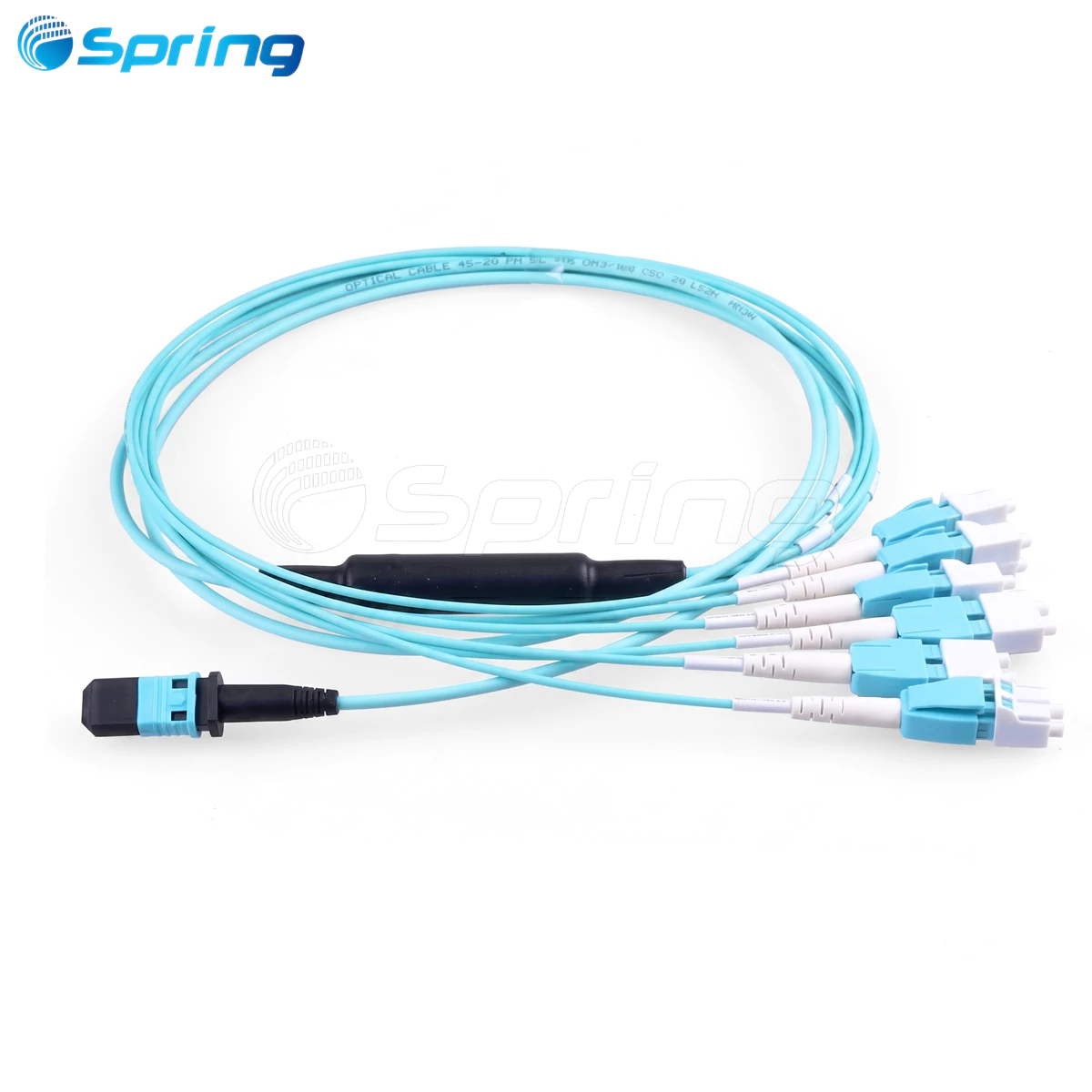
Breakout Cables: Breaking MPO to LC for mixed-speed environments.
These factory-tested elements minimize errors and ensure low insertion loss (typically <0.35 dB per connector). For more on standards, refer to IEEE 802.3 for Ethernet specifications or TIA-568 for cabling guidelines.
In data centers, for short-distance core links, users commonly adopt high-density 40G MPO-MPO pre-terminated OM3/OM4 fiber optic cable solutions. The 40G MPO cabling scheme can meet current and future bandwidth growth needs for several years and provides redundancy for upgrades, making it an ideal cost-effective solution.
Optimizing 40G Ethernet with MPO/MTP Cabling
For 40G deployments, QSFP+ modules commonly use 12-fiber MPO connectors, though only 8 fibers are active (4Tx/4Rx). The extra fibers? They're often reserved for future-proofing. When a 12-fiber MPO connector is connected to a QSFP optical module, only 8 channels are used for signal transmission.
However, the question arises: will the middle 4 channels be wasted? This is a cost-related issue-whether the middle 4 channels are reserved as spares or left unused. There is currently no standard answer. As a flexible and comprehensive manufacturer, Spring Optical provides two options for users, allowing them to select based on needs and increasing the flexibility of scheme design.
Two Key Strategies for 40G MPO Cabling
1. 8-Fiber Cable with 12-Fiber MPO: Cost-effective for direct links, reducing material bulk. Ideal for budget-conscious setups but limits reconfiguration. (12-fiber MPO terminated with 8-fiber cable, where the middle 4 channels of the MPO connector are unused, achieving better economic benefits for 40G device connections.)
2. Full 12-Fiber Cable and MPO: Maximizes utilization and flexibility, perfect for backbone layers. Slightly higher cost but better for scalability. (12-fiber MPO terminated with 12-fiber cable, where the middle 4 channels of the MPO connector remain usable, suitable for backbone cabling to enhance utilization density.)
The choice of which MPO patch cord/trunk depends on the user's system requirements and usage conditions; both schemes have their advantages and disadvantages. Spring Optical can provide professional advice based on the user's system design to help select the appropriate scheme.
Choose based on your needs-direct interconnects favor the 8-fiber option, while structured cabling benefits from 12-fiber.
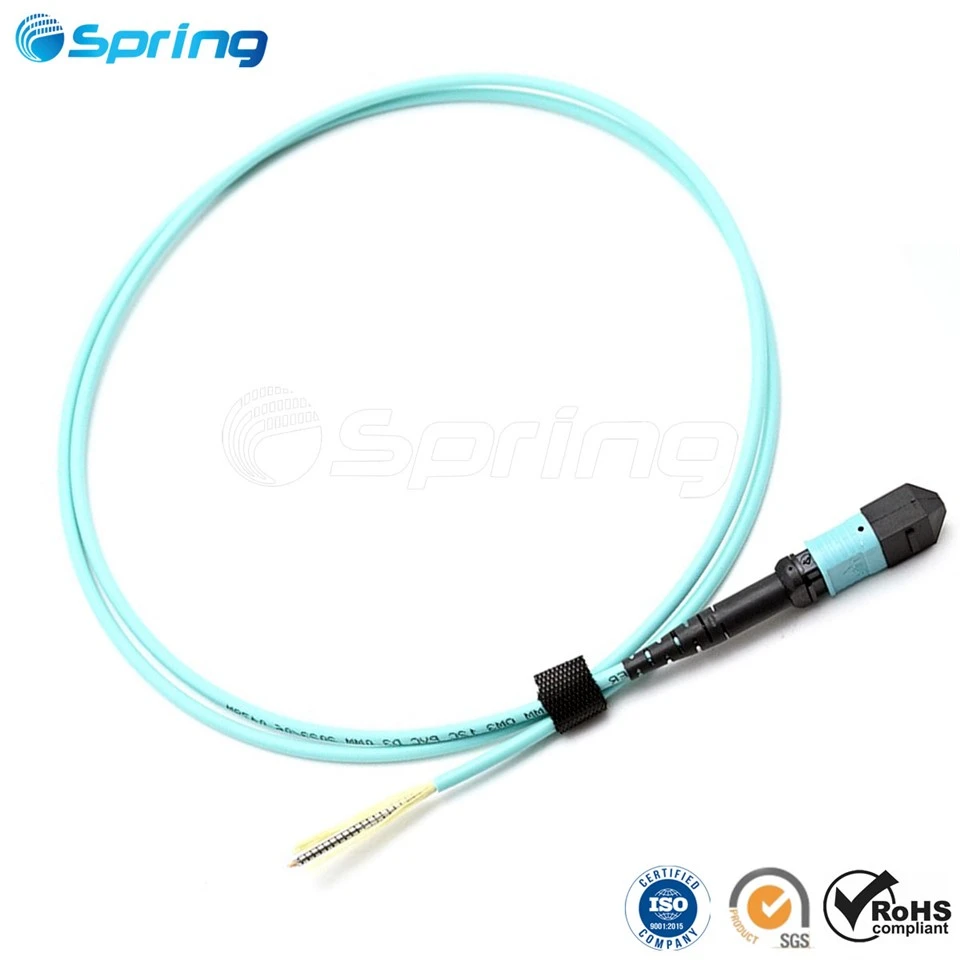
Here's an example of a typical MPO fiber patch cord:

MPO Fiber Patch Cord Selection Guide – High-Density Cabling
Common 40G Transmission Architectures
Below, we share two commonly used transmission schemes for deploying 40G Ethernet:
1. Direct MPO-to-MPO for 40G
If users plan to directly interconnect 40G network devices and ensure compatibility for future upgrades to 100G networks, they can use 12-fiber MPO connectors via QSFP optical modules for device connections. Refer to the following cabling scheme:
40G QSFP Module <-> MPO Patch Cord <-> Adapter <-> MPO Trunk <-> Adapter <-> MPO Patch Cord <-> 40G QSFP Module
Key Product Description: 40G MPO Patch Cord, 12-fiber MPO (Female) – 12-fiber MPO (Female), 8-fiber Cable, OM3, Polarity B, Key-up to Key-up, Riser, Low Loss, Without Pull Tab, 10 Meters.
Example config: 12-fiber MPO Female (Polarity B), OM3 cable for low-loss performance.
2. 40G to 10G Breakout
If 40G is only used as the backbone while actual applications are at 10G, plug-and-play MPO schemes can still be employed, facilitating quick deployment during future upgrades and saving upgrade costs. There are multiple cabling methods; refer to the following two recommended schemes:
A: Use MPO Fanout Patch Cord for 40G to 10G Conversion, with the benefit of reducing loss points.
40G QSFP Module <-> MPO Patch Cord <-> Adapter <-> MPO Trunk <-> Adapter <-> MPO-LC Fanout Patch Cord <-> 10G SFP+ Module
Key Product Description: MPO-LC Fanout Patch Cord, 12-fiber MPO (Female) – LC/PC, 4 Pairs Duplex LC, 8-fiber Cable, OM3, Riser, Low Loss, Without Pull Tab, 10 Meters.
B: Use MPO-LC Cassette Module for 40G to 10G Conversion, with the benefit of increasing cabling flexibility.
40G QSFP Module <-> MPO Patch Cord <-> Adapter <-> MPO Trunk <-> MPO-LC Cassette Module <-> LC Duplex Patch Cord <-> 10G SFP+ Module
Key Product Description: MPO-LC Fiber Optic Cassette Module, Pre-loaded with 12-fiber MPO (Male) – LC Direct Fanout Patch Cord, OM3, Width 120mm, 12-Port LC Adapter Panel, Low Loss.
The above examples are for reference only. For actual operations and product selection, it is recommended to consult the cabling manufacturer before purchasing.
For migration to 100G, consider architectures that reuse existing fibers. Market data shows multimode fiber cable demand growing to USD 12.11 billion in 2029.
Visualize a 40G to 100G migration setup:

Maximizing ROI with Strategic MPO/MTP Planning
Beyond bandwidth, MPO/MTP reduces labor costs, speeds rollouts, and eases upgrades-cutting long-term OpEx by 30-50%. With global optical fiber demand surging due to 5G and data centers, investing in high-quality, customizable solutions pays off. The use of MPO can help users achieve greater deployment benefits at minimal cost.
Tips for Success:
Assess polarity (A, B, C) early to avoid mismatches.
Use low-loss connectors for extended reaches.
Plan for 400G: Ensure multimode OM4/OM5 compatibility.
For expert insights, explore resources from manufacturers like Corning or CommScope.
Shenzhen Spring Optical's fiber optic pre-terminated products cover 1G/10G/40G/100G cabling systems, combined with flexible customization services, fully meeting customers' stringent requirements for cabling systems. In addition to supplying high-quality cabling products to meet users' requirements for 40G/100G networks, Spring Optical also provides the most appropriate technical support services. While improving network deployment efficiency and saving costs for users, it also provides comprehensive assurance for the stability of the network system. Each cabling product has its strengths, and proper selection helps unleash greater network benefits.
Conclusion
As data centers gear up for 2025 and beyond, MPO/MTP high-density cabling stands out for its efficiency and future-readiness. By adopting these strategies, you can achieve higher density, lower costs, and seamless scalability. 40G Ethernet has entered the stage of large-scale deployment. Properly selecting cabling products can make the entire network infrastructure deployment more flexible and effectively maximize equipment performance.
Spring Optical – Specialists in Fiber Optic Solutions with over 15 years in data center deployments.
For custom consultations or product inquiries, visit our Data Center Products or check industry standards at IEEE.org.