

Executive Summary for Network Architects: Choosing between QSFP-DD, QSFP28, or OSFP is not a superficial design choice-it is a foundational structural decision. Your selection dictates your faceplate density, your path to next-gen 800G/1.6T speeds, and your long-term Total Cost of Ownership (TCO). This guide provides a data-backed technical framework to help CTOs and network engineers de-risk their next fabric upgrade.
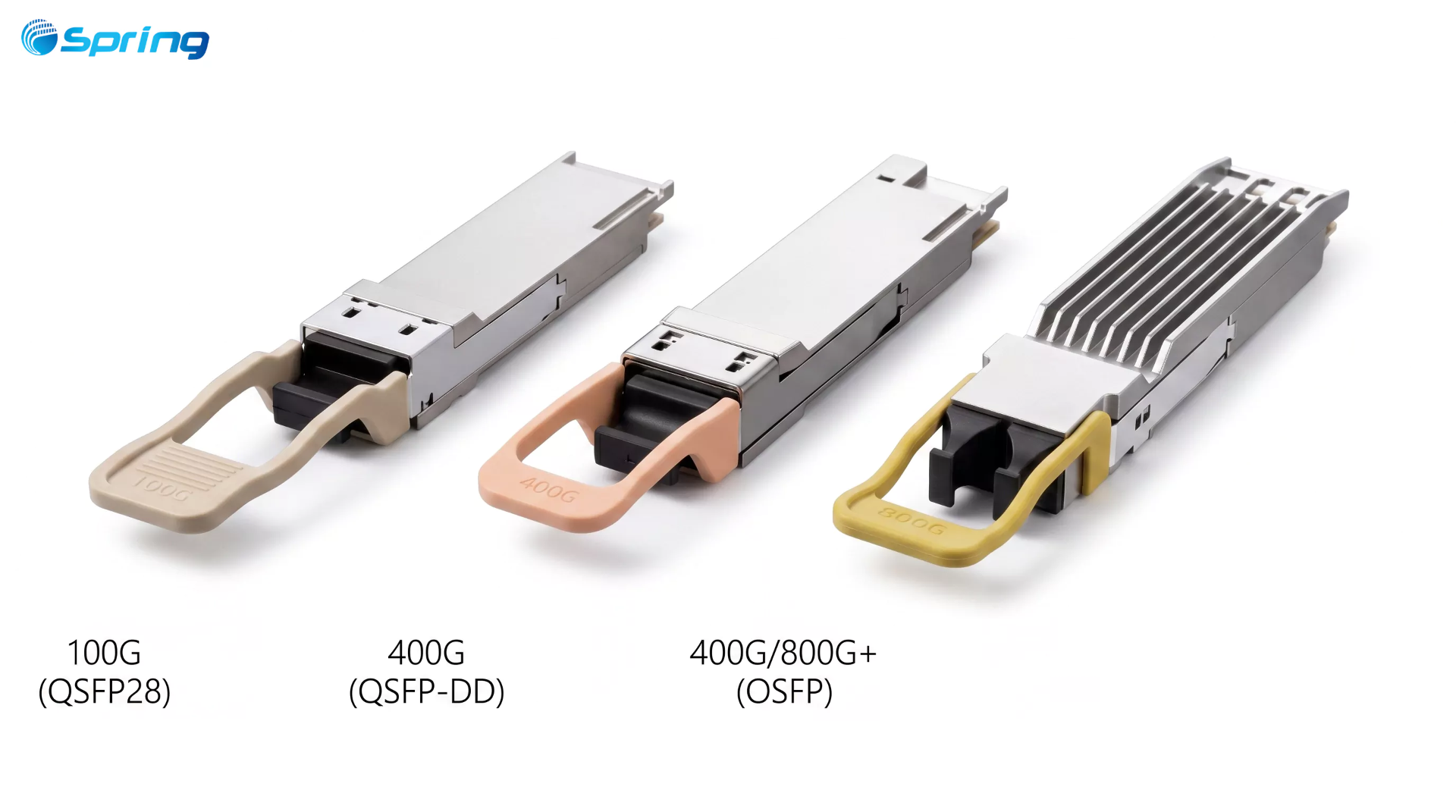
1. Quick Reference: Core Specification Comparison
To assist with high-level architectural planning, the table below outlines the absolute physical and electrical boundaries of each transceiver type according to official Multi-Source Agreement (MSA) standards.
| Specification | QSFP28 | QSFP-DD | OSFP |
| Max Data Rate | 100G | 400G / 800G | 400G / 800G / 1.6T |
| Electrical Lanes | 4×25G NRZ | 8×50G / 100G PAM4 | 8×50G / 100G PAM4 |
| Module Width | 18.35 mm | 18.35 mm | 22.58 mm |
| Max Power Budget | ~6 W | ~15 W (Up to 20W with custom cooling) | ~25 W |
| Backward Compatibility | QSFP+ | QSFP+, QSFP28, QSFP56 | None (Requires mechanical adapter) |
| 1RU Faceplate Density | 36 Ports | 36 Ports | 32 Ports |
| Primary Use Case | Legacy 100G Enterprise | Smooth 400G Cloud/Enterprise Migration | Greenfield AI / High-Performance Computing (HPC) |
2. Deep-Dive: Understanding Each Form Factor
2.1. QSFP28: The 100G Standard Workhorse
Technical Definition: Standardized by the SFF Committee, QSFP28 (Quad Small Form-factor Pluggable 28) has been the data center standard since 2016, delivering 100Gbps aggregation via four 25G NRZ electrical lanes.
Core Constraints: Capped permanently at 100G. Scaling network capacity beyond this threshold requires increasing physical port counts, resulting in immediate rack-space and line-card exhaustion.
2.2. QSFP-DD: Backward-Compatible 400G/800G Density
Technical Definition: Developed by the QSFP-DD MSA, this architecture expands the electrical interface to a "Double Density" configuration. It embeds a second row of electrical pins, doubling the transceiver lanes to 8 while maintaining the exact physical width of a standard QSFP port.
Value Proposition: Asset Preservation. A native QSFP-DD port accepts legacy QSFP28 modules seamlessly. This allows operators to purchase 400G-capable hardware today while sweating existing 100G optical inventory, eliminating stranded CapEx.
2.3. OSFP: Thermal-Optimized for High-Performance Compute
Technical Definition: Engineered by the OSFP MSA, the Octal Small Form-factor Pluggable is a clean-sheet design built specifically to handle extreme thermal loads. It is 23% wider and significantly thicker than the legacy QSFP footprint.
Value Proposition: Maximum Thermal Headroom. By integrating a high-efficiency heatsink directly onto the module chassis, OSFP safely dissipates up to 25W of power. This makes it the preferred wrapper for power-heavy AI training backplanes and upcoming 1.6T coherent optics.
3. The Industry Compatibility Matrix: Who Can Mate with Whom?
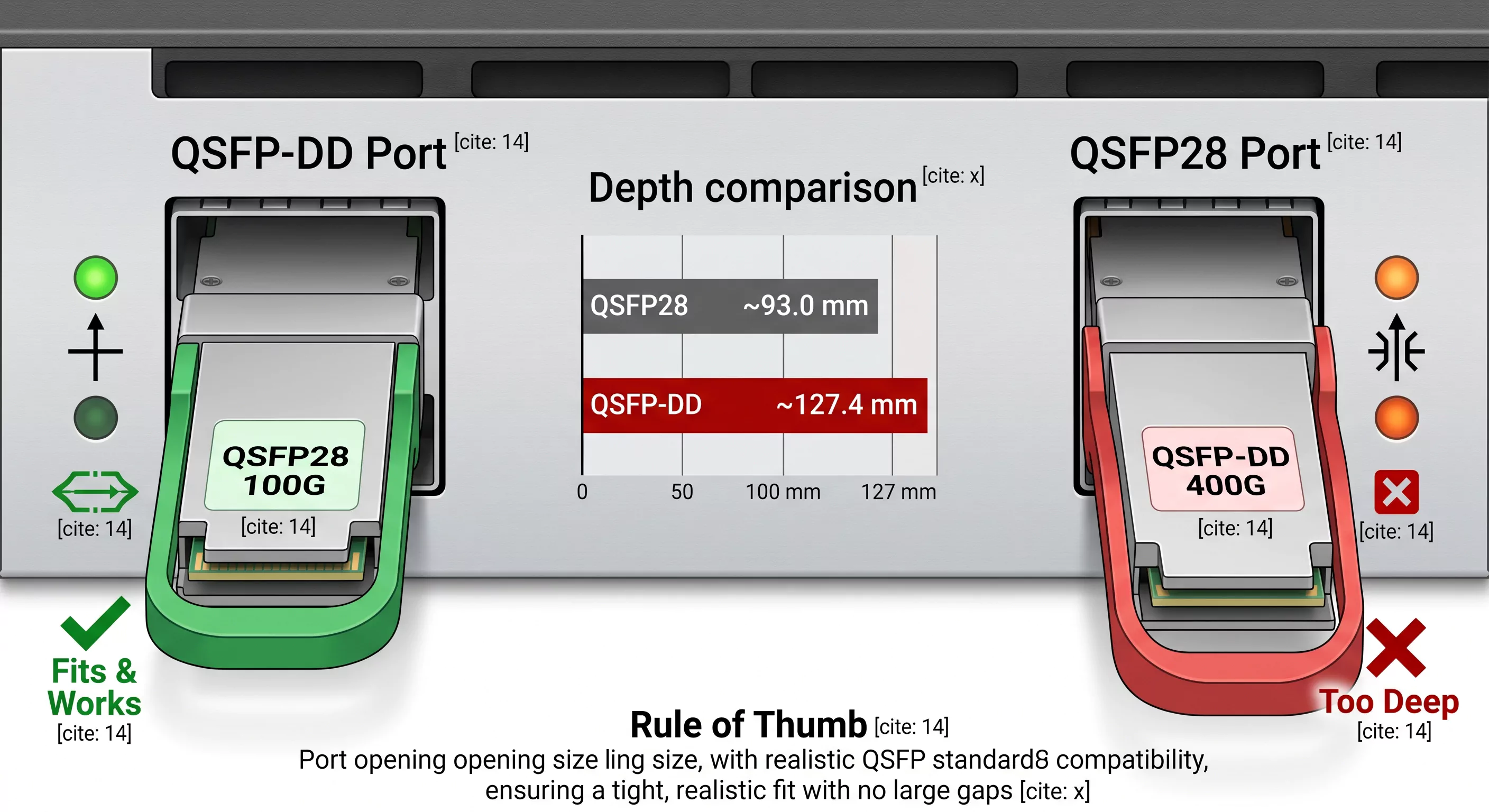
Understanding mechanical and electrical interoperability is critical to preventing hardware damage and link failures during deployment.
3.1. Official Interoperability Matrix
| Port Type | QSFP28 Module | QSFP-DD Module | OSFP Module |
| QSFP28 Port | ✅ Native Support | ❌ Incompatible (Module too deep) | ❌ Incompatible (Module too wide) |
| QSFP-DD Port | ✅ Native Support | ✅ Native Support | ❌ Incompatible (Module too wide) |
| OSFP Port | ❌ Incompatible (Requires Adapter) | ❌ Incompatible (Requires Adapter) | ✅ Native Support |
Interoperability between QSFP-DD and QSFP28 is strictly unidirectional. QSFP-DD ports accept QSFP28 modules due to shared mechanical widths and dual-row pin engineering. However, a QSFP-DD module cannot physically sit inside a legacy QSFP28 port, nor does a legacy QSFP28 port possess the 8 electrical lanes required to map the signal.
3.2. The OSFP Mechanical Isolation Principle
OSFP is entirely distinct from the QSFP ecosystem. Its 60-pin connector layout is fundamentally incompatible with standard QSFP slots. While QSFP28-to-OSFP mechanical adapters exist on the market, they introduce insertion loss, increase costs, and create additional points of failure. They are recommended only for minor legacy troubleshooting, not for wide-scale scaling.
4. Mechanical & Performance Benchmarks
4.1. Physical Dimensions & Volume Analysis
| Metric | QSFP28 | QSFP-DD | OSFP |
| Width | 18.35 mm | 18.35 mm | 22.58 mm |
| Height | 8.5 mm | 8.5 mm | 13.0 mm |
| Total Volume | ~4.7 $cm^3$ | ~5.4 $cm^3$ | ~11.8 $cm^3$ |
The Faceplate Density Penalty: The wider footprint of OSFP penalizes faceplate density. A standard 1RU switch chassis fits 36 QSFP-DD ports but only 32 OSFP ports. In a large-scale deployment of 100 switches, choosing OSFP results in a loss of 400 ports of capacity, or forces the purchase of approximately 12 extra switches to match equivalent port counts.
4.2. Power Envelope & Thermal Breakdown
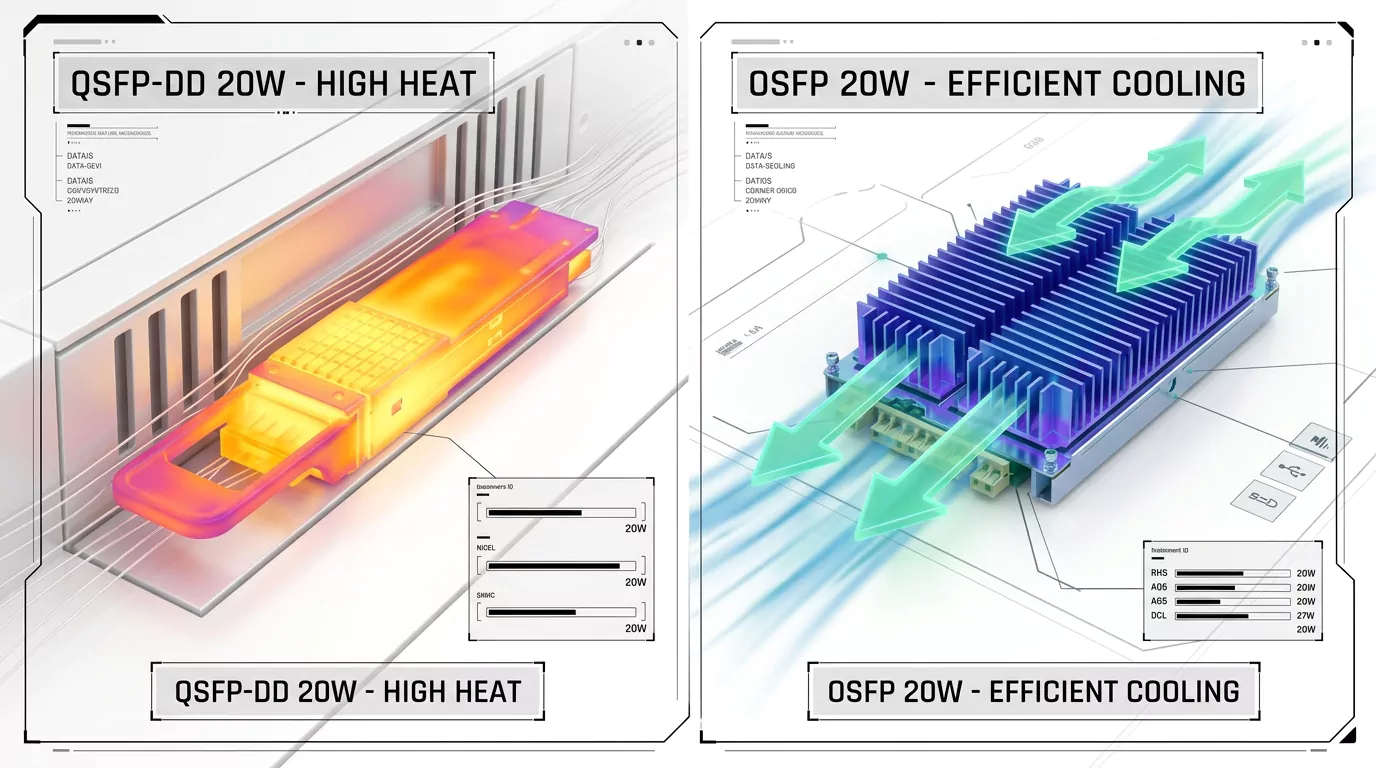
As data rates transition from NRZ to PAM4 modulation, power requirements scale aggressively:
| Optic Type | QSFP28 | QSFP-DD | OSFP |
| SR (Short Reach) | 3-4 W | 6-8 W | 6-8 W |
| LR (Long Reach) | 4-5 W | 12-15 W | 12-15 W |
| ZR (Coherent Long-Haul) | N/A | 15-20 W | 15-25 W |
| Maximum Thermal Limit | ~6 W | ~15 W | ~25 W |
While QSFP-DD easily handles standard short and medium-reach 400G optics, ultra-long-haul 400G/800G ZR coherent modules operate near its absolute thermal threshold. OSFP's superior volume offers a comfortable thermal buffer for these high-power environments.
5. Migration Blueprints: Upgrading from 100G to 400G
Blueprint 1: QSFP28 $\rightarrow$ QSFP-DD (Recommended for Most Data Centers)
Target Audience: Enterprises with significant current investments in 100G QSFP28 optics.
Execution Steps:
Deploy QSFP-DD switches into the aggregation/spine layer while retaining legacy 100G QSFP28 optics on the existing links.
Upgrade critical core/backbone links to native 400G QSFP-DD as traffic spikes demand.
Gradually upgrade Top-of-Rack (ToR) switches and server Network Interface Cards (NICs) over a 12–24 month lifecycle.
Financial Advantage: Preserves capital, eliminates the need for expensive structural adapters, and allows for a non-disruptive, phased CapEx rollout.
Blueprint 2: QSFP28 $\rightarrow$ OSFP (Specialized Greenfield Approach)
Target Audience: Operators with no legacy optical inventory or those requiring specialized long-haul ZR coherent networks.
Execution Steps:
Complete a wholesale "rip-and-replace" of the legacy switching fabric.
Deploy native OSFP switches across all layers.
Deploy mechanical conversion adapters for any mandatory legacy connections.
Financial Advantage: High upfront costs, but establishes an infrastructure completely optimized for future 1.6T scaling.
6. Greenfield Decision Framework: QSFP-DD vs. OSFP
When building a new networking environment from scratch, use the following decision matrix to determine the correct architecture.
6.1. Choose QSFP-DD If:
You are deploying a standard multi-tenant Cloud or Enterprise Data Center.
Mixed-workload flexibility and maximum port density per rack unit are your primary metrics.
You need to retain the ability to interconnect seamlessly with existing legacy enterprise infrastructure.
Your architectural roadmap predicts individual optic power draws staying under 15W.
6.2. Choose OSFP If:
You are building high-density, specialized AI training backplanes or machine learning compute fabrics.
Your deployment spans long-haul Data Center Interconnects (DCI) that mandate the use of high-power ZR/ZR+ coherent transceivers.
The project is an unconstrained, pure greenfield implementation with no legacy inventory to preserve.
You need to lock in thermal validation for next-generation 800G and 1.6T scaling.
6.3. Step-by-Step Selection Logic
To determine the optimal form factor for your specific deployment, follow this two-step decision matrix:
Step 1: Audit Your Existing Infrastructure Footprint
IF YES: If you have a significant inventory of active 100G QSFP28 optics that must remain in service $\rightarrow$ Select QSFP-DD. This route maximizes your current asset retention and enables a smooth, phased CapEx rollout.
IF NO: If you are building a greenfield environment with no legacy constraints $\rightarrow$ Proceed to Step 2.
Step 2: Evaluate Long-Haul Coherent & Next-Gen Scaling Requirements
IF YES: If you are deploying high-power long-haul ZR+ Coherent transceivers or require a direct, validated hardware path to 1.6T AI computing $\rightarrow$ Select OSFP. This route provides the mandatory thermal headroom needed for extreme power dissipation.
IF NO: If your optics will stay under 15W and you prioritize standard cloud/enterprise densities $\rightarrow$ Select QSFP-DD. This route optimizes faceplate port density and minimizes initial switch hardware costs.
7. Total Cost of Ownership (TCO) Case Study
To illustrate the financial impact of this architectural choice, let us evaluate a standard 100-rack data center refresh involving 2,000 active ports moving from 100G to 400G.
7.1. Hardware Component Benchmarks
While individual optical transceiver manufacturing costs (lasers, photodetectors, DSPs) are highly comparable across form factors, the supporting infrastructure costs diverge:
Switch Upfront Cost: QSFP-DD switches generally feature a less complex thermal layout inside the chassis, costing roughly $200–$400 less per port than equivalent OSFP models.
Structural Consumables: OSFP deployments facing legacy links require mechanical adapters costing $200–$400 per port.
7.2. Three-Year TCO Comparison
The QSFP-DD Legacy Asset Strategy: By retaining roughly 60% of existing QSFP28 optics during a phased upgrade, the operator saves $480,000 in immediate transceiver costs. Due to higher faceplate density, the facility requires 12% fewer physical switch chassis, saving an additional $180,000. Total 3-Year Savings: ~$660,000.
The OSFP "Rip-and-Replace" Strategy: Requiring a complete transceiver replacement upfront results in a $1,200,000 capital outlay. Mandatory legacy adapters add $160,000, and lower port density requires purchasing extra switch chassis totaling $180,000. Total 3-Year Premium: ~$1,540,000.
8. Real-World Deployment Scenarios
Scenario 1: Enterprise Data Center Core Refresh
Profile: A mid-sized financial institution updating a legacy 100G network containing 200 active QSFP28 modules.
Requirement: Boost backbone speeds to 400G while maintaining steady 100G access to legacy server tiers.
Decision: QSFP-DD
Result: Successfully completed a non-disruptive, phased 18-month migration. Legacy optics were retired naturally during normal hardware depreciation, saving the firm $300,000 in unnecessary hardware expenditures.
Scenario 2: Greenfield AI Training Cluster
Profile: A well-funded AI infrastructure startup building a high-density, GPU-accelerated training fabric.
Requirement: Provide maximum throughput per node with an explicit roadmap supporting next-generation 1.6T optical interconnects.
Decision: OSFP
Result: Deployed high-density OSFP switching architectures. The specialized 22W ZR+ optics run well within thermal limits, leaving the infrastructure perfectly positioned for seamless 800G and 1.6T drops.
9. Frequently Asked Questions (FAQ)
Can I run a legacy 100G QSFP28 module directly inside a 400G QSFP-DD port?
Yes. QSFP-DD slots feature native electrical and mechanical backward compatibility with the entire legacy QSFP family (including 100G QSFP28 transceivers and QSFP56). The legacy module engages the first row of pins automatically.
Do 400G QSFP-DD upgrades require modifying my existing fiber optic cable plant?
It depends strictly on your transceiver optics selection. Upgrading from a QSFP28 SR4 (MPO-12) to a 400G QSFP-DD SR8 requires moving to an MPO-16 cabling standard, forcing a fiber plant refresh. However, selecting a 400G QSFP-DD DR4 module allows you to leverage standard single-mode MPO-12 APC fiber, reusing your existing runs completely.
Which 400G form factor do Hyperscale Cloud Providers standardize on?
The market is structurally split based on deployment history. Meta and Google lean heavily toward OSFP to maximize thermal margins for greenfield AI infrastructures. Conversely, Microsoft Azure and AWS favor QSFP-DD to preserve backward compatibility across their massive global enterprise footprints.
10. Architectural Summary & Next Steps
There is no single "correct" form factor; the ideal choice depends on your starting point and your scaling destination:
Choose QSFP-DD if you have an active legacy 100G infrastructure, favor maximum rack density, and require a flexible, lower-TCO migration path.
Choose OSFP if you are building an unconstrained greenfield AI cluster, deploying power-heavy long-haul coherent optics, or establishing an explicit infrastructure path to 1.6T speeds.
Optimize Your High-Speed Infrastructure Migration
Navigating electrical lane configurations, thermal constraints, and fiber cabling compatibility can be complex. Don't risk stranded capital or unexpected network downtime.
👉 Contact Our Optical Infrastructure Experts Today to receive a customized TCO evaluation, check legacy component compatibility, or request a verified sample of our high-performance 400G QSFP-DD Transceivers and Next-Gen OSFP Optics for your lab testing.