

As modern enterprise networks, AI clusters, and cloud data centers continue evolving toward higher bandwidth and lower latency, choosing the right optical transceiver form factor becomes increasingly important. Among the most widely deployed pluggable optics, QSFP and SFP are two core standards used in telecom, Ethernet, data center, and broadband infrastructure.
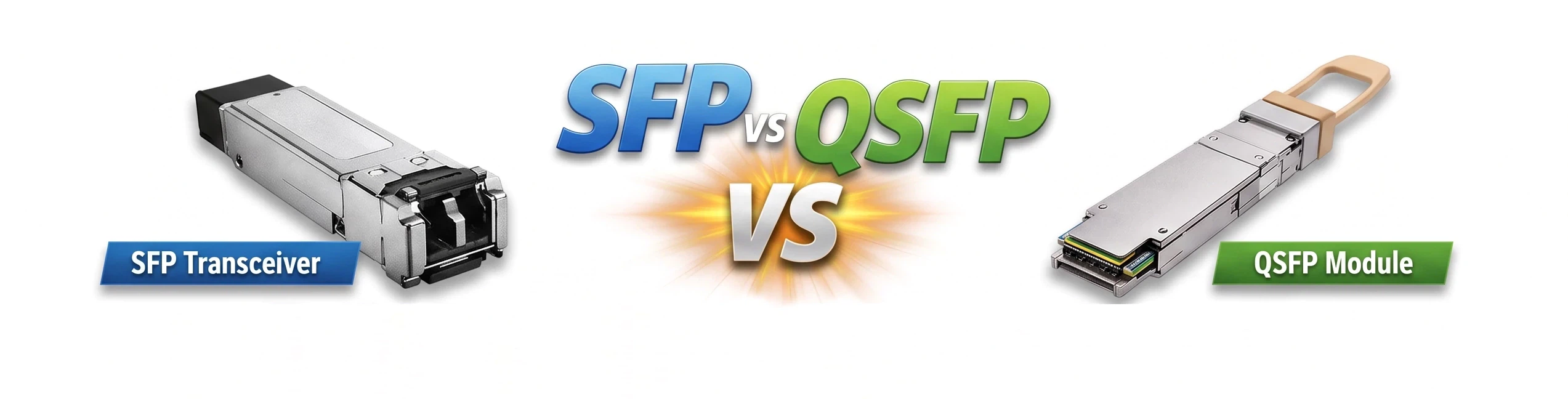
QSFP and SFP are both hot-swappable transceiver form factors used for fiber optic and high-speed data communication. The main difference between QSFP vs SFP is that SFP uses a single transmission lane for lower-speed connections, while QSFP uses multiple lanes in parallel to deliver much higher bandwidth and port density.
In practical deployments:
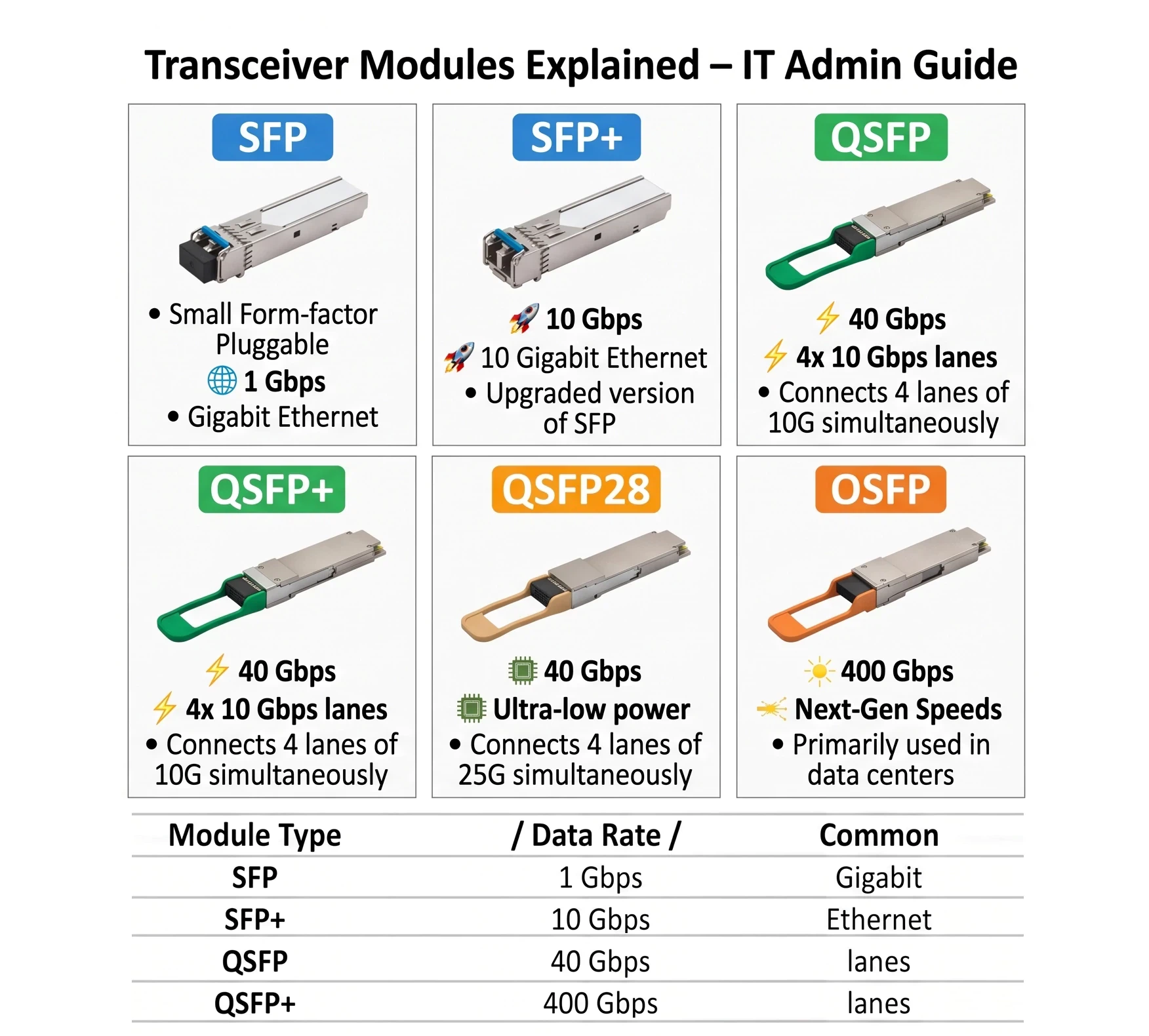
SFP modules are commonly used for 1G, 10G, and 25G access or server connections.
QSFP modules are typically deployed for 40G, 100G, 200G, and 400G aggregation, spine, backbone, and AI networking environments.
Understanding the differences between SFP and QSFP helps network architects optimize bandwidth scalability, cabling infrastructure, power consumption, and long-term upgrade flexibility.
Quick Comparison: QSFP vs SFP
| Feature | SFP | QSFP |
|---|---|---|
| Full Name | Small Form-factor Pluggable | Quad Small Form-factor Pluggable |
| Lane Count | 1 Lane | 4 Lanes (or 8 in QSFP-DD) |
| Typical Speed | 1G–25G | 40G–400G+ |
| Port Density | Lower | Higher |
| Power Consumption | Lower | Higher |
| Common Connectors | LC / RJ45 | MPO/MTP / LC |
| Typical Deployment | Access / Edge | Spine / Core / Aggregation |
| Breakout Support | Limited | Yes |
| AI & HPC Suitability | Limited | Excellent |
What is SFP?
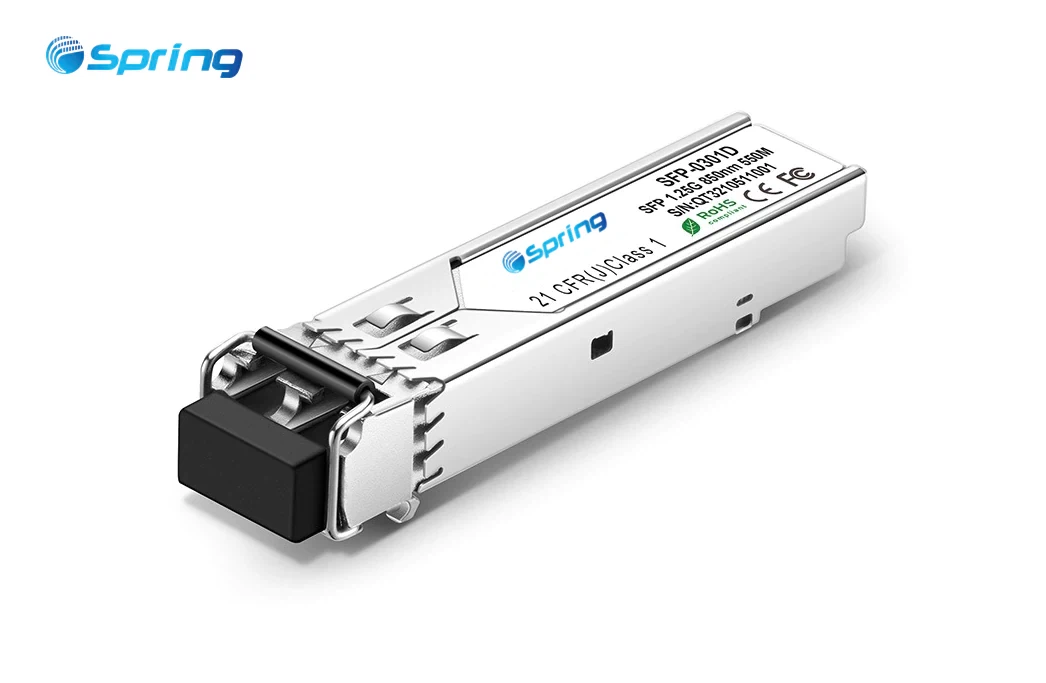
SFP (Small Form-factor Pluggable) is a compact hot-swappable transceiver module originally introduced for telecom and data communication networks.
SFP modules connect switches, routers, servers, media converters, and other networking equipment to fiber optic or copper cabling infrastructure. Compared with earlier GBIC modules, SFP transceivers offer smaller size, higher port density, and lower power consumption.
Today, the SFP family remains one of the most widely deployed optical transceiver standards in enterprise, telecom, and edge networking environments.
Key Features of SFP
Single-lane architecture
Compact form factor
Low power consumption
Hot-swappable design
High compatibility across networking platforms
Suitable for short, medium, and long-distance transmission
Common SFP Connector Types
LC Duplex
RJ45
BiDi LC
DAC cable
AOC cable
SFP Generations
SFP (1G)
Widely used in legacy enterprise networks, telecom systems, and Gigabit Ethernet infrastructure.
SFP+ (10G)
SFP+ supports 10 Gigabit Ethernet and remains highly popular in enterprise aggregation and server uplink deployments.
SFP28 (25G)
SFP28 is commonly deployed in modern data center leaf switches, server NICs, and 5G fronthaul networks.
SFP Series - Single-Lane Architecture
| Model | Data Rate | Common Optics & Distance | Typical Power |
|---|---|---|---|
| SFP | 1.25 Gb/s | SX (550 m), LX (10 km), ZX (80 km) | 0.4–1.0 W |
| SFP+ | 10.3125 Gb/s | SR (300–400 m), LR (10 km), ER/ZR (40–80 km+) | 0.7–1.5 W |
| SFP28 | 25.78 Gb/s | SR (70–100 m), LR (10 km), ER (40 km) | 0.8–1.5 W |
What is QSFP?
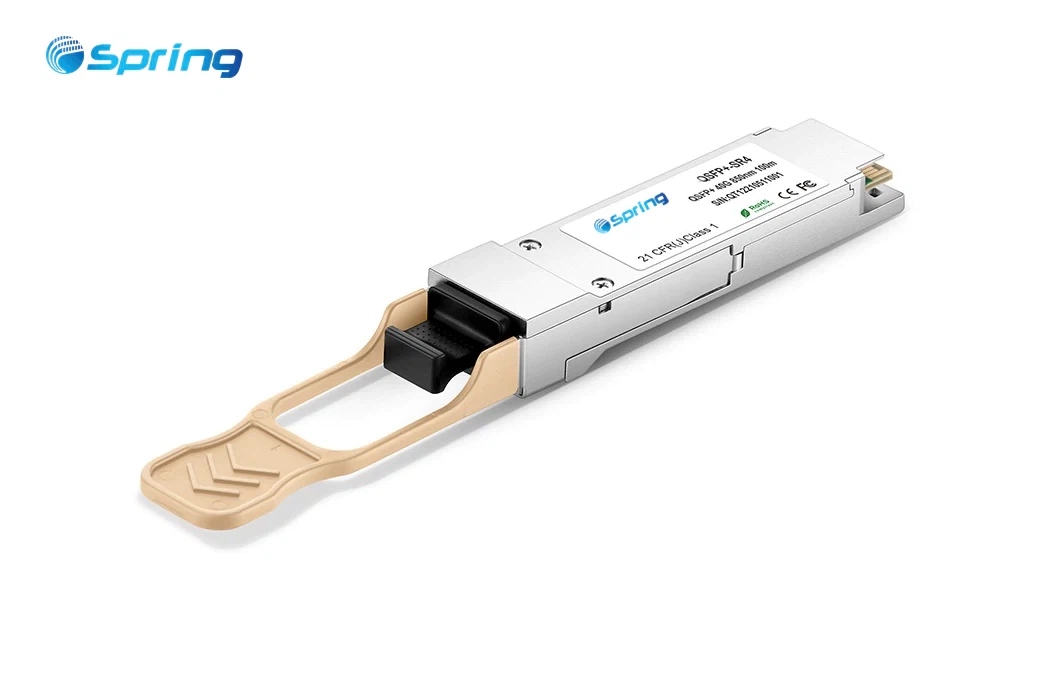
QSFP (Quad Small Form-factor Pluggable) is a high-bandwidth optical transceiver form factor that uses four parallel transmission lanes to provide significantly higher throughput than SFP modules.
QSFP modules are widely deployed in modern data centers, AI infrastructure, cloud computing platforms, telecom backbone networks, and high-density Ethernet switching environments.
Compared with SFP+, QSFP+ can support 4×10G or 4×14G transmission channels within a single module, enabling much higher port density and cabling efficiency.
Key Features of QSFP
Multi-lane architecture
High-density deployment
High aggregate bandwidth
Breakout cable support
Suitable for 40G, 100G, 200G, and 400G Ethernet
Optimized for spine-leaf architectures and AI clusters
Common QSFP Connector Types
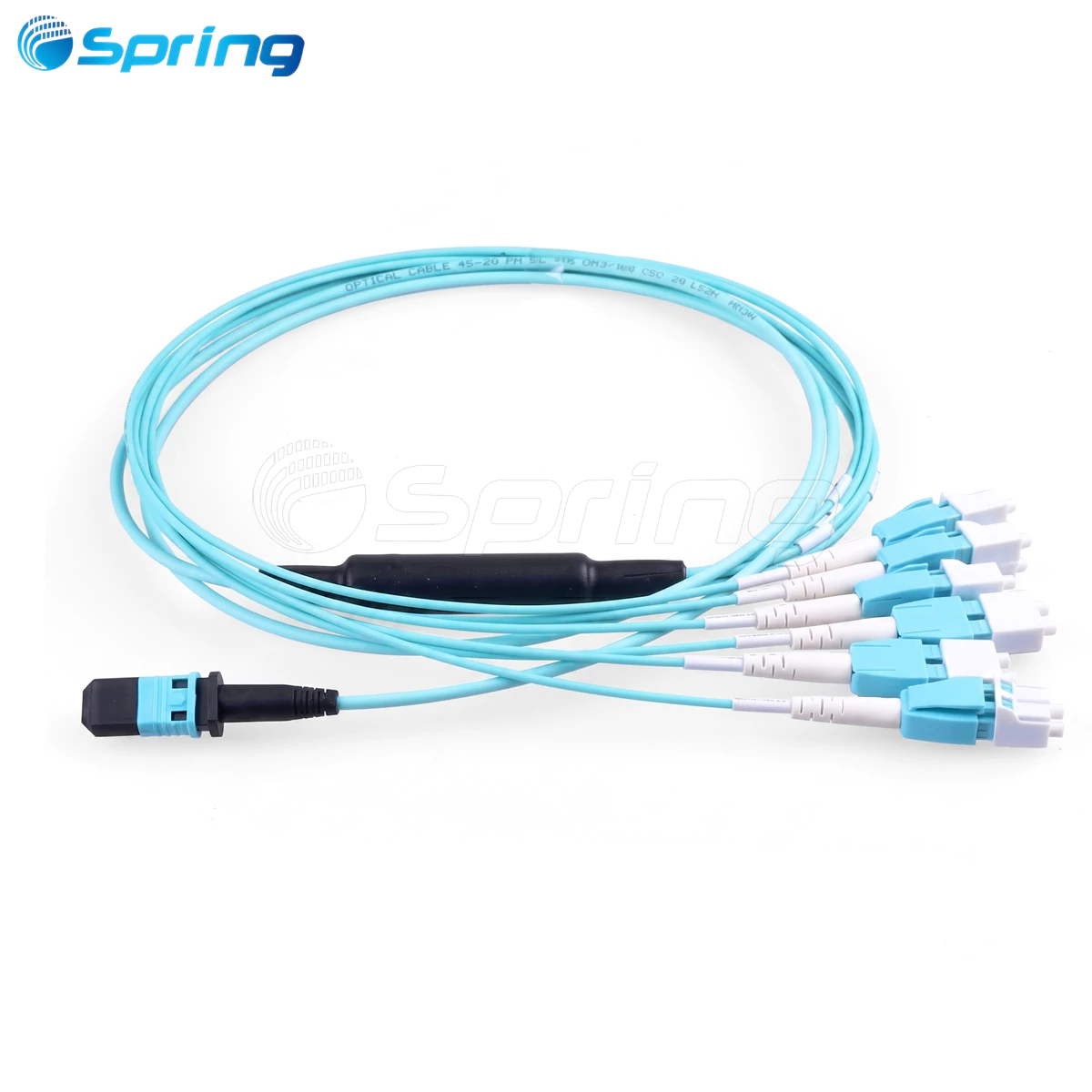
MPO/MTP
LC Duplex
DAC cable
AOC cable
MDC / CS high-density connectors
QSFP Generations
QSFP+ (40G)
Uses 4×10G lanes and is commonly deployed in 40G Ethernet infrastructure.
QSFP28 (100G)
Uses 4×25G lanes and has become the standard for 100G data center networking.
QSFP56 (200G)
Uses 4×50G PAM4 lanes for higher-capacity switching fabrics.
QSFP-DD (400G / 800G)
QSFP-DD introduces double-density architecture with 8 electrical lanes, supporting 400G and next-generation 800G networking.
QSFP Series - Multi-Lane Architecture
| Model | Aggregate Rate | Lane Config | Common Optics & Distance | Typical Power |
|---|---|---|---|---|
| QSFP+ | 40 Gb/s | 4 × 10G | SR4 (100–150 m), LR4 (10 km), ER (40 km) | 1.5–4.5 W |
| QSFP28 | 100 Gb/s | 4 × 25G | SR4 (70–100 m), LR4 (10 km), ER/ZR | 3.5–5.5 W |
| QSFP-DD | 200G / 400G+ | 8 × 25G / PAM4 | SR8, DR4, FR4, LR4, ZR | 8–22 W |
What is the Difference Between QSFP and SFP?
The primary difference between QSFP and SFP is bandwidth architecture.
SFP modules use a single transmission lane, while QSFP modules aggregate multiple lanes in parallel for significantly higher throughput and port density.
QSFP vs SFP Comparison Table
| Feature | SFP | QSFP |
|---|---|---|
| Architecture | Single Lane | Multi-Lane |
| Maximum Speed | 25G | 400G+ |
| Port Density | Standard | High Density |
| Cabling | Simpler | Higher Aggregation |
| Typical Use Case | Access / Edge | Spine / Core |
| Breakout Capability | No | Yes |
| AI Cluster Support | Limited | Excellent |
| Thermal Requirement | Lower | Higher |
Can QSFP Replace SFP?
No, QSFP modules cannot directly replace SFP modules because the physical form factors and electrical lane structures are different.
However, some QSFP ports support breakout configurations such as:
1×100G QSFP28 → 4×25G SFP28
1×40G QSFP+ → 4×10G SFP+
This allows higher-speed QSFP uplinks to connect with multiple lower-speed SFP interfaces through breakout cables.
Can SFP Fit into a QSFP Port?
Standard SFP modules cannot be inserted directly into QSFP ports because the physical sizes and interface architectures are different.
Some switches may support adapter solutions or breakout functionality, but compatibility depends on the switch ASIC, firmware, and vendor design.
Understanding Network Speeds (1G → 800G)
| Generation | Common Module |
|---|---|
| 1G | SFP |
| 10G | SFP+ |
| 25G | SFP28 |
| 40G | QSFP+ |
| 100G | QSFP28 |
| 200G | QSFP56 |
| 400G | QSFP-DD |
| 800G | QSFP-DD800 / OSFP |
As AI infrastructure, cloud computing, and GPU networking continue scaling, 400G and 800G optics are becoming critical for future data center architectures.
Bandwidth & Network Architecture Impact
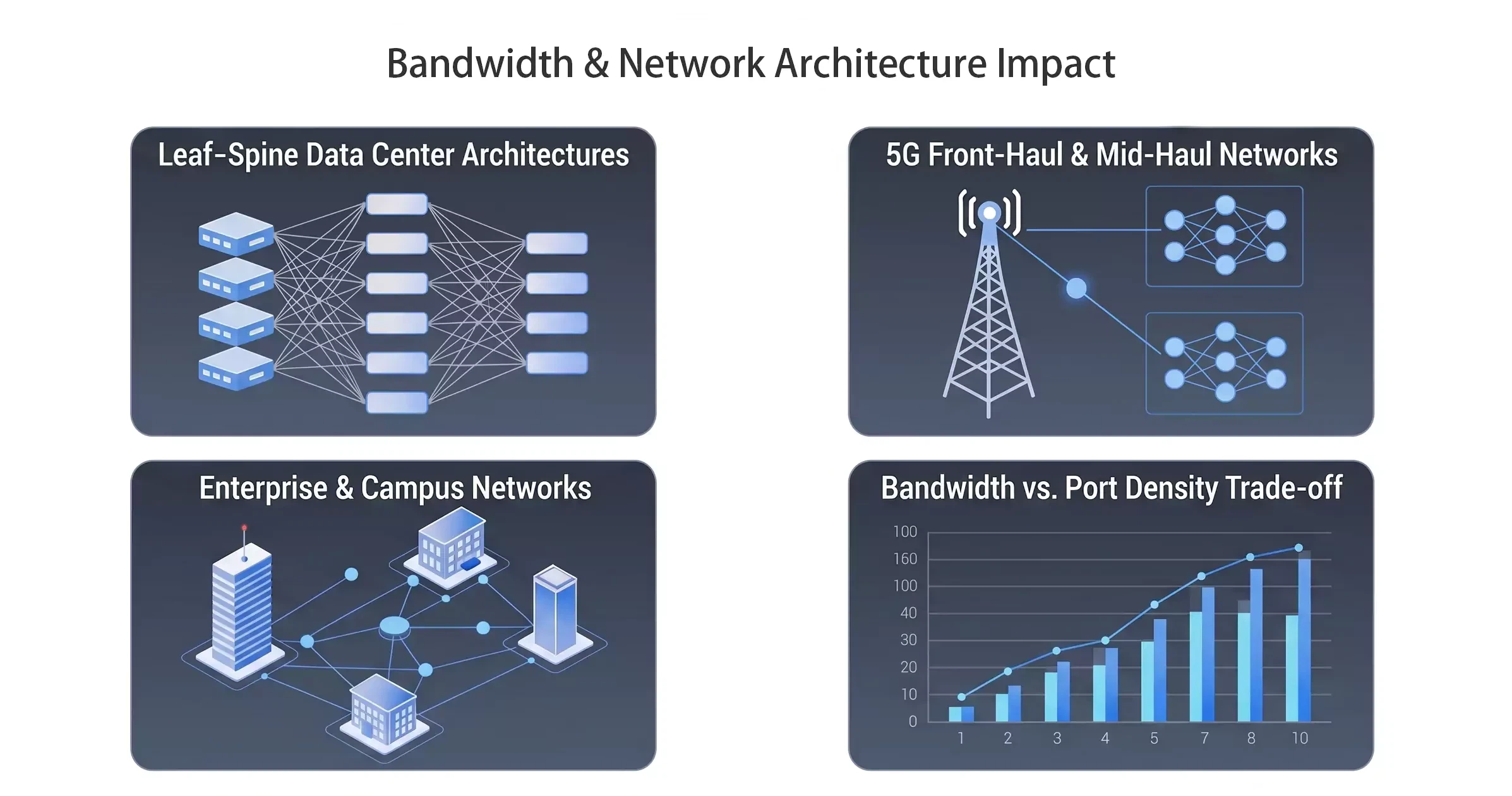
The choice between SFP vs QSFP directly affects network throughput, scalability, port density, and future upgrade capability.
Leaf–Spine Data Center Architectures
In modern leaf–spine fabrics:
SFP28 is typically deployed at the server-facing leaf layer
QSFP28 and QSFP-DD dominate spine and aggregation layers
Typical Architecture
| Layer | Typical Module | Bandwidth |
|---|---|---|
| Server Access | SFP+ / SFP28 | 10G–25G |
| Leaf Switch | QSFP28 | 100G |
| Spine Switch | QSFP-DD | 400G |
| AI Fabric | QSFP-DD / OSFP | 800G |
In several SPRINGOPTICAL data center audits, incorrect SFP uplink selection at leaf layers created bottlenecks during east-west traffic scaling. Upgrading to QSFP28 uplinks increased spine-leaf throughput by more than 2.5× without adding additional switch ports.
5G Front-Haul & Mid-Haul Networks
In 5G transport networks:
SFP28 Advantages
Lower power consumption
Compact size
Easier deployment
Lower thermal load
SFP28 is widely used for RRU and DU connectivity.
QSFP28 Advantages
QSFP28 is increasingly used at aggregation layers connecting multiple 25G radio links into centralized switching fabrics.
Field testing shows that combining SFP28 access with QSFP28 aggregation can reduce CAPEX while maintaining full line-rate transmission.
Enterprise & Campus Networks
The ideal transceiver choice depends on network scale and future bandwidth requirements.
| Requirement | Recommended Module |
|---|---|
| Small Office Backbone | SFP+ |
| Campus Aggregation | QSFP28 |
| Metro Ring | QSFP28 / QSFP-DD |
| AI Infrastructure | QSFP-DD |
| Future 400G Migration | QSFP-DD / OSFP |
In one multi-building campus deployment, using SFP28 for access and QSFP28 for aggregation reduced cable congestion and minimized switch count through breakout architecture.
AI Clusters & GPU Networking
AI infrastructure is rapidly accelerating demand for high-density optical interconnects.
Modern GPU clusters powered by NVIDIA networking platforms increasingly rely on:
400G QSFP-DD
800G QSFP-DD800
OSFP transceivers
High-density MPO cabling
Compared with SFP architectures, QSFP-based fabrics provide:
Higher rack bandwidth
Better port scalability
Lower latency aggregation
Improved switch utilization
This makes QSFP-DD critical for AI training clusters, HPC fabrics, and cloud-scale Ethernet networks.
How to Choose Between SFP and QSFP
Choose SFP When:
Deploying 1G–25G access networks
Building edge or enterprise access layers
Lower power consumption is important
Budget optimization matters
Simpler cabling is preferred
Choose QSFP When:
Building 100G–400G backbone networks
Designing leaf-spine architectures
Supporting AI/HPC workloads
Maximizing port density
Planning future 400G/800G migration
Power Consumption & Thermal Considerations
As bandwidth increases, transceiver power consumption also rises.
| Module | Typical Power |
|---|---|
| SFP | <1W |
| SFP+ | 1–1.5W |
| QSFP28 | 3.5–5.5W |
| QSFP-DD | 8–22W |
Higher-density QSFP deployments require:
Improved airflow
Better switch thermal design
Advanced cooling architecture
This is especially important in AI and hyperscale data center environments.
Summary
SFP and QSFP are both critical optical transceiver standards used in modern fiber optic communication networks.
SFP modules are best suited for lower-speed access, enterprise, and edge deployments where low power consumption and simple cabling are priorities.
QSFP modules are designed for high-bandwidth aggregation, spine, AI, and cloud networking environments where scalability and port density are essential.
As networks evolve toward AI computing, GPU fabrics, and 400G/800G Ethernet, QSFP-DD and next-generation high-density optics will continue driving data center infrastructure upgrades.
Network architects should evaluate current bandwidth requirements, future scalability, port density, power consumption, and breakout flexibility before selecting between SFP and QSFP solutions.
All insights above are based on real-world SPRINGOPTICAL deployments, interoperability testing, and multi-vendor network validation experience.
FAQ
Is QSFP faster than SFP?
Yes. QSFP supports multiple transmission lanes and significantly higher aggregate bandwidth than SFP.
What is the difference between QSFP and SFP?
SFP uses a single lane for 1G–25G transmission, while QSFP uses multiple lanes for 40G–400G+ networking.
Can QSFP ports support breakout cables?
Yes. QSFP ports commonly support breakout configurations such as 100G to 4×25G.
Which is better for AI networking, SFP or QSFP?
QSFP-DD and OSFP are better suited for AI and GPU networking due to higher bandwidth and port density.
Is SFP cheaper than QSFP?
Generally yes. SFP modules usually consume less power and cost less than high-speed QSFP optics.
What connector types are used with QSFP?
Common QSFP connectors include MPO/MTP, LC duplex, DAC, and AOC interfaces.
Which is better for enterprise networks?
SFP+ and SFP28 are ideal for enterprise access and aggregation, while QSFP is preferred for high-capacity campus cores and data center backbones.