

Author:Hayden Sun
Senior Fiber Optic Network Engineer (Data Center & High-Speed Optical Systems)
Introduction: Why MPO Fiber Optic Connectors Matter in Modern Data Centers
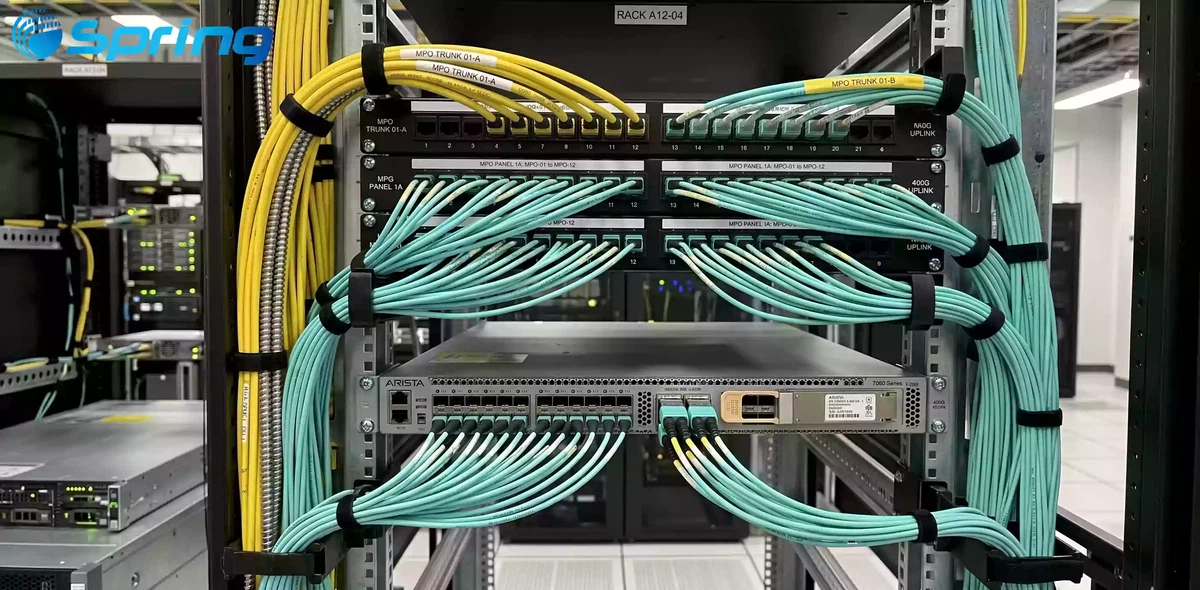
A hyperscale data center once encountered a critical infrastructure challenge: it needed to connect 10,000 new servers, but only 40% of planned fiber pathway capacity remained available, and the existing ceiling structure could not support additional cable trays.
The solution was not expanding physical space-it was adopting MPO fiber optic connectors.
By integrating 24 optical fibers into a single thumb-sized MPO connector, the deployment team completed the entire installation without modifying cable pathways, reducing installation time by 80%.
This demonstrates the core value of Multi-fiber Push-On (MPO) connector systems in modern high-density networks.
As data centers evolve from 100G → 400G → 800G → 1.6T, MPO connectors have become the default interface for parallel optical transmission systems, making them essential knowledge for network architects and cabling engineers.
What Is an MPO Connector?
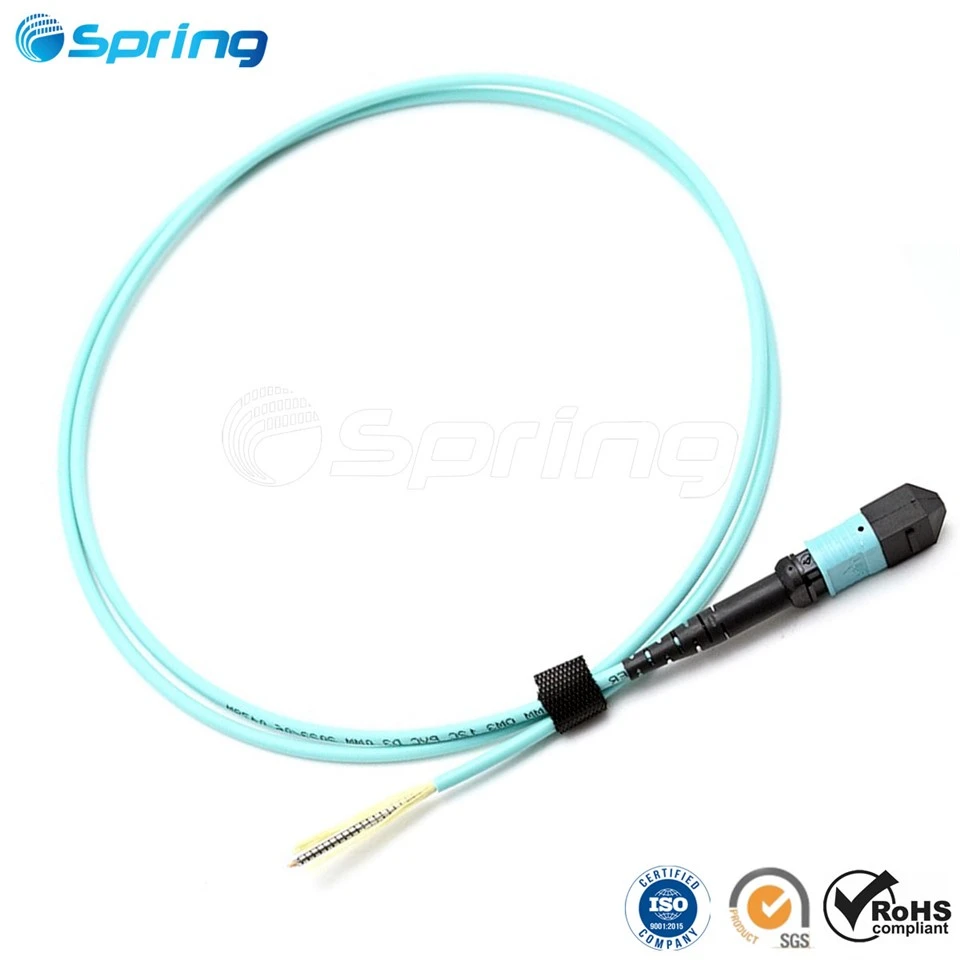
An MPO connector (Multi-fiber Push-On) is a high-density fiber optic connector that terminates multiple optical fibers within a single precision-molded MT ferrule (Mechanical Transfer ferrule).
Its compact rectangular design supports 8 to 72 fibers in one connector, significantly exceeding traditional LC or SC connectors, which typically support only 1–2 fibers.
Industry Standards
MPO connectors comply with:
IEC 61754-7
TIA-604-5 (FOCIS 5)
These standards ensure full interoperability between different manufacturers, making MPO a globally accepted solution for structured cabling in hyperscale environments.
Key Technical Specifications of MPO Connectors
| Specification | Details |
|---|---|
| Fiber capacity | 8, 12, 16, 24, 32, 48, 72 fibers |
| Common types | MPO-8 / MPO-12 / MPO-16 / MPO-24 |
| Ferrule type | Precision MT ceramic ferrule |
| Connector gender | Male (pins), Female (holes) |
| Polish type | UPC / APC |
| Insertion loss | 0.20–0.75 dB (grade dependent) |
| Operating temperature | -40°C to +85°C |
MPO Connector Components (Engineering Breakdown)
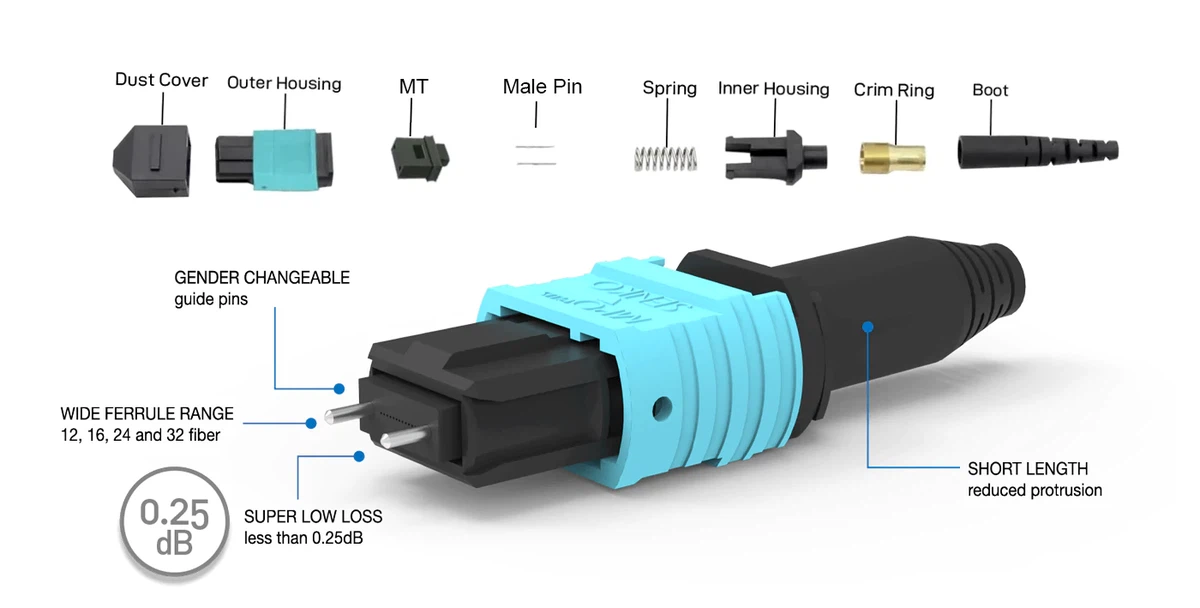
1. MT Ferrule
The MT ferrule precisely aligns multiple fibers in a single row.
Example: MPO-12 = 12 fibers in exact linear alignment.
2. Guide Pins
Male connector: contains two metal alignment pins
Female connector: contains matching alignment holes
These ensure sub-micron precision alignment during mating, which directly impacts insertion loss and return loss.
3. Keying Mechanism
A physical key prevents incorrect insertion and defines polarity orientation:
Key Up
Key Down
This directly affects fiber mapping and system polarity design.
4. Fiber 1 (White Dot Indicator)
A marking on the connector body identifies Fiber 1 position, critical for:
polarity verification
troubleshooting
documentation consistency
MPO vs MTP: Engineering-Level Difference
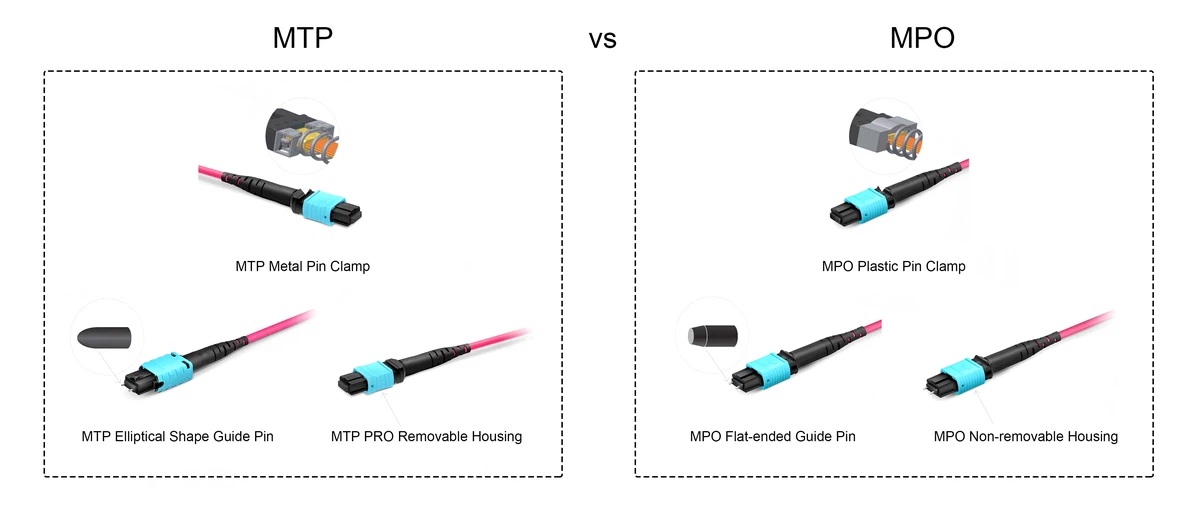
MPO and MTP are often confused, but they are not equivalent.
MPO (Standard Industry Connector)
A generic connector compliant with IEC standards. Any manufacturer can produce MPO connectors if they meet specification requirements.
MTP (Premium High-Performance Connector)
Developed by US Conec, MTP is an enhanced version of MPO with:
tighter mechanical tolerances
lower insertion loss
improved durability
floating ferrule design
better field maintainability
Key Engineering Insight
All MTP connectors are MPO-compatible, but not all MPO connectors meet MTP-level performance.
Performance Comparison
| Feature | MPO | MTP |
|---|---|---|
| Insertion loss | 0.35–0.75 dB | 0.15–0.35 dB |
| Elite grade loss | Not defined | <0.20 dB |
| Mating cycles | ~500 | 600+ |
| Ferrule | Fixed | Floating |
| Cleaning | Limited | Field-serviceable |
When to Use Each
Standard MPO is suitable for:
enterprise networks
moderate-density deployments
budget-sensitive projects
low reconfiguration environments
MTP is recommended for:
hyperscale data centers
400G/800G parallel optics
strict loss budgets
long-term critical infrastructure
MPO Connector Types and Fiber Configurations
Fiber Count Options
| Type | Fibers | Application |
|---|---|---|
| MPO-8 | 8 | 40G/100G SR4 |
| MPO-12 | 12 | general DC backbone |
| MPO-16 | 16 | 400G / 800G SR8 |
| MPO-24 | 24 | high-density aggregation |
| MPO-32+ | 32–72 | hyperscale architecture |
Engineering Interpretation
MPO-8
Optimized for:
4Tx + 4Rx parallel optics
MPO-12
Most widely used:
supports multiple generations
allows unused fibers for future scaling
MPO-16
Modern standard for:
400G SR8
800G SR8
zero fiber waste architecture
MPO-24
Used for:
100G SR10
ultra-high-density backbone systems
multi-channel aggregation
Male vs Female MPO Connectors
Male Connector
contains guide pins
used for trunk-to-trunk connections
Female Connector
contains alignment holes
used for equipment, transceivers, patch panels
Engineering Rule
Most switch and optical module ports are male → therefore, cables are typically female-ended.
MPO Polish Types: UPC vs APC
UPC (Ultra Physical Contact)
flat 0° polish
used in multimode systems (OM3/OM4/OM5)
standard for SR applications
APC (Angled Physical Contact)
8° angled polish
used for single-mode systems
required for long-distance DR/FR/LR optics
Critical Warning
Never mix APC and UPC connectors.
This can cause:
fiber damage
excessive insertion loss
return loss failure
MPO Polarity Explained (Critical for Deployment)
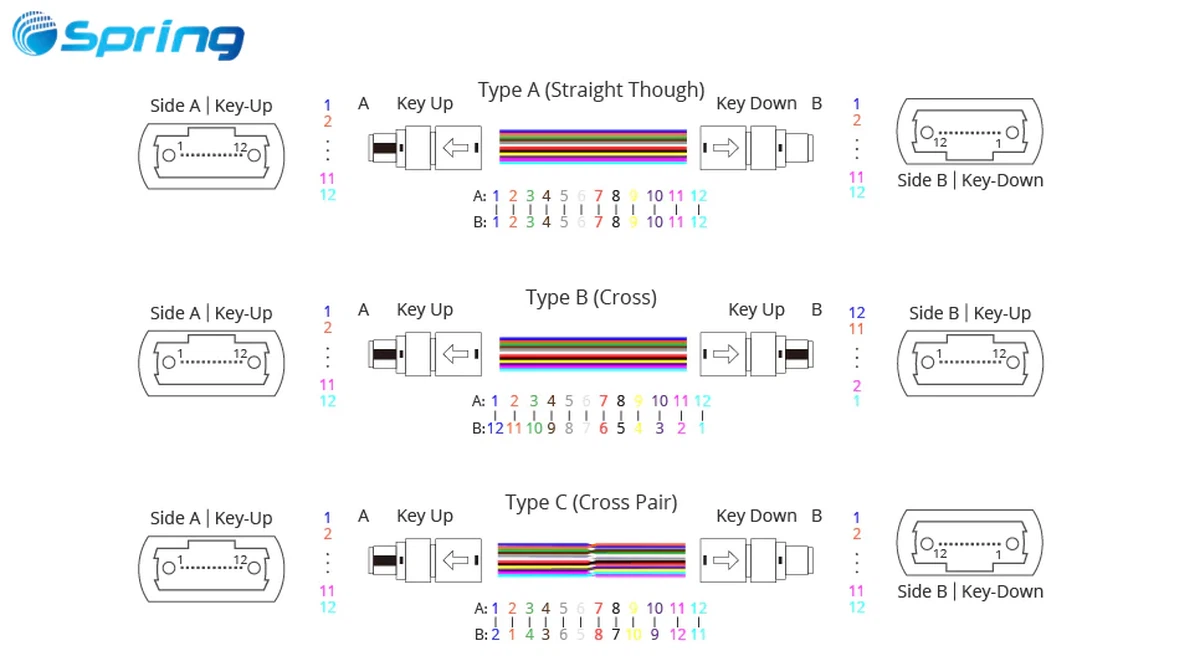
Polarity defines correct mapping between:
Tx (Transmit)
Rx (Receive)
Incorrect polarity is the #1 cause of MPO link failure in real deployments.
Standards: TIA-568.3-D
Type A Polarity (Straight Through)
Mapping
1→1, 2→2, 12→12
Best Use
patch panels
structured cabling systems
flexible upgrades
Type B Polarity (Reversed / Flipped)
Mapping
1→12, 2→11
Best Use
leaf-spine architectures
400G/800G parallel optics
OSFP/QSFP systems
Critical Requirement
Used by:
QSFP+
QSFP28
QSFP-DD
OSFP
Type C Polarity (Pair Swap)
Used mainly for:
MPO to LC breakout systems
legacy duplex migration
Rare in modern parallel optics.
MPO Polarity Selection Matrix
| Application | Recommended |
|---|---|
| 40G SR4 | Type B |
| 100G SR4 | Type B |
| 400G SR8 | Type B |
| 800G SR8 | Type B |
| Patch upgrades | Type A |
MPO Cable Types in Data Centers
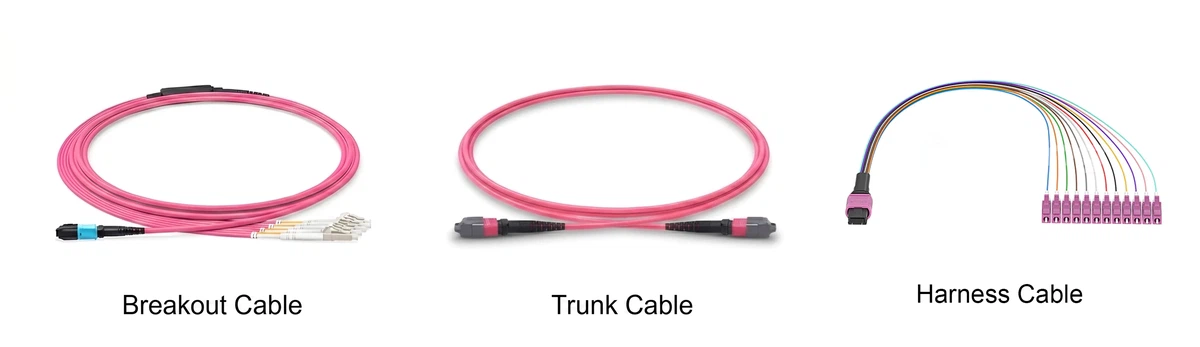
1. MPO Trunk Cables
MPO-to-MPO
backbone connectivity
MDF → IDF links
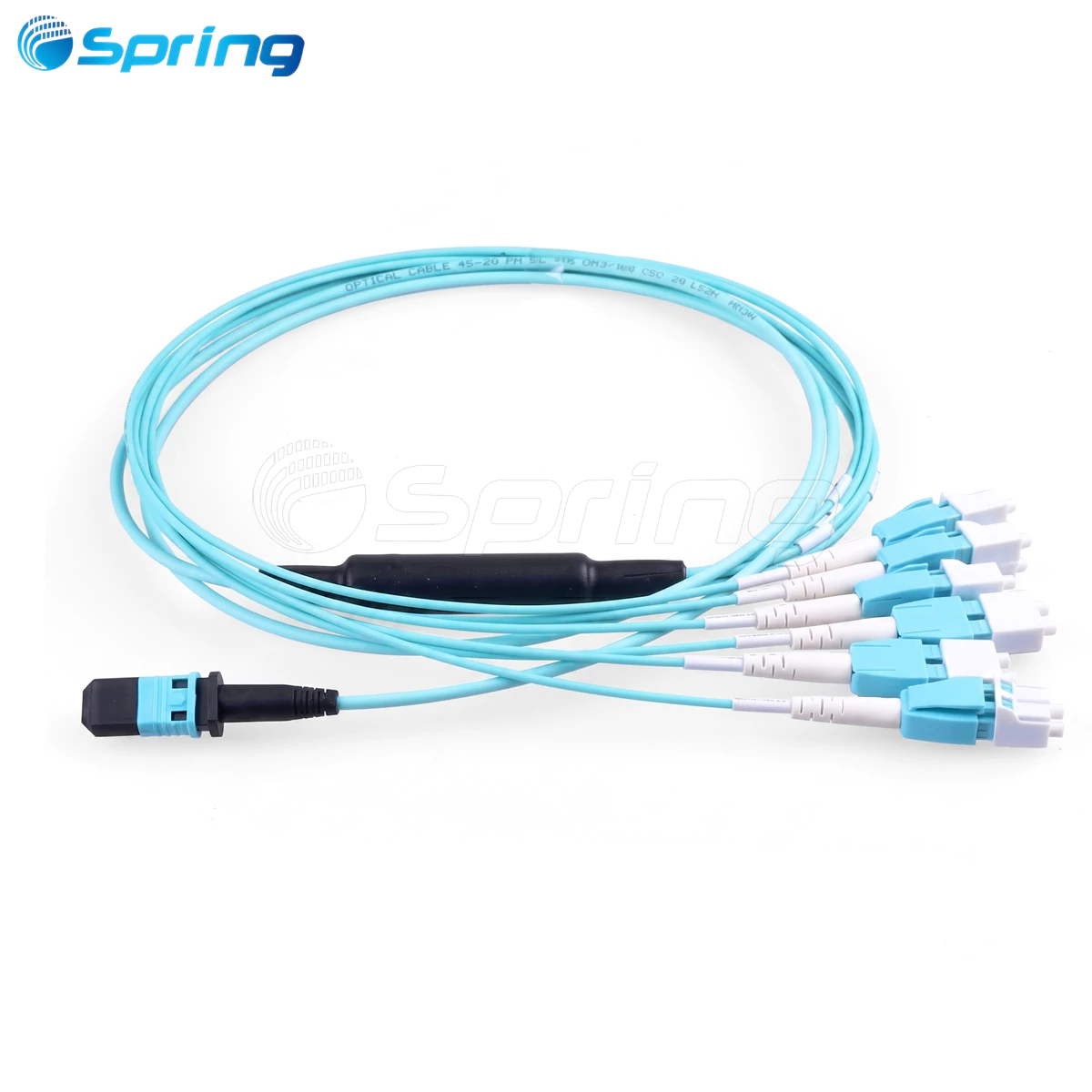
2. MPO Breakout Cables
MPO to LC
100G → 10G/25G server networks
3. MPO Patch Cords
short MPO-MPO cables
rack-level interconnects (1–5m)
Data Center Architecture Applications
Leaf-Spine Architecture
MPO trunks form high-speed spine layer connections.
Top-of-Rack (ToR)
Short MPO cables reduce congestion and latency.
End-of-Row (EoR)
Centralized switching with MPO distribution.
MPO in High-Speed Optical Systems
40G
SR4 (8 fibers)
100G
SR4 / DR4 / SR10
400G
SR8 / DR4 / SR16
800G
SR8 / DR8 using MPO-16
1.6T and Future Scaling
Future architectures will use:
16 × 200G lanes
or 32 × 100G lanes
MPO-24 and MPO-32 will dominate next-generation infrastructure.
OSFP and MPO Integration
Modern systems use MPO as default interface for high-speed optics.
Example mapping:
800G OSFP → MPO-16
1.6T OSFP → MPO-16 / MPO-32
Best Practices (Engineering Summary)
Standardize polarity (prefer Type B for parallel optics)
Label every fiber assembly
Never mix APC and UPC
Always test insertion loss before activation
Document fiber mapping at installation stage
Common MPO Installation Mistakes
Wrong polarity selection
Mixing connector types
Dirty ferrules
Incorrect male/female pairing
Excessive bend radius
FAQ
Q: What is MPO used for?
A: High-density optical connections in data centers and telecom networks.
Q: Is MPO better than LC?
A: Yes for high-density parallel optics, but LC is still used for duplex links.
Q: Can MPO support 400G and 800G?
A: Yes, MPO-16 is standard for 400G/800G SR8 systems.
Q: What is the difference between MPO and MTP?
A: MTP offers lower loss, higher precision, and better mechanical performance.
Conclusion
MPO fiber optic connector systems are now the backbone of modern high-speed optical infrastructure. From 40G to 800G and beyond, MPO enables:
higher density
faster deployment
scalable architecture
reduced cabling complexity
As data centers continue evolving toward 1.6T and multi-terabit architectures, MPO-based structured cabling will remain a core foundation technology.
Need Help Designing Your MPO System?
If you are planning or upgrading a data center fiber infrastructure, selecting the correct MPO configuration is critical for long-term scalability and performance.
We provide:
MPO trunk cables
MPO breakout assemblies
MTP low-loss solutions
400G / 800G structured cabling design support
👉 Contact our engineering team for technical consultation or custom design support.