

A System-Level Analysis of 7 FTTH Deployment Mistakes in BEAD-Driven Expansion
Introduction: Why Rural Broadband Expansion Keeps Failing
The BEAD (Broadband Equity, Access, and Deployment) program has injected an unprecedented $42.45 billion into the U.S. telecom landscape. Yet, despite this massive financial runway, rural FTTH (Fiber-to-the-Home) projects across North America are hitting a familiar wall. Timelines are slipping, and CAPEX is blowing past initial projections.
The hard truth? Funding was never the real bottleneck. The failure of most rural deployments lies in outdated, field-intensive legacy architecture that simply cannot scale across low-density geographies. To survive the strict compliance metrics of BEAD, operators and co-ops must shift from reactive field engineering to a standardized, system-level design methodology.
Here is a comprehensive breakdown of the 7 critical OSP (Outside Plant) deployment mistakes stalling rural expansion-and the architectural pivots required to fix them.
Mistake #1: Designing Routes on Desktop GIS Without Field Truth
Many network planners kick off their engineering phase using outdated GIS data or static demographic clustering. Designing a high-density route on a computer screen is one thing; executing it across rolling rural terrain, rocky soil, or dense vegetation is another.
The Root Cause: Relying strictly on automated demand modeling without verifying actual right-of-way (ROW) constraints or utility pole attachment availabilities during the initial blueprinting phase.
The Costly Impact: Underestimating "make-ready" utility pole work can delay a project by 6 to 12 months. If your backbone network overshoots actual subscriber density by even 20%, underutilized fiber segments will bleed your cash flow long before the first drop is lit.
The System Fix: Modern rural deployment requires data-driven route modeling that cross-references live terrain validation with active ROW clearance. Engineering teams must design routes based on optimized node placement, grouping subscribers into practical MST (Multiport Service Terminal) footprints early in the design cycle.
Mistake #2: Over-Relying on Field-Fusion Splicing for Drop Cables
The last mile is where profitability goes to die in rural deployments. In low-density areas where households are separated by hundreds of feet, sending a highly skilled splicing technician in a bucket truck to terminate every single subscriber drop is an operational money pit.
The Reality Check: Traditional field fusion splicing is slow, highly susceptible to environmental contamination (dust, moisture, sub-zero temperatures), and dependent on a scarce, expensive commodity: experienced labor.
The Systemic Impact: A high error rate in field-terminated connectors leads to massive rework costs. Every time a truck rolls back to troubleshoot a failed connector at the subscriber premises, your last-mile margins disappear.
OSP Comparison: Field Splicing vs. Pre-Connectorized FTTH
| Deployment Metric | Traditional Field Splicing | Pre-Connectorized (Plug-and-Play) |
| Labor Dependency | High (Requires certified splice technicians) | Low (General field crews can install) |
| Installation Speed | 45–60 minutes per subscriber drop | Under 15 minutes per subscriber drop |
| Environmental Risk | High (Dust, rain, and temperature interference) | Zero (Factory-sealed & optically tested) |
| Long-term Reliability | Variable based on individual technician skill | Consistent, certified low insertion loss |
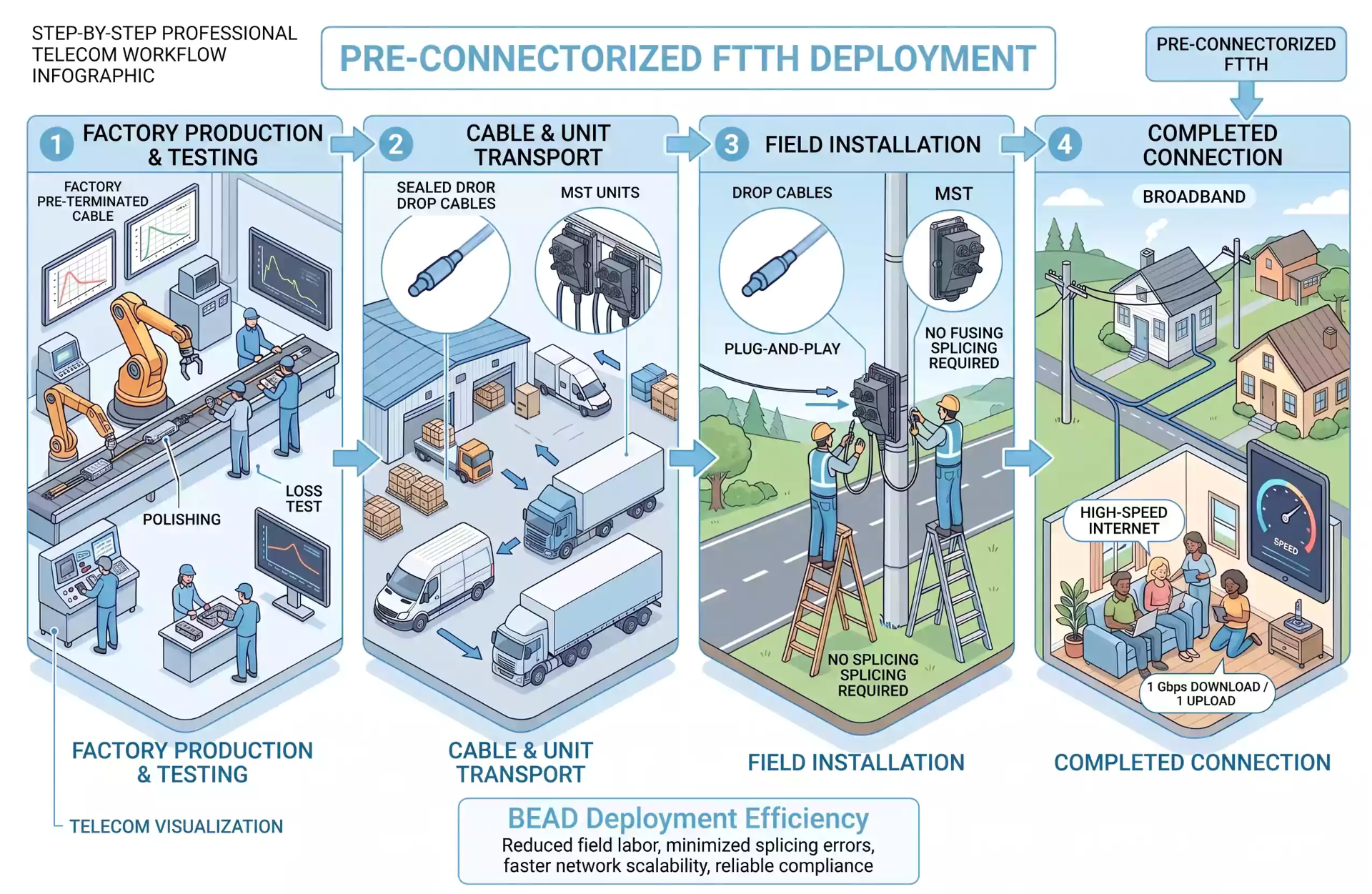
The System Fix: Pivot to a Pre-Connectorized FTTH strategy. Using factory-terminated drop cables eliminates field splicing entirely at the subscriber drop point. Field crews can simply click hardened connectors into place, accelerating the BEAD rollout timeline significantly.
Deep Dive: Read our comprehensive [Drop Cable Technical Guide] to choose the right mechanical pulling tension for rural aerial deployments.
Mistake #3: Inefficient, Centralized Multiport Service Terminal (MST) Layout Design
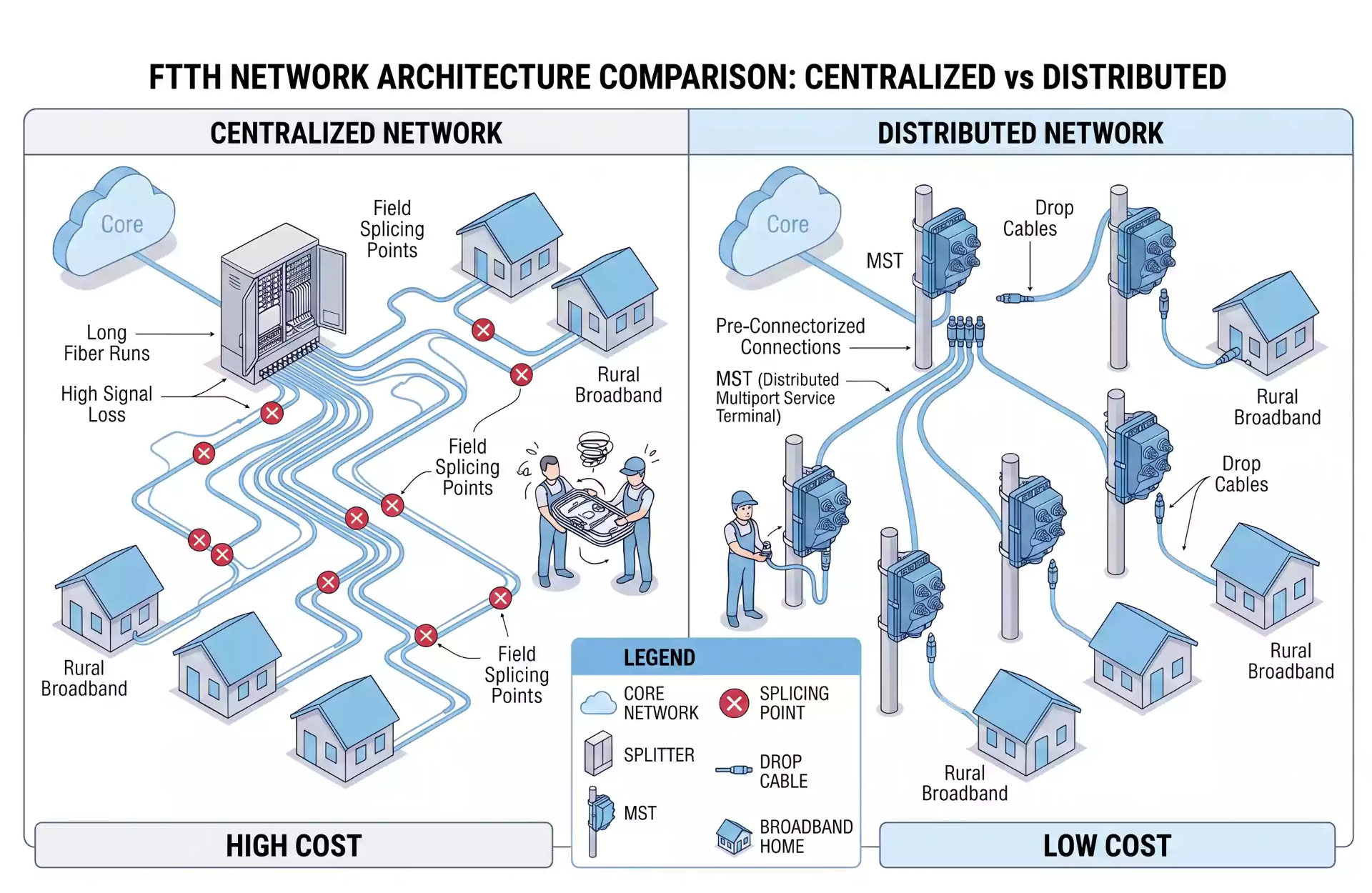
Centralized fiber aggregation works perfectly in dense urban centers, but applying the same topology to rural expansion is a fundamental architectural error.
The Root Cause: Attempting to pool subscribers into large, centralized splitters, which forces excessively long drop cable runs across low-density regions.
The Costly Impact: This creates massive network bottlenecks at distribution points, limits scalability for future property developments, and drastically increases the physical volume of fiber that field teams must manage.
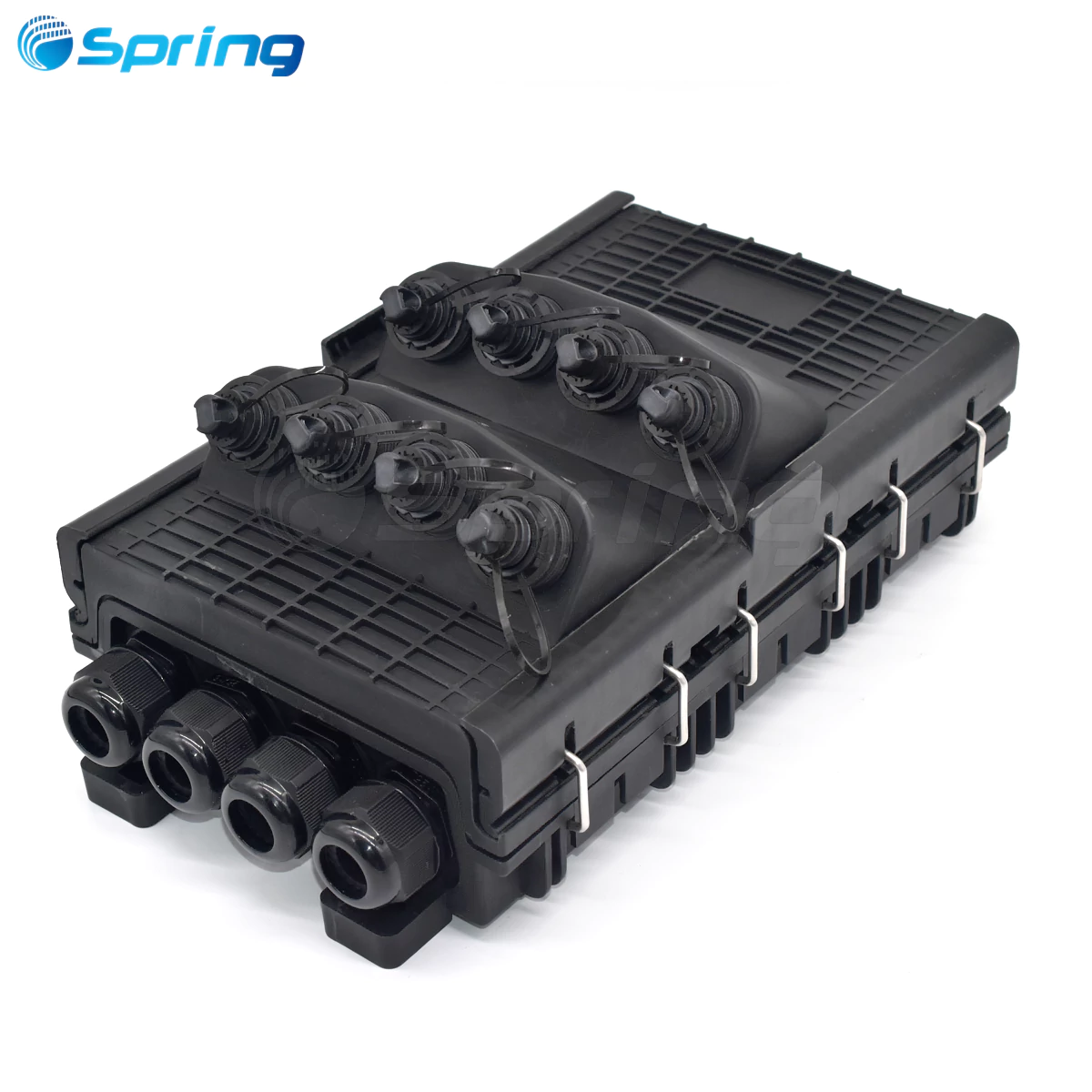
The System Fix: Adopt a distributed MST architecture. By cascading or indexing smaller, factory-sealed Multiport Service Terminals closer to actual subscriber clusters, you drastically reduce both backbone fiber counts and drop lengths.
"Standardized, distributed MST architecture reduces OSP layout complexity and eliminates up to 40% of field splicing requirements in rural environments."
Product Specs: Explore our engineered [MST Product Page] for heavy-duty, hardened terminal solutions.

Mistake #4: Ignoring Pre-Connectorized Plug-and-Play Architecture
Many traditional engineering and construction firms stick to what they know: manual, craft-heavy field construction. However, legacy deployment models are fundamentally incompatible with the rapid build-out paces required today.
The Root Cause: An organizational overreliance on traditional field splicing models, combined with a lack of modular, plug-and-play procurement planning.
The Costly Impact: Prolonged deployment cycles, highly variable installation quality, and an inability to hit project milestones, which can threaten funding guarantees.
The System Fix: High-performance rural ISPs are transitioning to modular, pre-connectorized FTTH deployment models. By moving the labor from the field to a controlled factory environment, operators ensure repeatable scalability and uniform optical performance across thousands of miles.
Solutions Guide: Learn how to deploy faster with our [Pre-Connectorized FTTH Solutions Page].
Mistake #5: BEAD Program Execution and Compliance Gaps
Navigating the regulatory framework of federal funding is just as critical as digging the trenches. Many ISPs focus so heavily on the physical engineering that they neglect the rigorous compliance tracking mandated by the NTIA.
The Root Cause: A structural disconnect between engineering designs, supply chain origin tracking, and federal reporting milestones.
The Costly Impact: Failing to meet strict deployment deadlines or accidentally violating Build America, Buy America (BABA) sourcing requirements risks severe funding clawbacks and catastrophic project cash-flow strain.
The System Fix: Integrate your deployment tracking systems directly with BEAD reporting workflows. Ensure your passive material suppliers provide fully documented, BABA-compliant components-such as certified fiber optic assemblies-from day one to guarantee seamless compliance audits.
Mistake #6: Unmanaged Last-Mile Constraints & Permitting Overlooks
The final segment from the distribution node to the side of the house is often the most volatile variable in rural broadband expansion.
The Root Cause: Failing to account for complex regional permitting, environmental impact studies, right-of-way approvals, and difficult physical geography (such as heavy tree canopies or rocky soil) during initial budgeting.
The Costly Impact: Extended permitting bottlenecks stop construction crews in their tracks, driving up contractor retention fees and blowing past seasonal weather windows.
The System Fix: Treat last-mile constraints as a primary engineering design factor, not an afterthought. Utilize hardened, ultra-reliable drop components that can withstand extreme environmental stress, reducing the need for deep-burial trenching where terrain permits.
Mistake #7: Lack of Standardized Field Coordination & Sourcing Kits
When an ISP relies on multiple third-party contractors and local field crews, maintaining consistent installation quality becomes an operational nightmare without strict standardization.
The Root Cause: A lack of uniform installation procedures, varying skill levels among local contractors, and fragmented component sourcing from mismatched manufacturers.
The Costly Impact: High optical attenuation (db loss) across the footprint, frequent component mismatches, extensive troubleshooting rework, and bloated long-term maintenance costs (OPEX).
The System Fix: Standardize your supply chain with repeatable, pre-packaged deployment kits. Providing contractors with pre-matched MSTs, drop cables, and mounting hardware ensures a uniform installation workflow, drastically minimizing human error in the field.
System-Level Solution: Optimizing Rural FTTH Architecture
The infrastructure failures listed above are not isolated incidents-they are symptoms of a deeper architectural problem. To maximize ROI and secure long-term network reliability under BEAD-driven expansion, operators must transition away from legacy, field-heavy construction toward a standardized, three-tiered framework:
Distributed MST Network Design: Shift from centralized splitters to cascaded, hardened multiports to bring distribution nodes closer to subscribers.
Factory-Terminated Pre-Connectorized Models: Replace unpredictable field fusion splicing with factory-tested, plug-and-play components to eliminate craft-sensitivity.
Modular Supply Chain Sourcing: Deploy repeatable, standardized component kits to accelerate field workflows and guarantee structural network predictability.
Conclusion: Building a Scalable Rural Broadband Future
Rural broadband projects do not fail because of capital shortages; they fail due to non-standardized FTTH deployment architecture and craft-heavy field execution models.
To achieve predictable, long-term success under the BEAD program, the paradigm must shift:
From Reactive Field Engineering $\rightarrow$ To System-Level Architectural Design
From Labor-Intensive Construction $\rightarrow$ To Pre-Connectorized, Plug-and-Play Architecture
From Legacy Centralized Networks $\rightarrow$ To MST-Based Distributed Cascaded Topologies
By modernizing the outside plant design, ISPs can build faster, slash last-mile truck rolls, and deliver reliable, high-speed connectivity to rural communities for decades to come.
Frequently Asked Questions (FAQ)
Why do rural broadband projects fail under the BEAD program?
Project failures are primarily driven by systemic deployment inefficiencies, severe labor shortages of certified splice technicians, and unexpected make-ready utility pole delays, rather than an actual shortage of capital.
What is the most critical mistake in rural FTTH deployment?
The most damaging mistake is relying on traditional, field-heavy fusion splicing across low-density rural routes. This strategy significantly increases labor costs, deployment timelines, and human error rates compared to plug-and-play models.
How does a distributed MST architecture improve rural deployment?
Distributed MST (Multiport Service Terminal) layouts place distribution points closer to rural households. This minimizes the length of individual subscriber drop cables, optimizes backbone fiber utilization, and cuts down on overall field splicing requirements.
What are the operational benefits of Pre-Connectorized FTTH?
Pre-connectorized systems utilize factory-sealed, optically tested components. This eliminates the need for specialized splicing labor in the field, cuts drop installation times from one hour to under 15 minutes, and guarantees low insertion loss regardless of weather conditions.
How can rural ISPs lower their last-mile deployment costs?
Operators can drastically reduce last-mile costs by standardizing their supply chain with modular deployment kits, utilizing pre-terminated drop cables, and integrating automated OSP design software to eliminate manual field routing errors.
Additional OSP Engineering Resources
[Multiport Service Terminal (MST) for FTTH: Complete Guide to Architecture, Deployment, Cost & ROI]
[What Is the Purpose of the MST Multiport Service Terminal?]