

Author: CoCo – 10+ Years' Experience – Spring Optical Fiber Experts coco@springoptic.com
Introduction
As modern data centers evolve to support AI, machine learning, and high-performance computing (HPC), network architects face unprecedented challenges in fiber connectivity. Traditional MPO (Multi-Fiber Push-On) connectors, supporting 8, 12, or 24 fibers, have long been the industry standard for high-density cabling. However, with the emergence of 800G Ethernet and early 1.6T network architectures, MPO connectors are reaching their limitations in density, scalability, and future readiness.
MMC (Multiport Modular Connector) is a next-generation fiber connector designed for Very Small Form Factor (VSFF) applications. It offers higher density, improved insertion loss, and better scalability for AI and hyperscale data centers. This guide compares MMC and MPO connectors, analyzes their applications, and provides actionable recommendations to help you choose the right connector for your next-generation deployment.
Internal Links: [Data Center Products], [Data Center Fiber Optic Solutions], [Fiber Backbone Cabling]

What Is an MPO Connector?
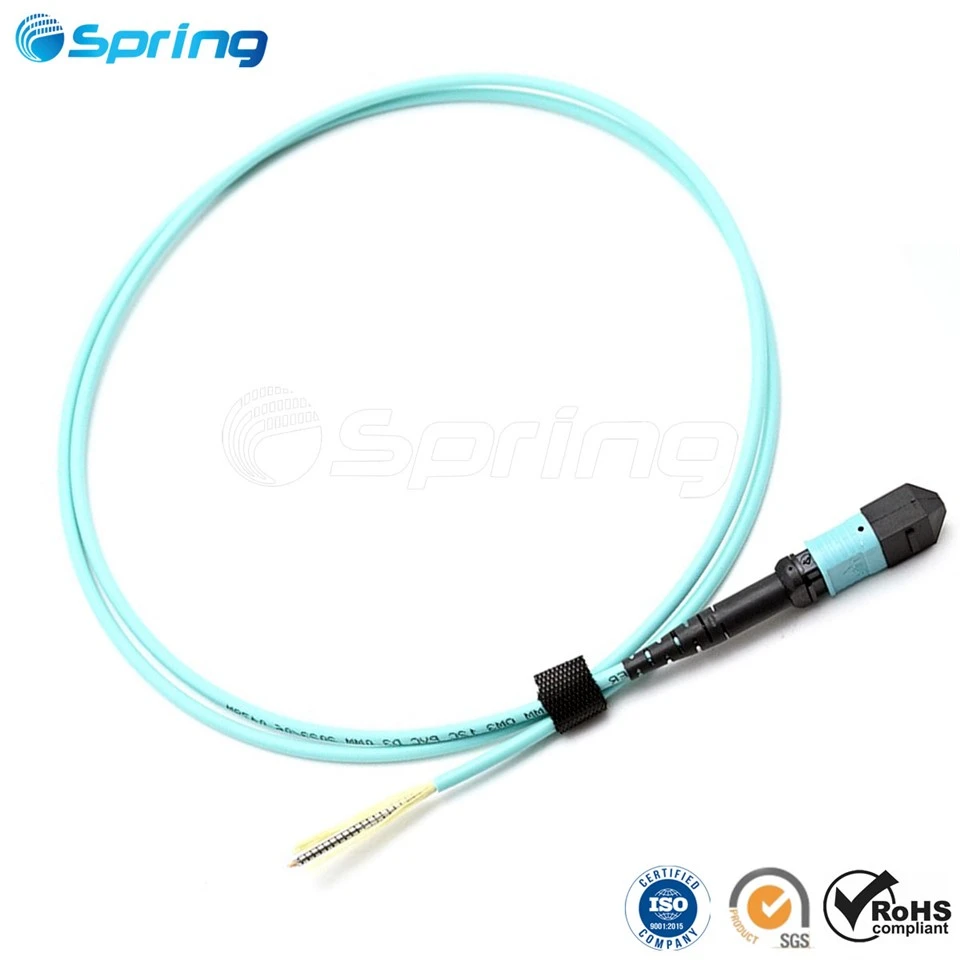
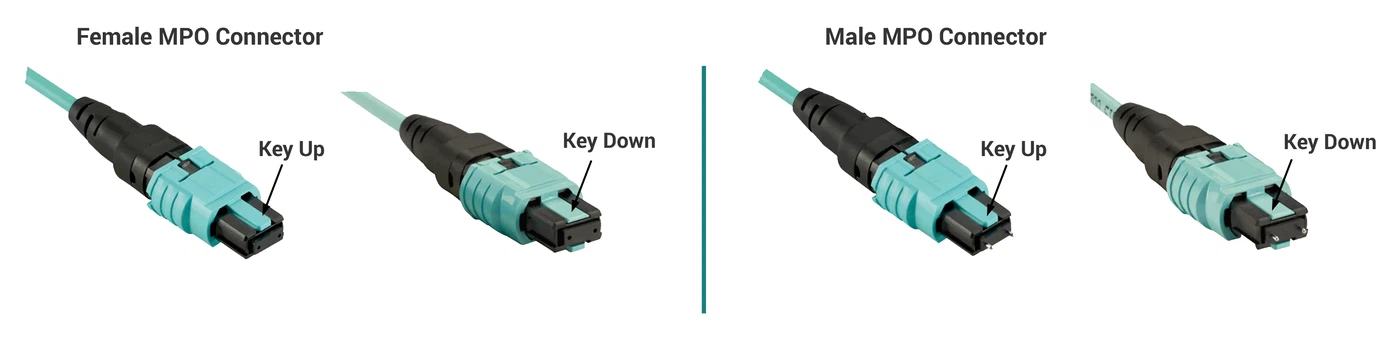
MPO connectors, standardized under IEC 61754-7 , have been the backbone of high-density fiber cabling for over a decade. They enable multi-fiber parallel transmission for 40G SR4, 100G SR10, and other high-speed data center links.
Key Features of MPO Connectors
Standardization: Conforms to global IEC standards, ensuring compatibility across vendors.
High Fiber Count: Supports 8, 12, or 24 fibers per connector, enabling dense parallel transmission.
Quick Deployment: Pre-terminated MPO trunk cables reduce installation time and minimize human error.
Male and Female Types: Male connectors feature alignment pins; female connectors are pinless for proper mating.
Practical Tip: Maintain proper polarity, alignment, and fiber type (OM3, OM4, or OM5) to optimize network performance.
Internal Links: [MPO Breakout Cable], [MPO trunk cable]
What Is an MMC Connector?
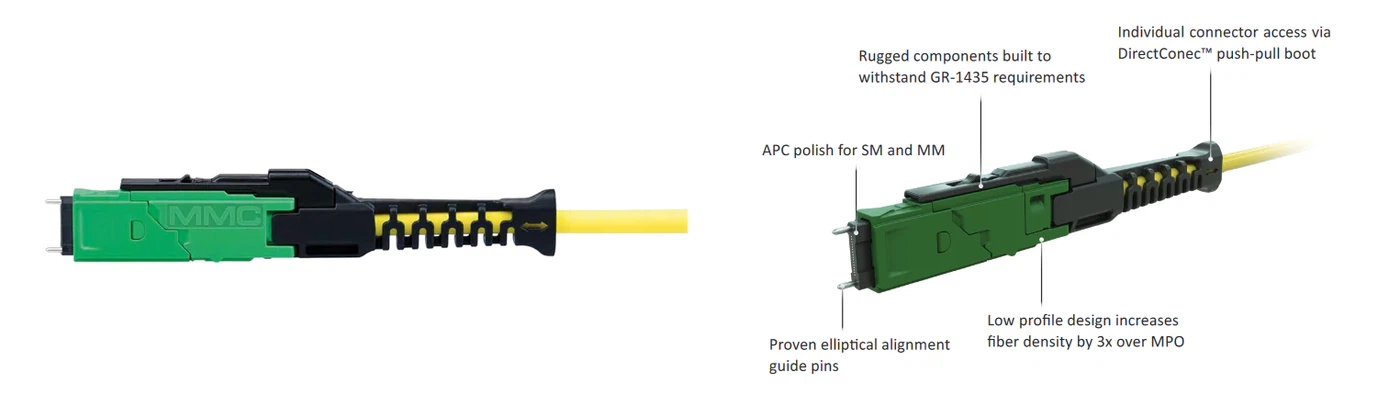
MMC connectors overcome MPO limitations in high-density environments, using VSFF design and TMT ferrule technology for superior performance.
Key Features of MMC Connectors
Very Small Form Factor (VSFF): Smaller footprint enables up to 3x higher fiber density per rack.
TMT Ferrule Technology: Precision ferrules reduce insertion loss and improve alignment.
High Fiber Density: Supports 16, 24, or 48+ fibers, allowing efficient parallel transmission.
Optimized for AI and HPC: Designed for 800G and future 1.6T links.
Example: A 42U rack hosting an AI cluster with NVIDIA DGX systems can accommodate 288 fibers using MMC connectors, compared to 96 fibers with MPO, reducing cabling complexity and improving airflow.
Key Differences Between MMC and MPO
Size & Density
MPO: Standard size; rack density limited.
MMC: VSFF design; up to 3x more fibers per rack unit.
Example: Using MMC, data centers can achieve 288 fibers per 42U rack compared to 96 with MPO.
Fiber Count
MPO: 8, 12, 24 fibers.
MMC: Flexible; supports 16, 24, 48+ fibers.
Insertion Loss
MPO: ~0.35 dB typical 2.
MMC: ~0.25 dB with TMT ferrules, minimizing signal degradation in dense links.
Installation & Handling
MPO: Established procedures; easier for legacy teams.
MMC: Requires precise handling and trained personnel; supports compact, organized cabling.
Tip: Provide hands-on training for MMC ferrule handling to maintain low insertion loss.
Scalability (AI / HPC)
MPO: Adequate for 40G/100G legacy deployments.
MMC: Designed for AI clusters, hyperscale environments, and 800G/1.6T future deployments.
MMC vs MPO: Performance Comparison Table
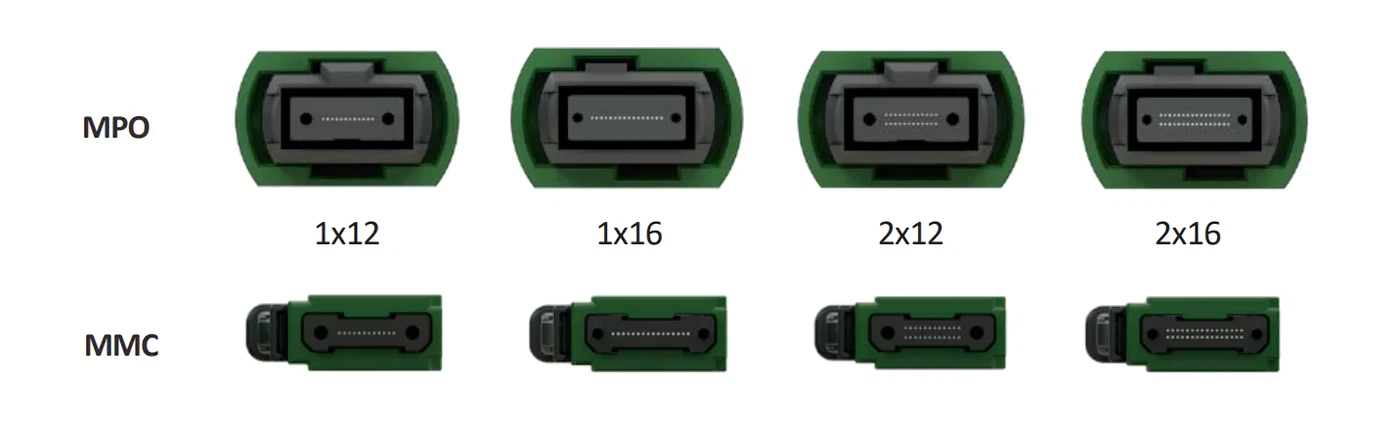
| Feature | MPO Connector | MMC Connector | Recommendation |
|---|---|---|---|
| Size & Form Factor / Density | Standard size; typical 1RU panels have limited port counts. | Ultra-compact VSFF design; up to 3× the port density in the same rack space. | MMC for high-density racks |
| Ferrule Design | Standard MT ferrule with fibers in a single row (8, 12, 24 fibers). | TMT ferrule with vertically stacked fibers (16, 24 fibers in a much smaller footprint). | MMC for low-loss, high-density applications |
| Fiber Count / Common Counts | 8, 12, 24 (also 32, 48) | 16, 24, 48+ | MMC for scalability |
| Insertion Loss | ~0.35 dB typical | ~0.25 dB with TMT ferrules | MMC for low-loss applications |
| Installation / Handling | Standard push-pull; polarity managed via A/B/C keying. | DirectConec™ push-pull sleeve for easier operation in high-density environments; requires training. | MPO for legacy, MMC for next-gen |
| AI/HPC Readiness / Primary Use Case | Mainstream data centers, enterprise networks, 40G/100G/400G applications. | Optimized for AI clusters, hyperscale data centers, and 800G/1.6T future deployments. | MMC preferred |
| Cost | Lower upfront | Higher upfront (but saves rack space and reduces cabling complexity) | MPO if cost-sensitive |
Takeaway: MMC connectors excel in density, performance, ferrule innovation, and future-proofing for AI/HPC data centers, while MPO connectors remain suitable for legacy deployments and cost-conscious projects.
Real-World Case: High-Density Fiber Deployment
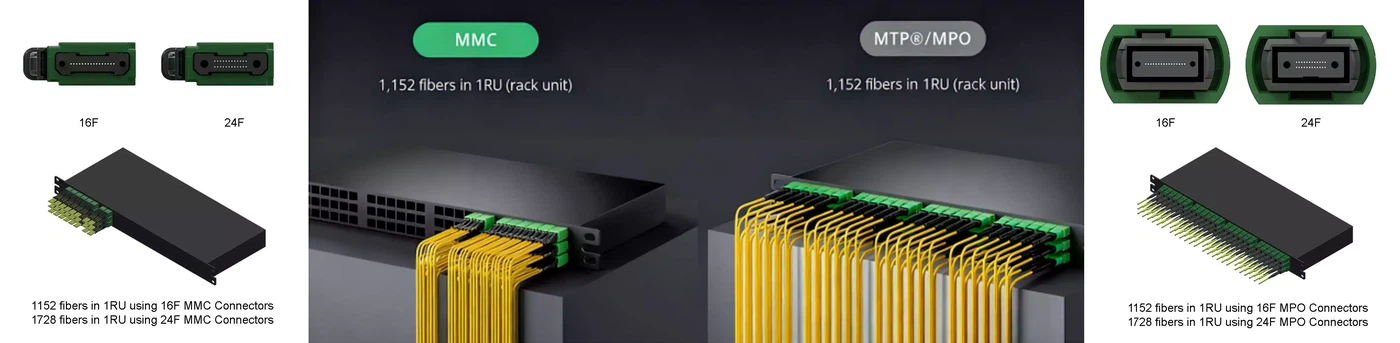
In modern AI and HPC data centers, high-density cabling is a critical consideration for rack design. Using 16-fiber MPO connectors, a single 1RU panel can accommodate up to 1,152 fibers. With 16-fiber MMC connectors, the same number of fibers requires only one-third of the space.
Expanding further, 24-fiber MPO connectors allow a 1RU panel to support 1,728 fibers. Using 24-fiber MMC connectors, the same 1,728 fibers can fit in 1RU while still occupying only one-third of the space compared to MPO.
This case clearly demonstrates the density advantage of MMC connectors: they significantly reduce rack space usage, simplify cable management, and improve airflow, providing an ideal solution for 800G and future 1.6T network expansions.
For real-world AI cluster implementations, see [NVIDIA DGX AI Cluster Case Studies] or [Hyperscale Data Center Whitepapers].
Why MMC Is Gaining Popularity in AI Data Centers
800G / 1.6T Bandwidth Demand
AI and HPC workloads require high-speed links that increase fiber count per rack.
Panel Space Optimization
MMC's compact form factor enables more fibers per rack unit, maximizing usable space.
High-Density Trend
Modern data centers aim to reduce cabling bulk while improving airflow and performance.
Example: AI clusters deploying NVIDIA DGX systems save space and improve cooling efficiency using MMC connectors.
Contact our fiber connectivity experts to plan MMC adoption in your next-gen data center.
MPO vs MMC: Which One Should You Choose?
Choose MPO if:
Your network relies on legacy MPO infrastructure
Budget constraints are critical
Installation teams are familiar with MPO procedures
Choose MMC if:
Planning new AI or hyperscale deployments
High-density rack utilization is required
Future-proofing for 800G/1.6T networks is a priority
Request consultation for a next-generation fiber deployment plan.
Can MMC Replace MPO?
While MMC offers superior performance, it will not immediately replace MPO:
Legacy Support: MPO remains in widespread use in existing data centers.
Mixed Deployments: MPO and MMC can coexist during phased upgrades.
Trend: MMC adoption is expected to increase rapidly in AI and hyperscale environments.
Migration Strategy: From MPO to MMC
Recommended Approach
Assessment: Identify racks that benefit from high-density MMC.
Phased Upgrade: Replace MPO ports gradually with MMC in new deployments.
Mixed Cabling: Maintain MPO for legacy applications; deploy MMC for high-density racks.
Training: Educate installation teams on MMC handling and best practices.
Practical Advice: Document polarity, fiber type, and insertion loss to ensure seamless migration.
Contact us for tailored MPO-to-MMC migration solutions.
FAQ
Q: Is MMC compatible with MPO?
A: Yes, with proper breakout cables or adapters, MMC and MPO can interoperate in hybrid deployments.
Q: Will MMC replace MPO completely?
A: Not in the short term. MPO remains prevalent for legacy deployments, but MMC adoption is increasing for AI and high-density networks.
Q: Is MMC more expensive than MPO?
A: MMC has higher upfront cost due to TMT ferrules and VSFF design, but long-term savings arise from higher density and reduced rack space.
Q: What applications require MMC?
A: AI clusters, hyperscale data centers, high-density 800G/1.6T deployments.
Conclusion
MPO connectors remain reliable for legacy deployments and budget-conscious projects. However, for modern AI, HPC, and hyperscale data centers, MMC connectors provide superior density, performance, and scalability.
Decision Guide:
Continue with MPO if your deployment is legacy or cost-driven.
Choose MMC for next-generation, high-density, AI-ready networks.
Contact our fiber connectivity experts to design or migrate your data center cabling for optimal performance.