

Author: Hayden
Modern enterprise buildings are experiencing a rapid increase in bandwidth demand due to the growth of cloud computing, IoT devices, high-definition video applications, and advanced wireless technologies such as Wi-Fi 6, Wi-Fi 6E, and emerging Wi-Fi 7 networks.
As horizontal cabling evolves from traditional 1G Ethernet to 2.5GBASE-T, 5GBASE-T, and 10GBASE-T, the fiber backbone cabling that connects building floors, network rooms, and aggregation switches must scale accordingly.
Today, many organizations deploy 40G and 100G fiber backbone networks, while new infrastructure designs already prepare for future 400G and 800G optical upgrades.
At Spring Optical, we provide high-density MPO/MTP trunk cable solutions designed for data centers, enterprise buildings, telecom networks, and FTTH deployments. Our pre-terminated backbone infrastructure enables fast installation, low insertion loss, and simplified migration from 10G to 100G and beyond.
Key Takeaways
Fiber backbone cabling connects equipment rooms and telecommunications rooms inside building networks.
Modern enterprise infrastructure increasingly requires 40G and 100G fiber backbone speeds.
MPO/MTP trunk cables enable high-density parallel fiber transmission for backbone architecture.
OM4 and OM5 multimode fiber are widely used for high-speed building backbone networks.
Pre-terminated MPO backbone infrastructure simplifies installation and supports future 400G upgrades.
What Is Fiber Backbone Cabling in Building Networks?
Fiber backbone cabling is the high-capacity optical infrastructure that interconnects major network distribution points within a building.
It typically connects:
Equipment Room (ER)
Main Cross-Connect (MC)
Telecommunications Rooms (TR)
Unlike horizontal cabling that connects end devices, building fiber backbone networks aggregate traffic from multiple access switches and wireless access points.
The primary functions of fiber backbone cabling include:
Connecting network rooms across multiple floors
Aggregating traffic from horizontal networks
Supporting high-speed Ethernet transmission
Providing scalable infrastructure for future upgrades
Because backbone networks carry aggregated traffic, they must support significantly higher bandwidth than horizontal cabling systems.
Why Fiber Backbone Cabling Must Exceed Horizontal Network Speeds
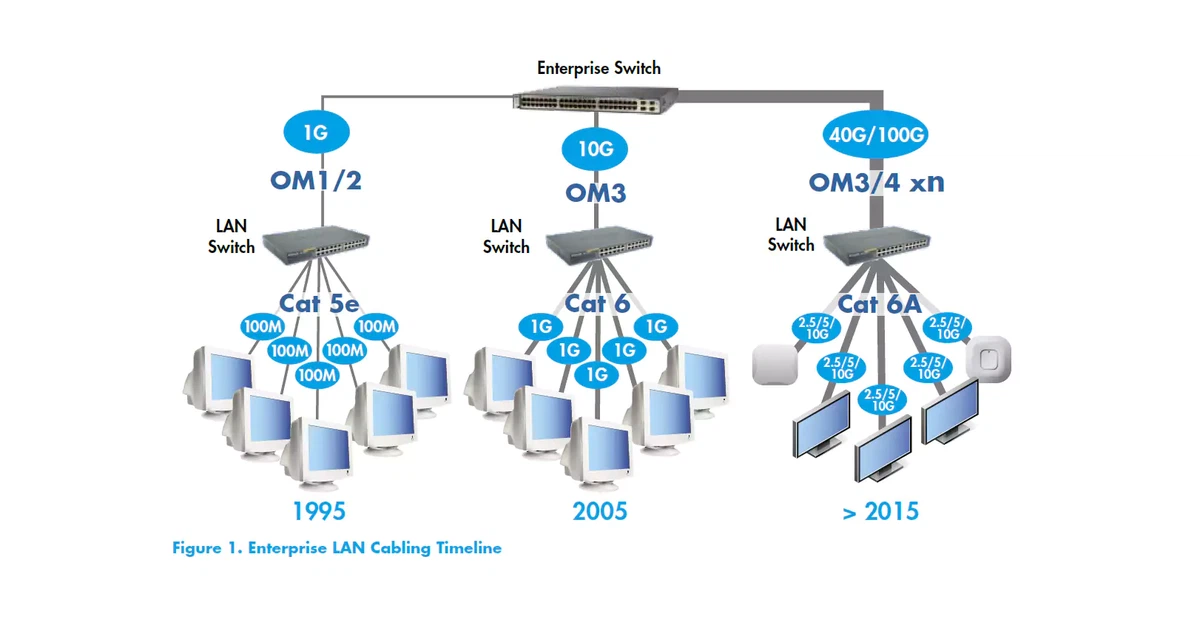
A common design principle in structured cabling is that the backbone network should provide approximately ten times the bandwidth of horizontal links.
| Era | Horizontal Network | Typical Backbone |
|---|---|---|
| Early Ethernet | 100 Mbps | 1G fiber backbone |
| Gigabit era | 1G Ethernet | 10G fiber backbone |
| Modern networks | 2.5G / 5G / 10G | 40G / 100G fiber backbone |
This design ensures the backbone network can handle aggregated traffic from multiple switches, servers, and wireless access points.
With the rapid expansion of Wi-Fi devices, cloud applications, and IoT systems, fiber backbone infrastructure has become the most critical component of modern building networks.
For new building deployments, OM4 or OM5 multimode fiber is typically recommended to support high-speed parallel optics.
Building Fiber Backbone Architecture and Topology
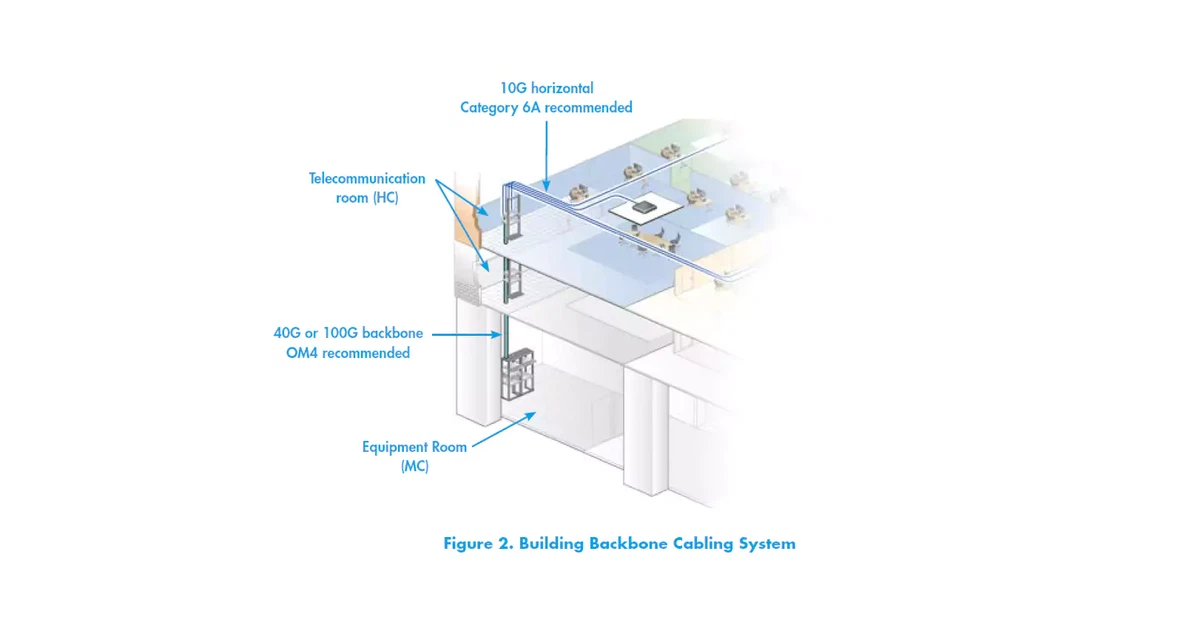
Modern building networks typically adopt a hierarchical star topology.
In this architecture:
The Equipment Room (ER) houses core network equipment
The Main Cross-Connect (MC) manages backbone connections
Each floor contains a Telecommunications Room (TR)
Backbone fibers connect the central equipment room to each telecommunications room.
Architecture overview:
Equipment Room (ER)
│
Main Cross-Connect (MC)
│
┌────┼────┐
TR1 TR2 TR3
This topology provides several advantages:
centralized network management
simplified troubleshooting
scalable expansion for future growth
Large campus networks may also deploy Intermediate Cross-Connects (ICs) between MC and TRs.
Recommended Fiber Types for Fiber Backbone Cabling
Selecting the appropriate fiber type is essential for reliable fiber backbone cabling systems.
| Fiber Type | Distance | Advantages |
|---|---|---|
| OM3 Multimode | 100–300 m | cost-effective, widely deployed |
| OM4 Multimode | 150–550 m | optimized for 40G/100G |
| OM5 Multimode | 150–400 m | supports SWDM technology |
| OS2 Singlemode | >550 m | long distance, future-proof |
For most enterprise buildings, OM4 multimode fiber provides the best balance between performance and cost.
It is widely used for 40G and 100G fiber backbone deployments.
10G Fiber Backbone Cabling Using LC Duplex Architecture
Traditional 10G fiber backbone networks commonly use LC duplex connectors.
In this architecture:
one fiber transmits data (Tx)
one fiber receives data (Rx)
Typical components include:
LC patch panels
duplex fiber optic cables
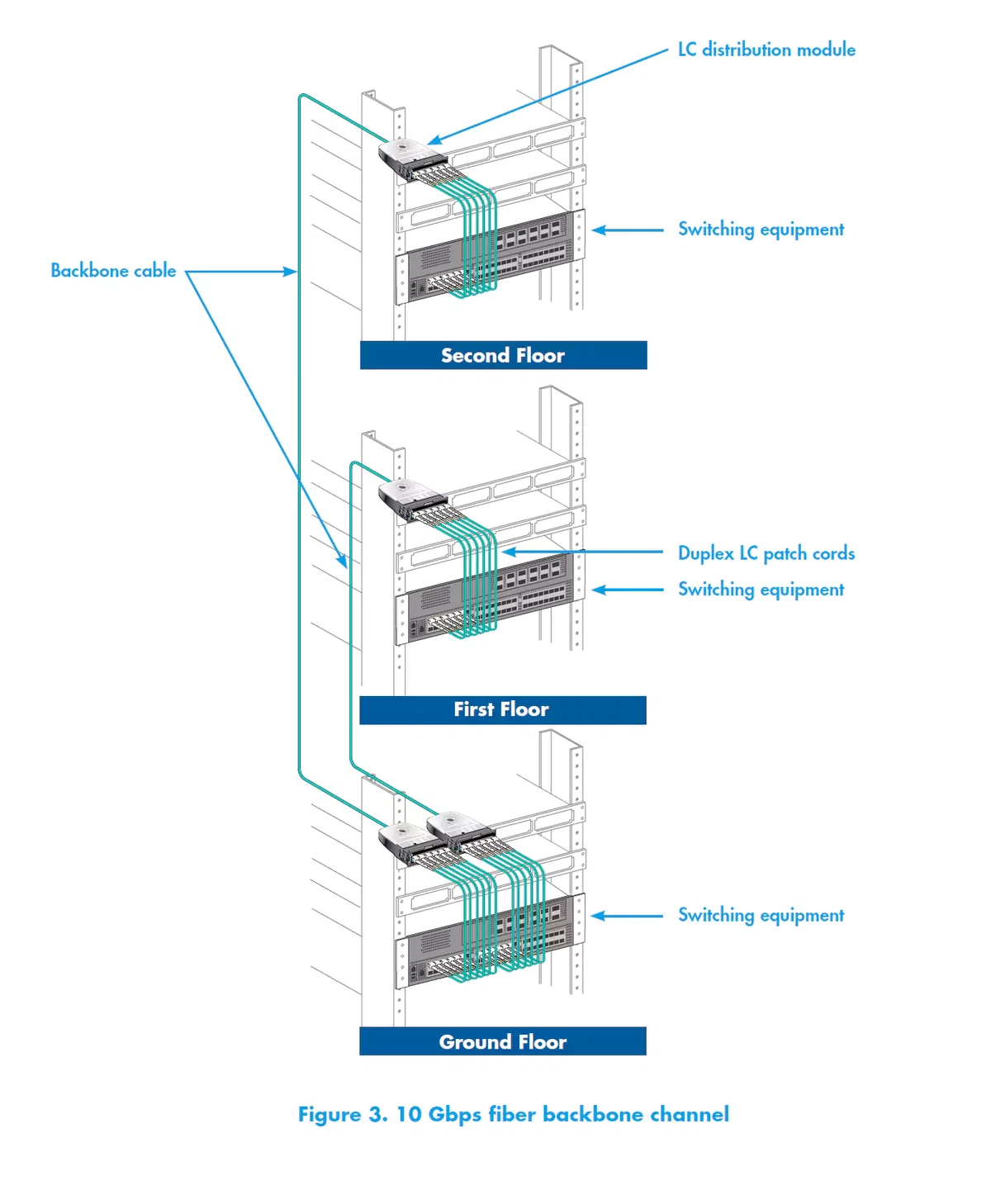
This serial transmission model works efficiently for 10GBASE-SR Ethernet links.
However, when network speeds increase to 40G and 100G, the industry shifts to parallel optical transmission technologies.
MPO/MTP Trunk Cables for 40G and 100G Fiber Backbone
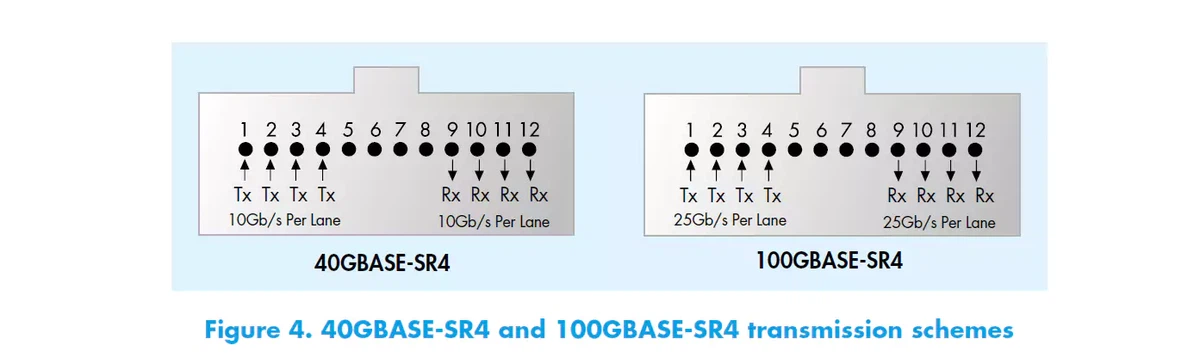
High-speed Ethernet standards such as 40GBASE-SR4 and 100GBASE-SR4 require parallel fiber transmission.
Transmission requirements:
| Standard | Fiber Count | Lane Speed |
|---|---|---|
| 40GBASE-SR4 | 8 fibers | 10 Gbps |
| 100GBASE-SR4 | 8 fibers | 25 Gbps |
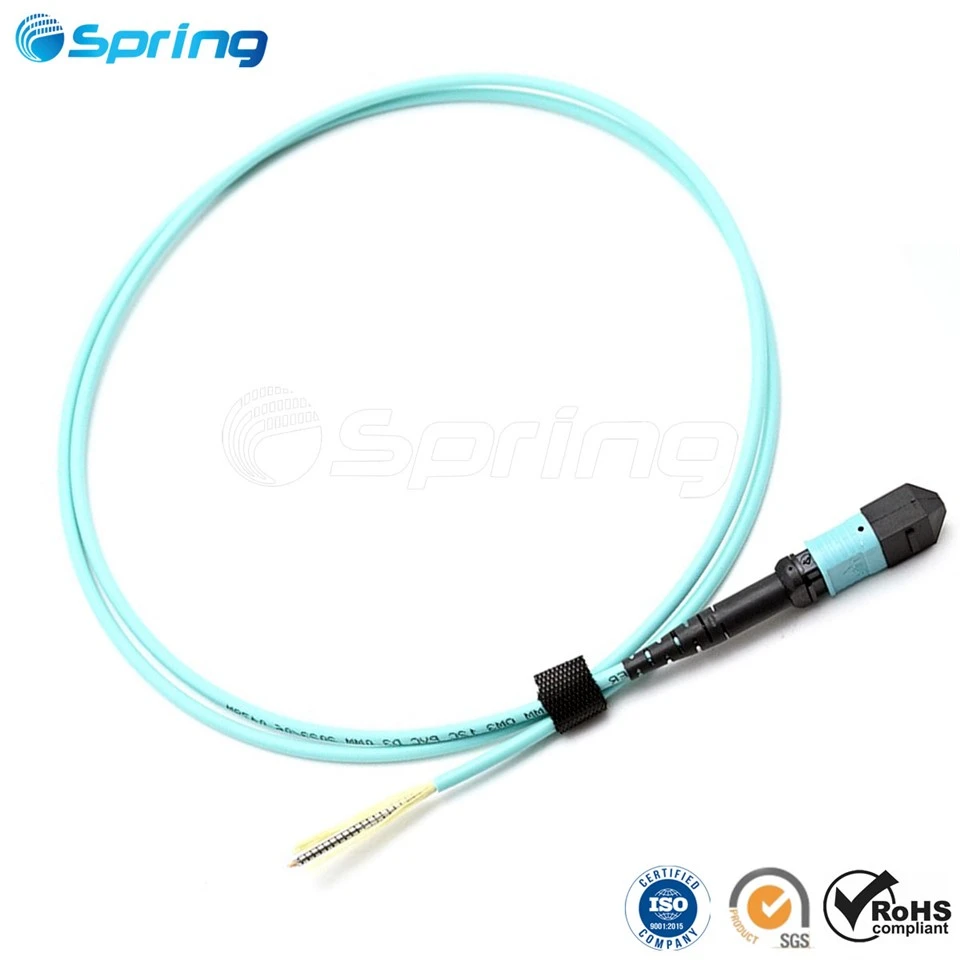
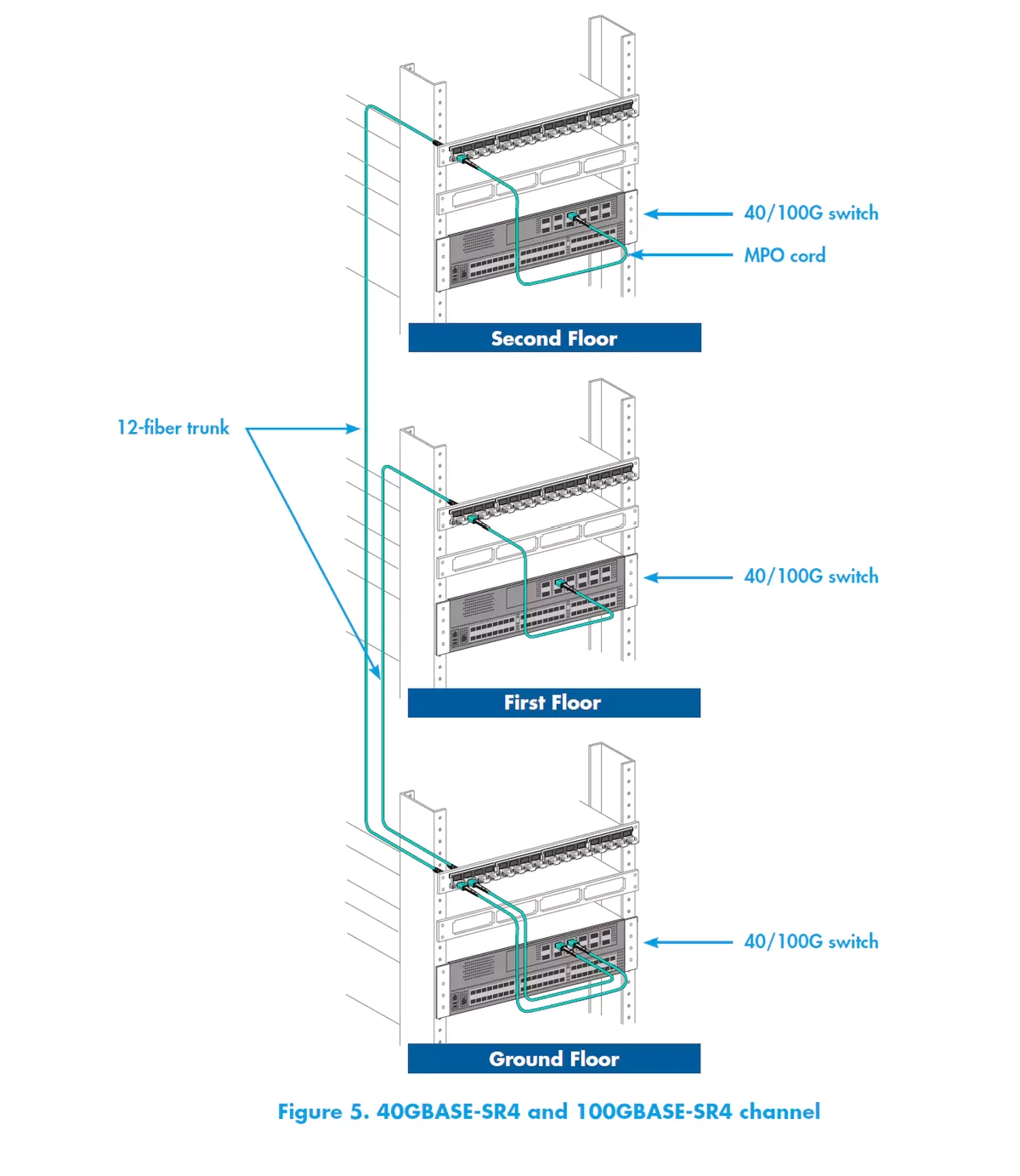
To support this architecture, networks use MPO/MTP trunk cables, which integrate multiple fibers into a single high-density connector.
Typical backbone configurations include:
| MPO Trunk | Fiber Count | Application |
|---|---|---|
| 2× MPO-12 | 24F | standard building backbone |
| 4× MPO-12 | 48F | medium density |
| 6× MPO-12 | 72F | high capacity backbone |
| 8× MPO-12 | 96F | large enterprise networks |
| 6× MPO-24 | 144F | hyperscale environments |
These MPO backbone cables simplify cable routing in vertical risers and data pathways.
Advantages of MPO/MTP Backbone Cabling
Compared with traditional duplex fiber systems, MPO/MTP backbone infrastructure offers several advantages.
High Fiber Density
MPO connectors support multiple fibers in a single interface, allowing efficient use of limited cable pathways.
Faster Installation
Pre-terminated MPO trunk cables reduce installation time and eliminate onsite fiber termination.
Lower Optical Loss
Factory-polished connectors ensure consistent optical performance and low insertion loss.
Future Network Scalability
MPO infrastructure supports high-speed upgrades including:
40G Ethernet
100G Ethernet
400G networks
next-generation optical architectures
How to Upgrade Fiber Backbone from 10G to 40G or 100G
Many organizations upgrade their backbone networks without replacing the entire cabling infrastructure.
A typical migration strategy includes:
Step 1 – Deploy MPO trunk cables during initial installation
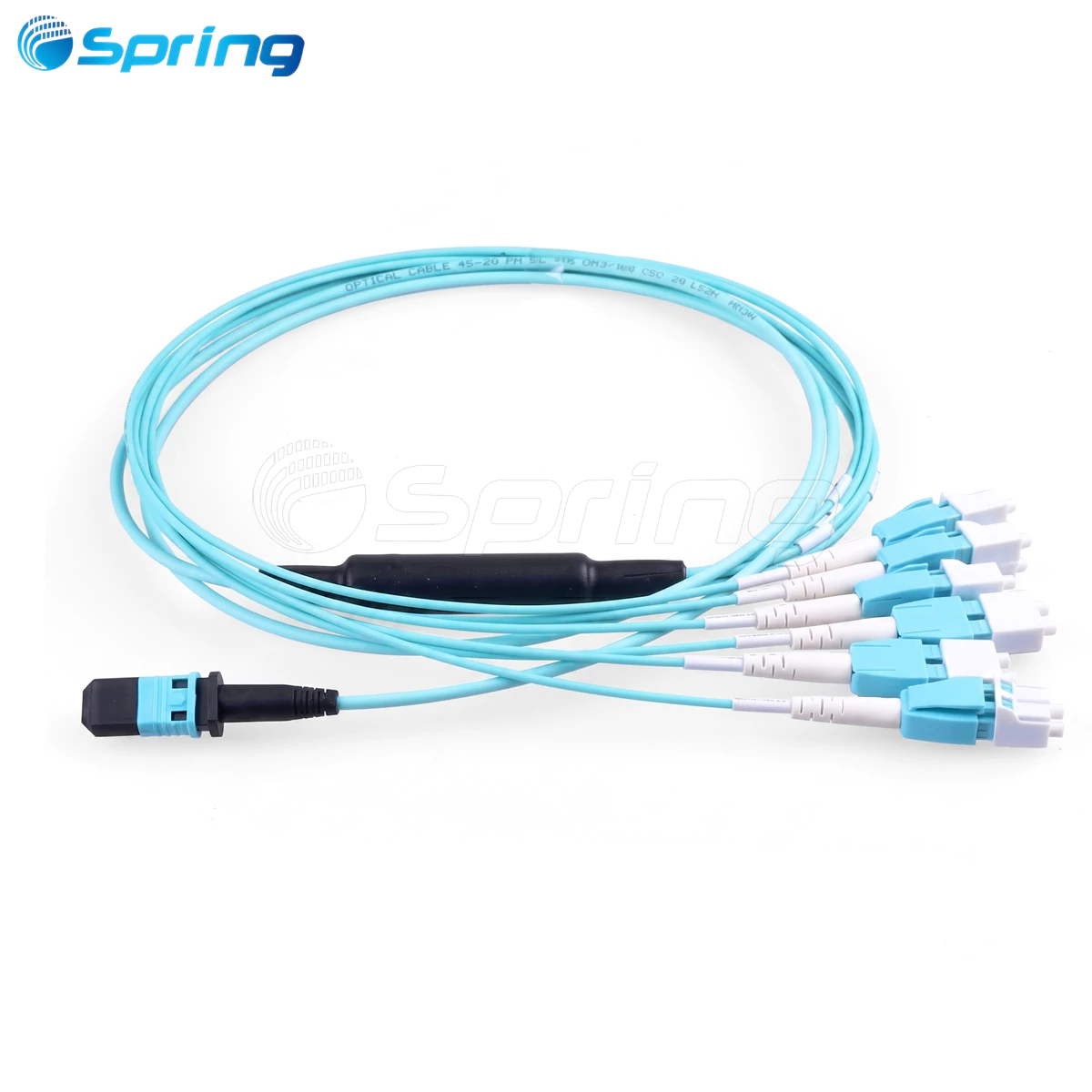
Step 2 – Use MPO-to-LC harness cables for 10G equipment
Step 3 – Upgrade switches and modules to 40G or 100G
Step 4 – Reuse the existing MPO trunk infrastructure

This approach significantly reduces:
upgrade costs
network downtime
installation complexity
Transmission Distances for 10G, 40G, and 100G Fiber Backbone
Transmission distance depends on the selected fiber type.
| Application | OM3 | OM4 / OM5 |
|---|---|---|
| 10GBASE-SR | 300 m | 550 m |
| 40GBASE-SR4 | 100–135 m | 150–170 m |
| 100GBASE-SR4 | 70–85 m | 100–120 m |
Under optimized conditions, advanced VCSEL transceivers can extend reach to nearly 400 meters on OM4 fiber.
Upgrading Legacy LC Backbone to MPO Infrastructure
Many existing buildings still operate LC-based backbone networks.
These systems can be upgraded using MPO-to-LC fanout cables.
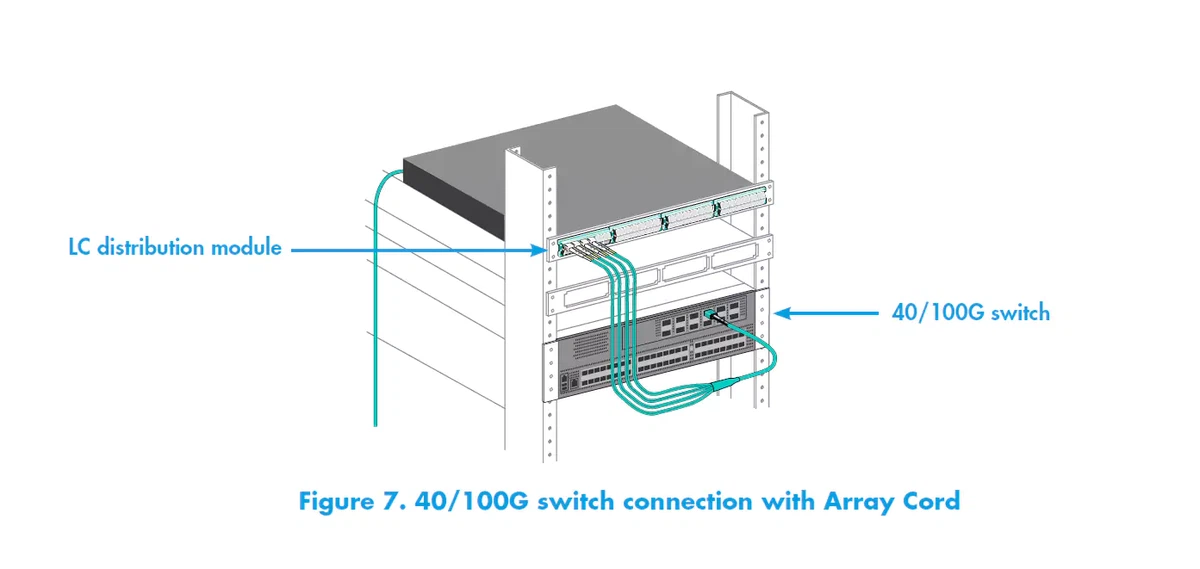
Advantages include:
compatibility with legacy LC equipment
simplified migration to high-speed networks
reduced need for new fiber installation
Fanout cables convert multiple LC connectors into a single MPO interface compatible with modern optical modules.
Pre-Terminated MPO/MTP Fiber Backbone for New Buildings
New building projects increasingly adopt pre-terminated MPO/MTP backbone cabling systems.
Key advantages include:
Faster Deployment
Factory-terminated connectors enable plug-and-play installation.
Higher Fiber Density
Mini-diameter trunk cables save valuable space in vertical risers.
Reduced Installation Risk
Protective pulling sleeves protect connectors during installation.
Future Scalability
MPO infrastructure supports:
10G Ethernet
40G / 100G networks
future 400G / 800G architectures
How to Design a 40G/100G Fiber Backbone Network
Network engineers typically follow several key steps when designing high-speed fiber backbone architecture.
Step 1 – Select OM4 or OM5 fiber
Step 2 – Deploy hierarchical star topology (ER → TR)
Step 3 – Install high-density MPO/MTP trunk cables
Step 4 – Use breakout modules or harness cables
Step 5 – Plan spare fibers for future expansion
This design approach ensures long-term scalability and simplified network management.
FAQ: Fiber Backbone Cabling for 40G/100G Networks
What is fiber backbone cabling?
Fiber backbone cabling is the high-capacity optical infrastructure that connects equipment rooms, telecommunications rooms, and distribution points inside a building network.
Why use MPO trunk cables in backbone networks?
MPO trunk cables provide high fiber density and support parallel optical transmission required for 40G and 100G Ethernet networks.
Which fiber type is best for building backbone networks?
OM4 multimode fiber is widely recommended for 40G and 100G building backbone cabling, while OS2 fiber is used for longer distances.
Can existing 10G networks be upgraded to 100G?
Yes. Many organizations upgrade using MPO trunk cables and breakout modules, allowing the existing backbone infrastructure to support higher speeds.
OM4 vs OM5 fiber for backbone networks?
OM4 fiber is sufficient for most enterprise deployments, while OM5 supports SWDM technologies and future high-capacity optical systems.
Conclusion: Future-Proof Building Fiber Backbone Networks
As enterprise networks continue to evolve, fiber backbone cabling becomes the foundation of modern connectivity.
Deploying OM4 or OM5 multimode fiber combined with MPO/MTP trunk cables allows organizations to support:
10G access networks
40G and 100G aggregation layers
future upgrades to 400G and beyond
By implementing scalable backbone architecture today, network operators and building owners can ensure their infrastructure remains reliable, efficient, and ready for future bandwidth demands.
Spring Optical provides complete MPO/MTP fiber backbone solutions, including trunk cables, breakout assemblies, and customized pre-terminated cabling systems for enterprise and data center networks.