

Author: Hayden
MPO/MTP Conversion Patch Cords Explained: 1×16–2×12, 1×24–3×8, and 2×12–3×8 Architectures for 400G/800G AI Data Centers
As AI training clusters, GPU fabrics, and 400G/800G spine-leaf architectures continue scaling, traditional point-to-point fiber patching is no longer sufficient.
Modern AI data centers require parallel optics compatibility, higher fiber efficiency, and flexible structured cabling architectures.
This is where MPO/MTP conversion patch cords become critical.
In this guide, we explain:
What MPO/MTP conversion patch cords are
Why they are essential in AI data centers
The differences between 1×16–2×12, 1×24–3×8, and 2×12–3×8 architectures
How they support BASE-12 and BASE-24 structured cabling
Why MPO/MTP Conversion Cables Matter in AI Data Centers
AI data centers heavily deploy:
400G QSFP-DD SR8
200G QSFP56 SR4
100G QSFP28 SR4
40G QSFP+ SR4
High-density spine-leaf topologies
These optical modules use parallel transmission lanes (multiple Tx/Rx channels) instead of duplex fiber.
As networks migrate from 40G → 100G → 200G → 400G → 800G, efficient fiber core utilization becomes a design priority.
MPO/MTP conversion patch cords allow operators to:
Maximize fiber utilization within trunk systems
Support mixed-rate deployments
Enable staged network upgrades
Maintain compatibility with BASE-12 and BASE-24 architectures
Avoid costly trunk replacement
For AI infrastructure, where port density and bandwidth scaling are continuous requirements, conversion assemblies provide architectural flexibility.
What Are MPO/MTP Conversion Patch Cords?
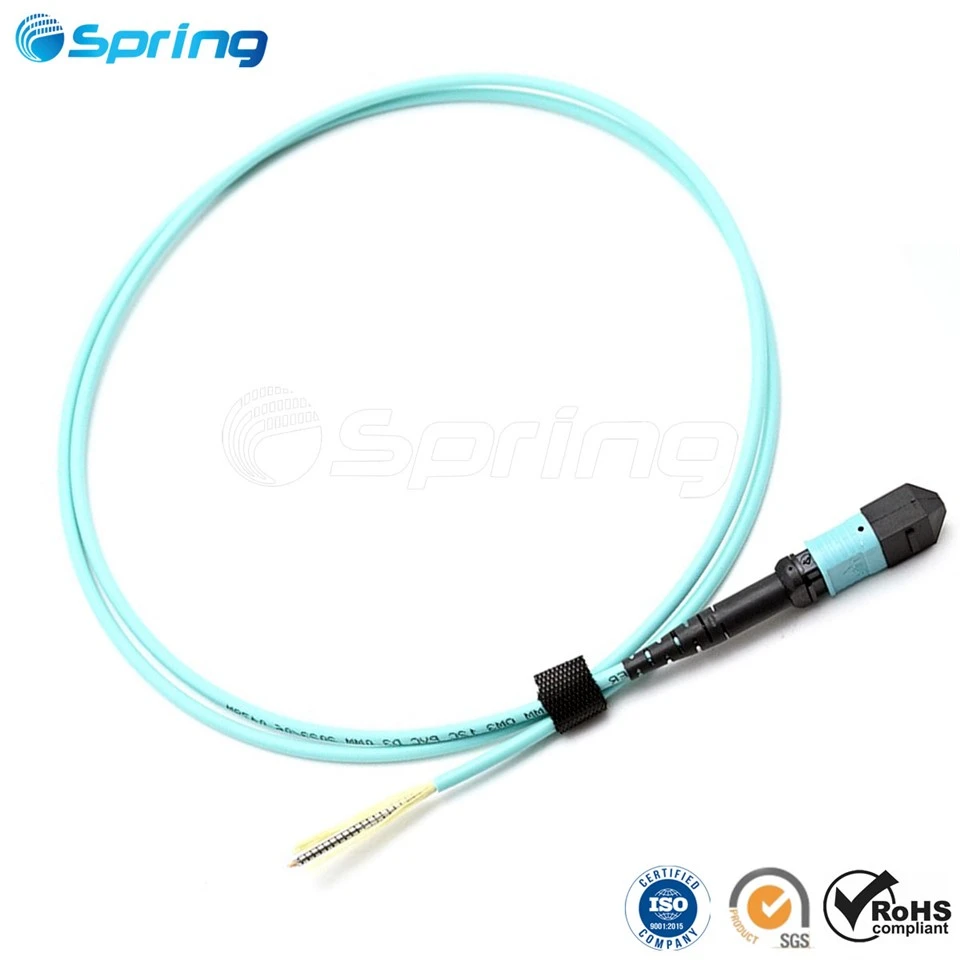
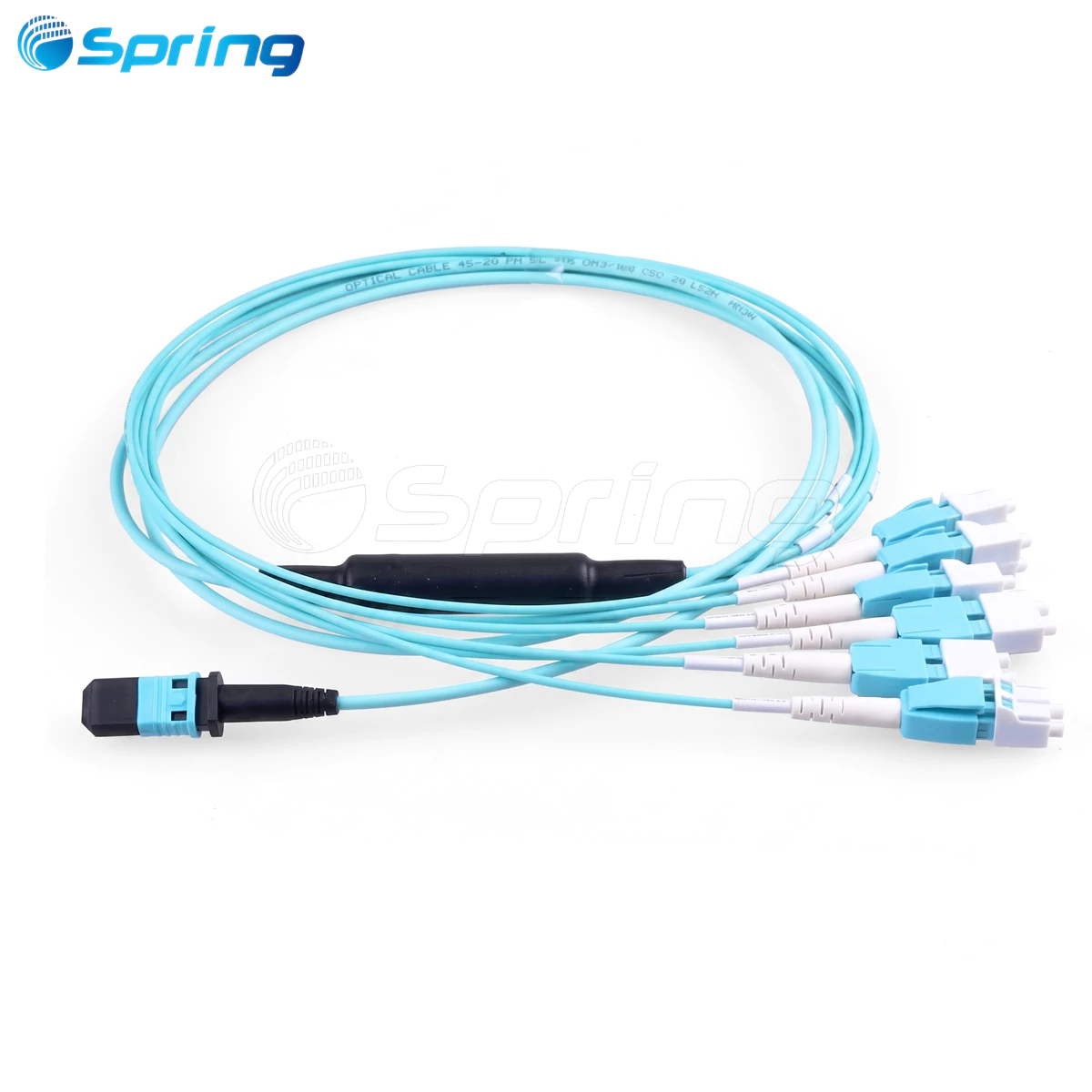
Unlike standard trunk or breakout cables, MPO/MTP conversion cables redistribute fiber counts between different connector configurations.
They are commonly categorized as:
MPO/MTP to MPO/MTP trunk patch cords
MPO/MTP breakout patch cords
MPO/MTP conversion patch cords (fiber count redistribution)
This article focuses specifically on conversion structures increasingly used in AI data center deployments.
01. MPO/MTP – 2×MPO/MTP Patch Cord (1×16 to 2×12)
Structure

One end: 1 × 16-fiber MPO/MTP connector
Other end: 2 × 12-fiber MPO/MTP connectors
Typical Application

This architecture is widely deployed in:
400G QSFP-DD SR8 environments
Hybrid 200G/400G data center networks
AI cluster aggregation layers
A 400G SR8 module operates with:
8 transmit fibers
8 receive fibers
Total: 16 fibers
The 1×16 to 2×12 conversion redistributes the 16 active fibers into dual 12-fiber interfaces for integration within structured cabling systems.
Why It Is Important
Supports BASE-16 and hybrid BASE-12 systems
Improves port adaptability
Preserves trunk infrastructure investment
Enables coexistence of multiple interface standards
In high-density AI fabrics, this structure helps maintain architecture flexibility during migration phases.
02. MPO/MTP – 3×MPO/MTP Patch Cord (1×24 to 3×8)
Structure

One end: 1 × 24-fiber MPO/MTP connector
Other end: 3 × 8-fiber MPO/MTP connectors
This configuration is primarily used in BASE-24 structured cabling systems.
Application Scenario 1: 40G / 100G Structured Cabling

Both:
40G QSFP+ SR4
100G QSFP28 SR4
Use 4 parallel bidirectional channels (4Tx + 4Rx = 8 fibers).
A 24-fiber trunk can be efficiently divided into three 8-fiber interfaces.
Benefits include:
Full utilization of 24-fiber trunk cables
Reduced unused fiber waste
Improved aggregation layer scalability
Application Scenario 2: 120G CXP to 40G QSFP+ SR4

A 120G CXP module contains:
12 parallel bidirectional channels
10G per channel
Each 40G QSFP+ SR4 module uses:
4 channels
Therefore:
1 × 120G CXP = 3 × 40G QSFP+ SR4
The 1×24 to 3×8 conversion patch cord aligns perfectly with this channel distribution.
This architecture was widely used in early HPC systems and remains relevant in legacy upgrade environments.
03. 2×MPO/MTP – 3×MPO/MTP Patch Cord (2×12 to 3×8)
Structure

One end: 2 × 12-fiber MPO/MTP connectors
Other end: 3 × 8-fiber MPO/MTP connectors
This solution is designed for BASE-12 architectures.
Application Scenario 1: 40G to 10G Migration

In 40G-to-10G migration environments:
One side connects to three 40G QSFP+ SR4 modules
The opposite side connects through two MPO-LC breakout assemblies
Twelve 10G SFP+ SR modules are supported
Within a BASE-12 trunk system, this allows:
Incremental network upgrades
Trunk preservation
Channel redistribution without backbone replacement
Application Scenario 2: 40G / 100G Structured Cabling

Using a 2×12 to 3×8 conversion cable:
Three 40G or 100G modules can be interconnected
BASE-12 fiber resources are fully optimized
Port density is improved
This is particularly valuable in large-scale AI and cloud environments.
BASE-12 vs BASE-24 vs BASE-16: Why Architecture Selection Matters
AI data centers now face mixed deployment environments:
| Architecture | Typical Fiber Count | Common Application |
|---|---|---|
| BASE-12 | 12 fibers | 40G / 100G legacy systems |
| BASE-24 | 24 fibers | Aggregation and high-density distribution |
| BASE-16 | 16 fibers | 400G SR8 / next-gen parallel optics |
Conversion MPO assemblies bridge these architectures without full infrastructure redesign.
Key Technical Considerations for MPO/MTP Conversion Cables
Unlike duplex LC patch cords, multi-fiber MPO/MTP assemblies require strict configuration control.
Male vs Female Connector Matching
MPO connectors are available in:
Male (with guide pins)
Female (without guide pins)
Incorrect pairing will prevent physical mating.
Polarity Management (Type A / B / C)
Incorrect polarity configuration can cause:
Tx/Rx misalignment
Link failure
Downtime in high-speed AI fabrics
Precise polarity design is critical for 400G/800G deployments.
Growing Demand for MPO Conversion Solutions in AI Data Centers
As the adoption of:
400G QSFP-DD
800G OSFP
High-density GPU clusters
Spine-Leaf architectures
accelerates globally, demand is increasing for:
MPO-16 solutions
BASE-24 trunk systems
Low-loss elite MTP assemblies
High-precision conversion cables
Structured fiber systems must now support flexible channel redistribution to accommodate AI traffic growth.
Conversion MPO/MTP patch cords are becoming a core component of scalable data center architecture.
Why Choose Spring as Your MPO/MTP Manufacturer
As a professional MPO/MTP manufacturer, Spring provides:
Precision-engineered conversion assemblies
Low insertion loss performance
High return loss stability
Strict polarity and pin configuration control
Custom fiber count architecture design
Factory pre-terminated and fully tested solutions
Our MPO assemblies are designed for hyperscale AI data centers, cloud infrastructure, and high-performance computing facilities.
Conclusion
MPO/MTP conversion patch cords are essential components in modern AI data center structured cabling systems.
They:
Improve fiber core utilization
Enable smooth bandwidth migration
Support BASE-12, BASE-24, and BASE-16 architectures
Ensure compatibility with parallel optical modules
As AI infrastructure continues expanding toward 800G and beyond, flexible MPO conversion architectures will play an increasingly critical role.
If you are designing or upgrading an AI data center, Spring can provide customized MPO/MTP conversion solutions tailored to your structured cabling architecture.