

Author: CoCo coco@springoptic.com
Fiber optic tools are specialized instruments designed for the precise installation, termination, maintenance, testing, and troubleshooting of optical fiber cables in FTTH and telecom networks. These tools protect the fragile glass fiber while ensuring clean end-faces, minimal signal loss, and fast fault location - essential for building reliable gigabit and multi-gigabit FTTH networks.
Introduction
The global expansion of Fiber to the Home (FTTH) continues at full speed in 2026. For telecom operators and ISPs, using the right fiber optic tools directly impacts installation speed, network quality, and long-term operational costs.
This comprehensive guide covers the must-have fiber optic tools for FTTH deployments - from cable preparation to testing - with detailed specifications, step-by-step instructions, professional tips, and practical comparisons tailored for field technicians and network engineers.
What Are Fiber Optic Tools?
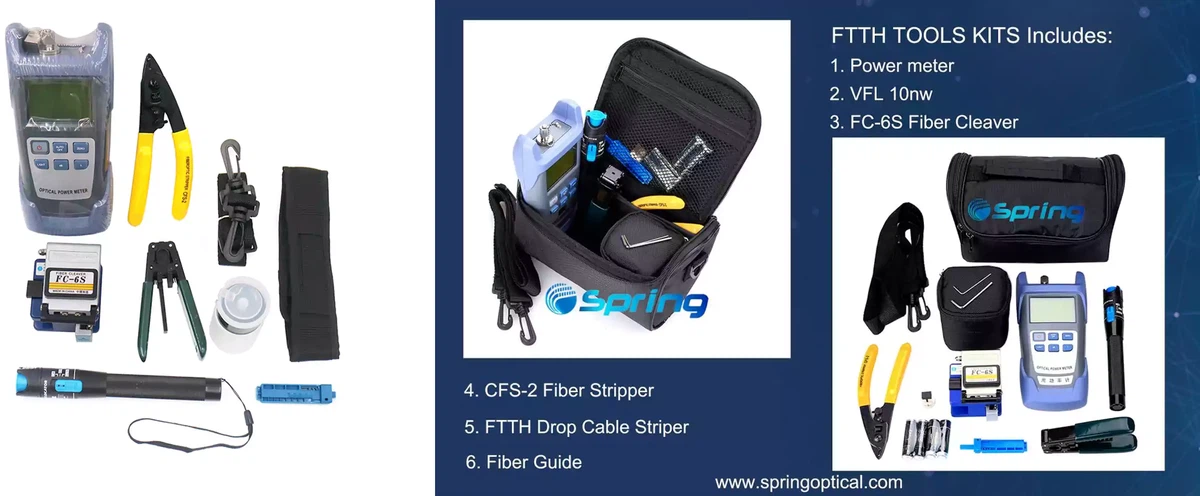
Fiber optic tools are purpose-built handheld and bench instruments used to handle, prepare, terminate, and test optical fiber cables in telecommunications networks.
Unlike general-purpose tools, they are engineered to safeguard the delicate 125 μm glass cladding while delivering micron-level precision required for low-loss connections.
Main categories include:
·Preparation tools (strippers and cleavers)
·Fault location devices (Visual Fault Locator)
·Power measurement instruments (Optical Power Meter)
·Specialized tools for FTTH drop cables
How Fiber Optic Tools Work
Most fiber optic tools operate using mechanical precision or optical principles:
·Mechanical tools employ sharp, hardened blades and controlled pressure to remove protective layers without damaging the glass core.
·Optical tools inject visible red light (VFL) or calibrated infrared light (power meter) to detect faults or measure signal strength.
·The primary objective is to produce a clean, perpendicular fiber end-face (cleave angle typically < 0.5°) and verify that every connection meets IEC and Telcordia standards for insertion loss and return loss.
Key Fiber Optic Tools for FTTH
Fiber Optic Stripper
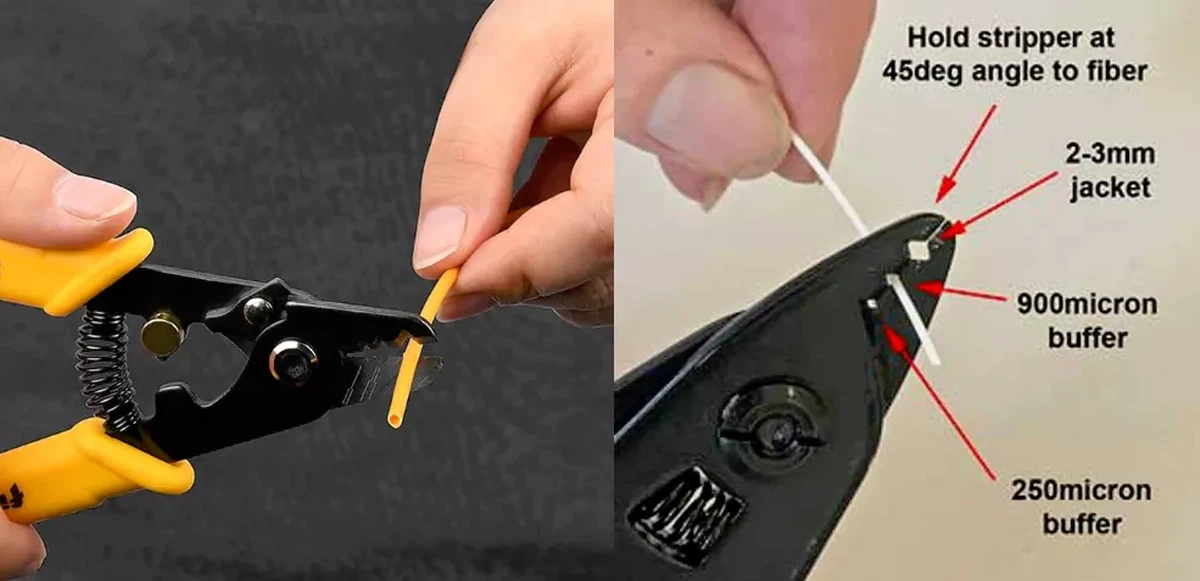
A fiber optic stripper is a specialized hand tool that safely strips different layers of fiber cables without nicking or damaging the glass core.
A precision hand tool used to remove the outer jacket, buffer, and coating layers of fiber optic cables.

Key Features of Fiber Optic Stripper:
Tri-hole design for 2–3 mm jackets, 600–900 µm buffers, and 250 µm coatings
High-temperature quenched carbon steel jaws for exceptional sharpness and durability
Safety lock mechanism to prevent accidental injury
Reinforced springs for high strength and fatigue resistance
Ergonomic non-slip rubber handle for extended field use
Adjustable tension via 1.5 mm Allen key
Large hole: 2 mm–3 mm outer jacket
Middle hole: 900 µm ~ 250 µm soft rubber buffer
Small hole: 250 µm–125 µm fiber coating
(Suggested Image: High-resolution photo of tri-hole fiber optic stripper with alt text "Tri-hole fiber optic stripper for FTTH drop cables and patch cords")
Fiber Optic Cleaver

A fiber optic cleaver is a precision cutting tool used to create a perfectly flat, mirror-like end-face on the optical fiber before splicing or terminating. This clean and perpendicular cleave is critical for achieving low insertion loss and high return loss in both mechanical and fusion splicing.
A fiber optic cleaver is a specialized instrument that precisely cuts the glass fiber at a controlled angle (typically < 0.5°), producing a smooth, defect-free end-face essential for high-quality, low-loss optical connections.
How It Works
The cleaver uses a diamond or tungsten carbide blade to score the fiber cladding, then applies controlled tension to create a clean break. This process ensures the fiber end-face is perpendicular to the axis and free of chips, lips, or hackle.
Mechanical Cleavers - Most common and cost-effective for field use. Suitable for single-fiber and ribbon fiber.
Laser Cleavers - Offer ultra-high precision with no physical contact, ideal for high-end data centers or laboratory environments (less common in standard FTTH deployments due to higher cost).
Cleave angle: ≤ 0.5° (typical)
Cleave length: 5–20 mm adjustable
Blade lifetime: 1,000 – 48,000 cleaves (depending on model and rotation)
Support for 250 µm coated fiber, 900 µm tight buffer, and ribbon fiber
Compact, lightweight design for easy field operation
Built-in fiber waste collector for safety and cleanliness
Proper cleaving is one of the most important steps in FTTH installation - a poor cleave can increase splice loss by 0.3 dB or more, significantly impacting overall link performance.
Visual Fault Locator (VFL)
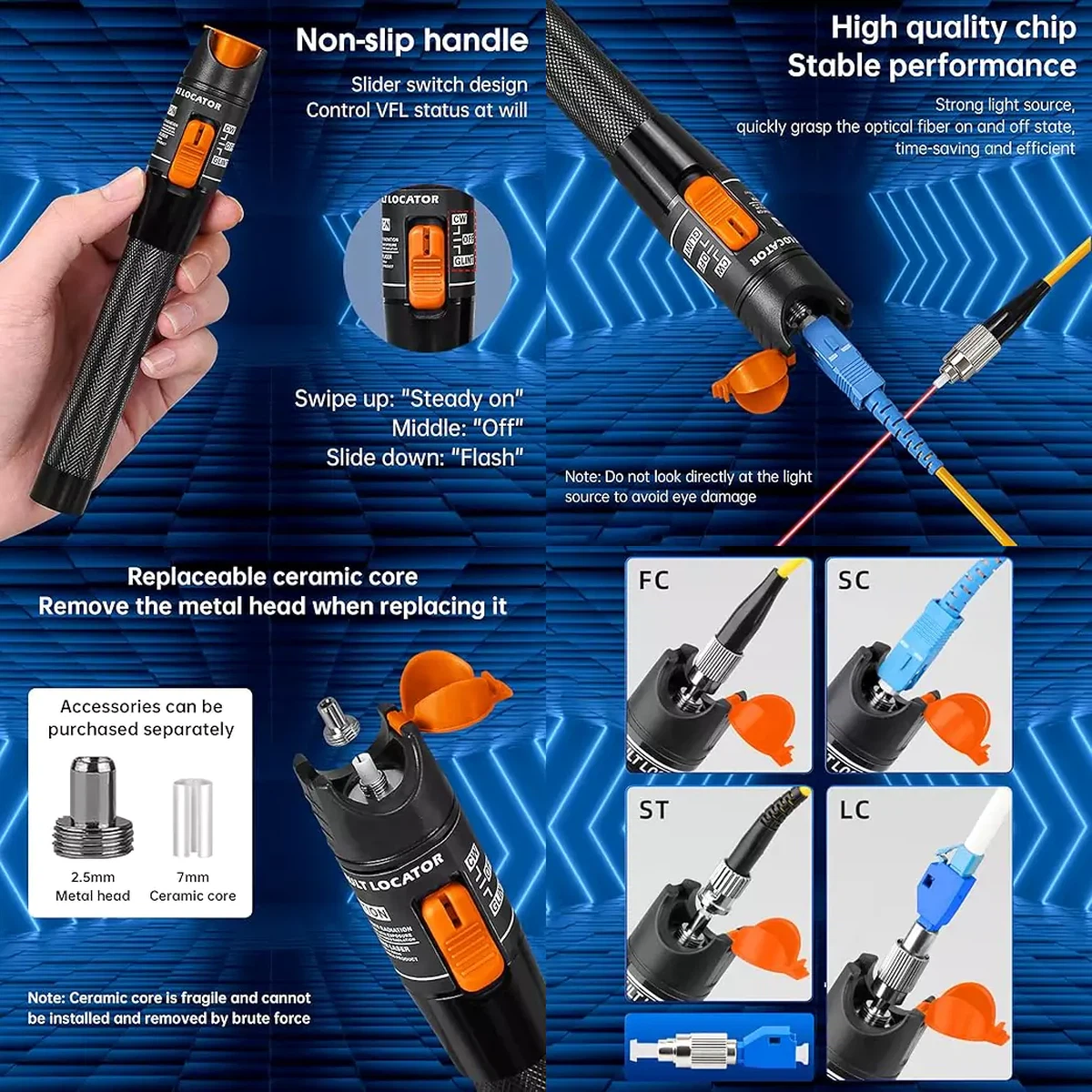
A compact red laser device used to quickly locate breaks, severe bends, or faulty splices in fiber cables.
A Visual Fault Locator (VFL) is a pen-shaped tool that injects visible 650 nm red light into the fiber. Light visibly leaks at any discontinuity, enabling instant fault identification without expensive equipment.
Wavelength: 650 nm ± 10 nm
Light Source: FP-LD laser
Output Power: 1 mW to 50 mW (10 mW+ recommended for FTTH)
Connector: 2.5 mm universal adapter
Operating Modes: CW or 2 Hz modulation
Battery Life: ≥10 hours (2 × AA batteries)
Weight: 160 g
Dimensions: 175 × 26 × 26 mm
Drop Cable Stripper
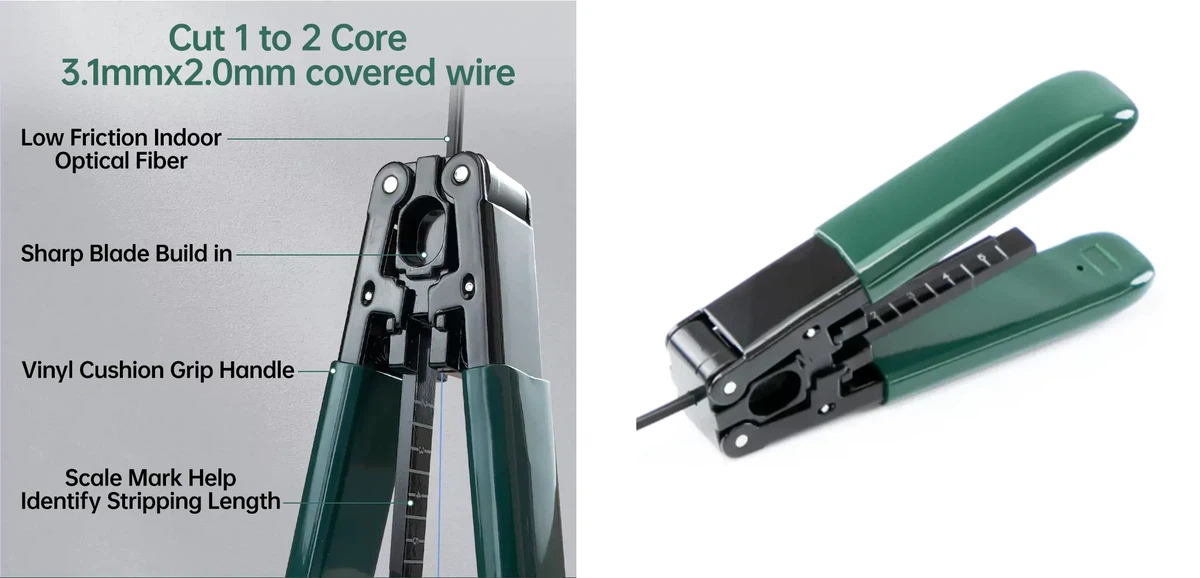
Specialized tool designed exclusively for FTTH flat drop cables (1-core & 2-core).
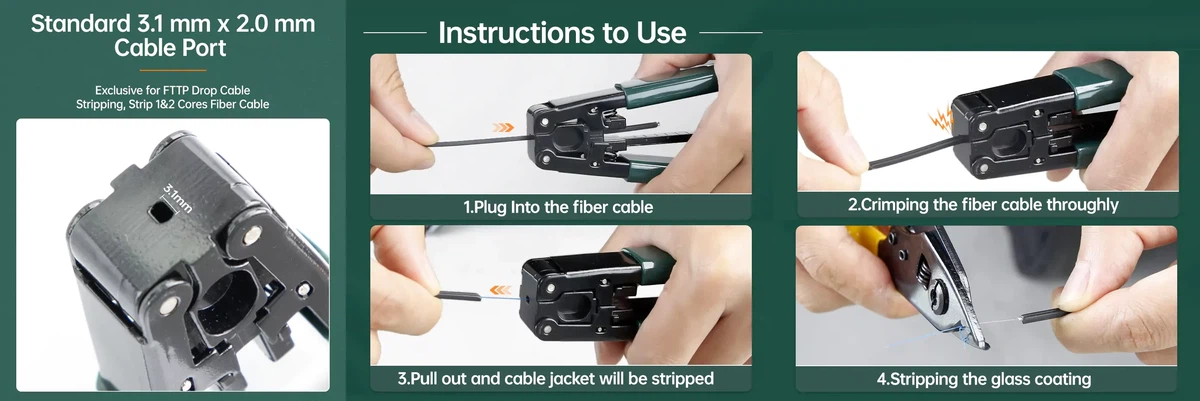
Standard 3.1 mm × 2.0 mm cable port
Optimized for FTTP/FTTH drop cables
Clean stripping of jacket in one motion
Insert the drop cable into the port
Crimp firmly and evenly
Pull out - jacket strips automatically
Proceed to strip the glass coating layer
Optical Power Meter

Handheld device for accurate measurement of optical signal power in FTTH networks.
Wavelength Range: 800–1700 nm
Detector: InGaAs
Measurement Range: -70~+3 dBm or -50~+20 dBm
Simultaneous mW and dB display
Auto shutdown, backlight, self-calibration, wavelength memory
Battery Life: ≥48 hours
Connector Support: SC, FC, ST (ST optional)
FTTH/FTTP subscriber drop cable installation
Drop cable preparation and termination
Network commissioning and acceptance testing
Routine maintenance and fault troubleshooting
GPON/XG-PON power level verification
Advantages of Using Professional Fiber Optic Tools
Significantly faster installation speed and higher productivity
Lower insertion loss and improved network performance
Reduced fiber damage and rework rate
Enhanced technician safety and ergonomic comfort
Higher first-time pass rate during deployments
Comparison of Fiber Optic Tools
| Tool | Professional Features | Basic Version | Key Benefit for FTTH |
|---|---|---|---|
| Fiber Optic Stripper | Tri-hole, safety lock, adjustable tension | Fixed holes, no lock | Clean, damage-free stripping |
| Visual Fault Locator | 10–50 mW, long battery, modulation | 1 mW only | Better visibility over longer distances |
| Drop Cable Stripper | 3.1 × 2.0 mm dedicated port | Universal, less precise | Fast & clean stripping of FTTH flat drop cables |
| Optical Power Meter | Wide range, self-calibration, wavelength memory | Narrow range | Accurate GPON/XG-PON power measurement |
How to Choose the Right Fiber Optic Tools for FTTH
Match the stripper to your most common cable types (especially flat drop cables).
Select a VFL with at least 10 mW output for reliable fault visibility.
Prioritize ergonomic design and safety lock features for daily field work.
Ensure the power meter supports 1310 nm, 1490 nm, and 1550 nm wavelengths.
Consider purchasing a complete FTTH tool kit for consistent quality and performance.
Real-World Deployment Example
A leading ISP in Southeast Asia standardized its FTTH installation teams with professional fiber optic tools (tri-hole stripper, high-precision cleaver, 10 mW VFL, and optical power meter). Average installation time per drop cable dropped from 45 minutes to 18 minutes, while the first-time acceptance pass rate improved to 98.7%. The use of VFL also reduced unnecessary truck rolls by 65%.
Frequently Asked Questions (FAQ)
Q1: What are the must-have fiber optic tools for FTTH installation? A: The essential toolkit includes a fiber optic stripper, fiber cleaver, Visual Fault Locator (VFL), drop cable stripper, and optical power meter.
Q2: Can one fiber optic stripper handle both patch cords and drop cables? A: A quality tri-hole stripper works for most cables, but a dedicated drop cable stripper provides faster and cleaner results for FTTH flat drop cables.
Q3: How far can a Visual Fault Locator detect faults in buried drop cables? A: A 10 mW or higher VFL can typically be seen through most jackets up to several hundred meters, making it highly effective for quick fault location.
Q4: Which wavelengths should an optical power meter support for FTTH? A: It should support at minimum 1310 nm, 1490 nm, and 1550 nm - the standard wavelengths used in GPON and XG-PON networks.
Q5: How often should blades be replaced on strippers and cleavers? A: Depending on usage, rotate or replace blades after 1,000–5,000 cleaves/strips to maintain precision.
Q6: Are these tools suitable for both new installations and ongoing maintenance? A: Yes. They are widely used for initial FTTH deployments as well as daily network maintenance and troubleshooting.
Conclusion
In 2026, professional fiber optic tools remain the foundation of successful FTTH network deployment and reliable long-term operation. By investing in high-quality fiber optic strippers, cleavers, VFLs, drop cable strippers, and optical power meters, telecom operators and ISPs can achieve faster installations, lower costs, and superior network performance.
Start equipping your teams with the right tools today to stay ahead in the expanding FTTH market.
Thank you so much for your vauble time, Any request please
contact with coco@springoptic.com or WhatsApp: https://wa.me/8614796743611