

Introduction
As digital transformation accelerates worldwide, reliable broadband solutions have become essential for businesses, communities, governments, and telecommunications operators. Whether deploying Fiber-to-the-Home (FTTH), expanding broadband wireless networks, upgrading enterprise networks, or building smart cities, selecting the right broadband solution directly impacts network performance, scalability, and long-term operational costs.
Today's broadband solutions landscape extends far beyond traditional cable internet. Modern broadband access solutions include fiber optic networks, fixed wireless access (FWA), cable broadband, DSL, satellite internet, and emerging 5G technologies. Each offers unique advantages depending on deployment scenarios, geographic conditions, bandwidth requirements, and budget.
Among these technologies, fiber broadband has become the preferred choice for future-proof broadband access because of its unmatched speed, reliability, and virtually unlimited bandwidth capacity.
This comprehensive guide explains everything you need to know about broadband solutions vs wireless networks-from network architecture and broadband access solutions to deployment strategies and infrastructure components-helping network operators, ISPs, contractors, and developers choose the most effective solution.
What Is a Broadband Solution?
A broadband solution refers to an integrated system of technologies, infrastructure, and hardware components designed to deliver high-speed, always-on internet access to residential, commercial, industrial, and public end-users.
A complete, end-to-end broadband solution typically consists of:
Broadband Access Network: The "last-mile" connection linking the end-user to the local service provider.
Backbone Transmission Network: The high-capacity long-haul core routes that move massive data volumes between cities and regions.
Fiber Optic Infrastructure: The physical layer, including fiber cables, ducts, and routing systems.
Optical Distribution Network (ODN): The passive splitters, hubs, and closures that split and route light signals.
Customer Access Equipment: On-premises hardware like Optical Network Terminals (ONT) and routers.
Network Management Systems (NMS): Software platforms used for traffic optimization, monitoring, and troubleshooting.
Unlike legacy dial-up or early-generation connections, modern broadband solutions deliver continuous, high-bandwidth throughput that powers mission-critical digital applications:
Enterprise Cloud Ecosystems: Multi-cloud management and real-time remote database syncing.
Next-Gen Media Streaming: Ultra-HD, 4K/8K video streaming, and low-latency interactive broadcasting.
Smart City Enablers: AI-driven traffic management, public surveillance networks, and automated utility grids.
Industrial IoT & Automation: Real-time sensor aggregation, robotics communication, and edge computing in smart manufacturing.
How Broadband Networks Work
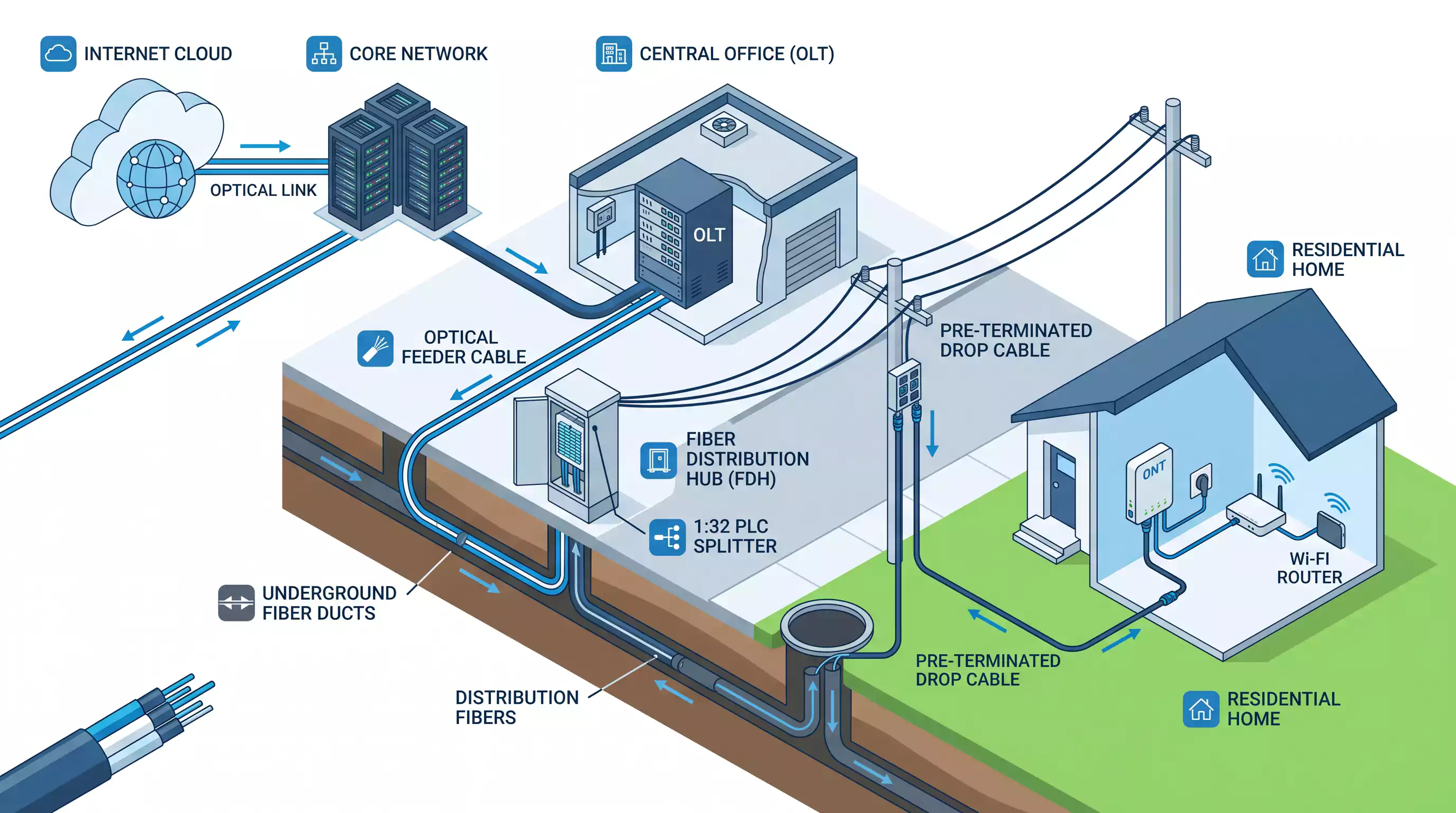
To understand why traditional copper and broadband wireless infrastructures are rapidly transitioning to fiber-deep architectures, it is essential to examine how modern networks move data.
Broadband Infrastructure
Broadband infrastructure comprises the physical, passive, and active hardware layers that transport data packets from global internet exchanges down to individual user devices.
In a modern high-performance layout, this deployment path relies on a sequence of precise passive components:
[Central Office / OLT] → [Fiber Distribution Hub / PLC Splitter] → [Multiport Service Terminal (MST)] → [Plug-and-Play Drop Cable] → [Subscriber ONT]
This passive architecture removes active, power-consuming components from the field, eliminating thousands of potential failure points.
Broadband Access Network
The access network serves as the final delivery mechanism. While legacy architectures relied heavily on copper-based infrastructures (DSL and Cable DOCSIS), modern broadband access solutions utilize Passive Optical Network (PON) standards-such as XGS-PON-to deliver symmetrical gigabit speeds efficiently over a single fiber strand to multiple subscribers via optical splitters.
Core Network
The core network functions as the high-speed transit backbone. It links local distribution networks to regional data centers and tier-1 carrier networks using high-capacity, heavy-count backbone fiber cables capable of terabit-per-second throughput with minimal optical attenuation.
Types of Broadband Solutions: Architecture & Performance Metrics
Selecting the right broadband access technology requires balancing geographic constraints, upfront deployment budgets, and performance requirements.
| Broadband Technology | Top Downstream Speed | Average Latency | Physical Lifespan | Primary Constraints |
| Fiber Broadband (FTTH) | 10 Gbps+ (Symmetrical) | < 2 ms | 25+ Years | Higher initial trenching/civil engineering cost |
| Cable Broadband (DOCSIS 4.0) | Up to 10 Gbps (Asymmetrical) | 12–28 ms | 10–15 Years | Bandwidth degradation during peak subscriber hours |
| Fixed Wireless Access (FWA) | 100–500 Mbps | 30–50 ms | 5–8 Years (Hardware) | Direct line-of-sight (LoS) requirements; weather fading |
| Satellite (LEO Constellations) | 50–220 Mbps | 25–45 ms | 4–7 Years (Satellite) | Heavy atmospheric interference; higher monthly subscription costs |
| DSL Broadband | Up to 100 Mbps | 30–60 ms | Aging Legacy | Extreme performance loss relative to distance from CO |
Fiber Broadband (FTTH / FTTx)
Fiber-to-the-Home (FTTH) and Fiber-to-the-X (FTTx) networks replace copper wires entirely with glass optical fibers that transmit data as light pulses. By operating in the low-attenuation infrared spectrum (typically 1310nm, 1490nm, and 1550nm wavelengths), fiber broadband bypasses the physical bandwidth caps of copper, delivering high-speed data across much longer distances without requiring mid-route signal boosters.
Cable Broadband (DOCSIS)
Cable broadband utilizes the hybrid fiber-coaxial (HFC) networks built by cable TV providers. While recent DOCSIS upgrades have boosted speeds, the underlying architecture relies on a shared-medium framework. This means available bandwidth decreases when multiple users in the same neighborhood access the network simultaneously.
Broadband Wireless Networks
Deploying broadband wireless networks allows operators to deliver internet over radio frequencies between fixed locations, such as a cellular tower and a subscriber's building antenna. While broadband wireless bypasses the need for underground cabling, its signal quality is highly dependent on terrain, line-of-sight paths, and local weather patterns.
Technical Comparison: Broadband vs Wireless Networks
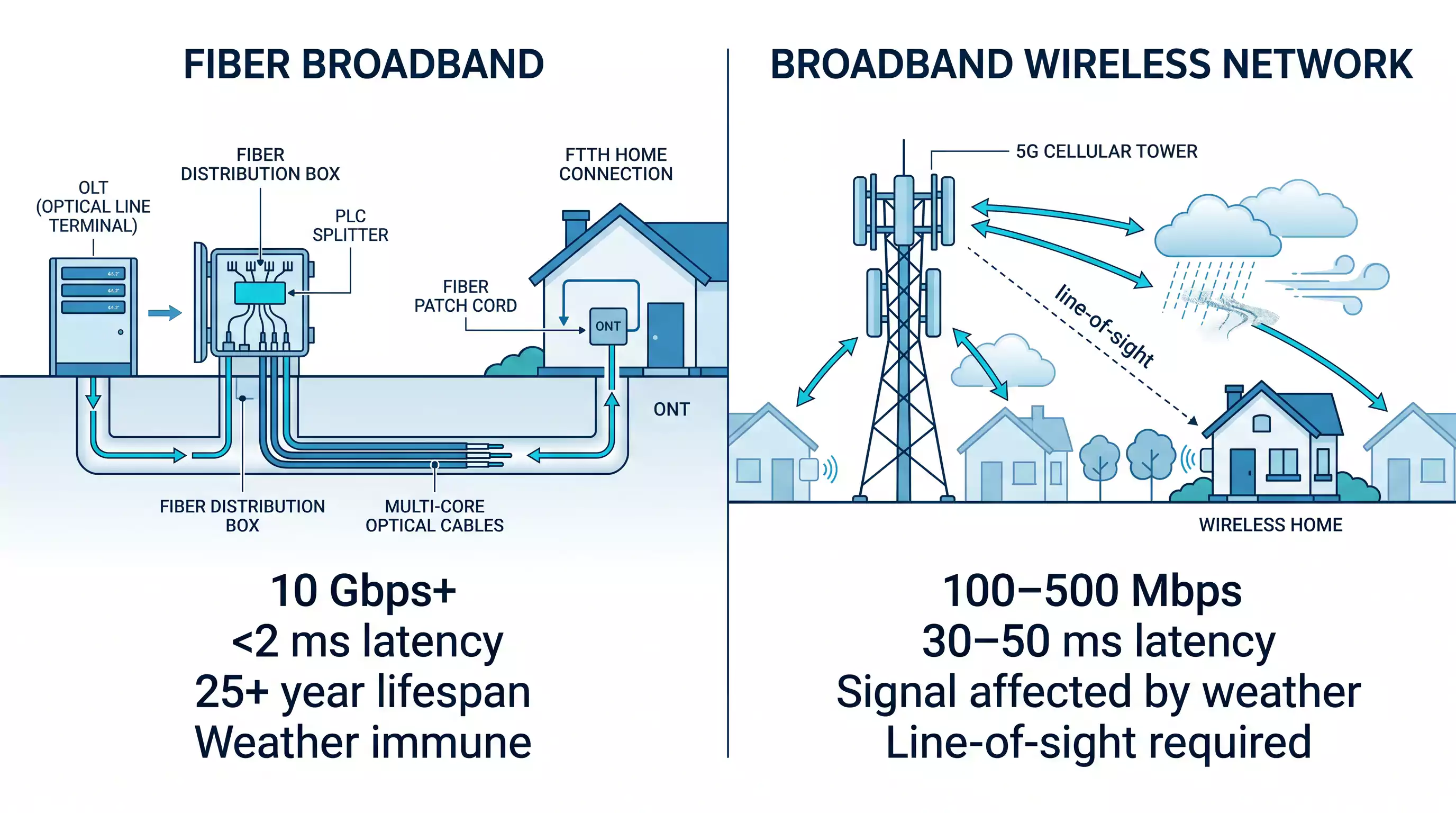
A common point of confusion for buyers is analyzing broadband vs wireless performance. To properly address what is the difference between broadband and wireless, we must understand that broadband defines the high-speed data service itself, while wireless represents just one of its delivery mediums. When evaluating broadband and wireless infrastructures for core deployments, several technical factors emerge.
Symmetrical vs. Asymmetrical Speed: Fiber broadband natively supports symmetrical gigabit connections (identical upload and download speeds), which are crucial for cloud uploads and video broadcasting. Broadband wireless networks are structurally asymmetrical, prioritizing downloads while limiting uploads during peak usage.
Electromagnetic & Weather Immunity: Optical fiber uses light inside non-conductive dielectric glass structures. It is completely immune to electromagnetic interference (EMI), radio frequency interference (RFI), lightning strikes, and heavy rainfall. In the broadband vs wireless debate, wireless networks face severe signal degradation from building materials, foliage, and atmospheric moisture.
Latency Benchmarks: Fiber networks achieve ultra-low, single-digit millisecond latency ($<2\text{ ms}$). This is essential for latency-sensitive applications like automated financial systems, real-time cloud computing, and industrial robotics. Wireless and 5G connections typically introduce higher, more variable latency ($20\text{-}50\text{ ms}$).
Long-Term Scalability: Upgrading a wireless network requires purchasing expensive spectrum licenses and replacing base station radios. Upgrading a fiber network is much simpler: the underground fiber strands stay in place, and capacity scales up just by swapping out the active electronics at the ends of the line.
Commercial Broadband Solutions for Specialized Industries
Different industries require custom-tailored commercial broadband deployments to maintain operational efficiency and zero-downtime reliability.
High-Density Broadband Call Centers
Modern broadband call centers and centralized broadband call center operations handle thousands of simultaneous VoIP channels, CRM data syncing, and AI-driven voice analytics. For a broadband call center, even a 50ms latency spike or minor packet loss can cause dropped calls and garbled audio. Implementing high-performance fiber broadband access solutions ensures the jitter-free, symmetrical throughput required to run large-scale customer support hubs smoothly.
Hyperscale Data Centers
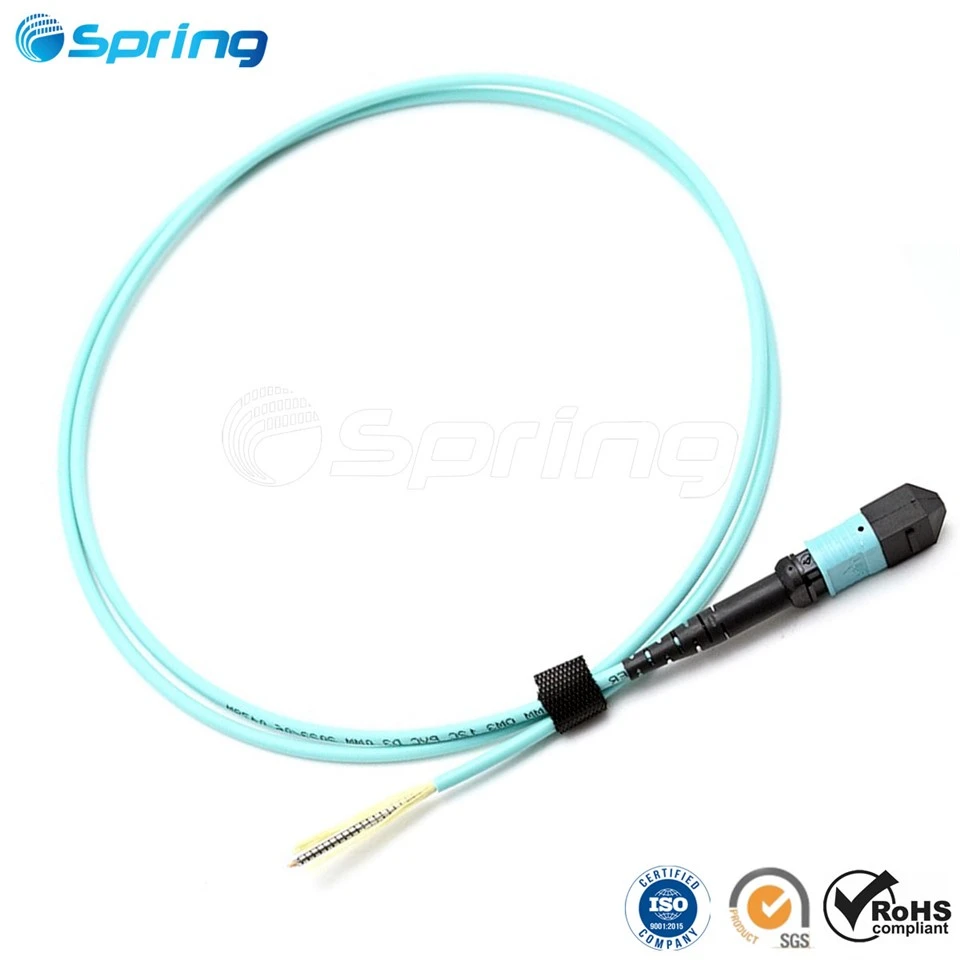
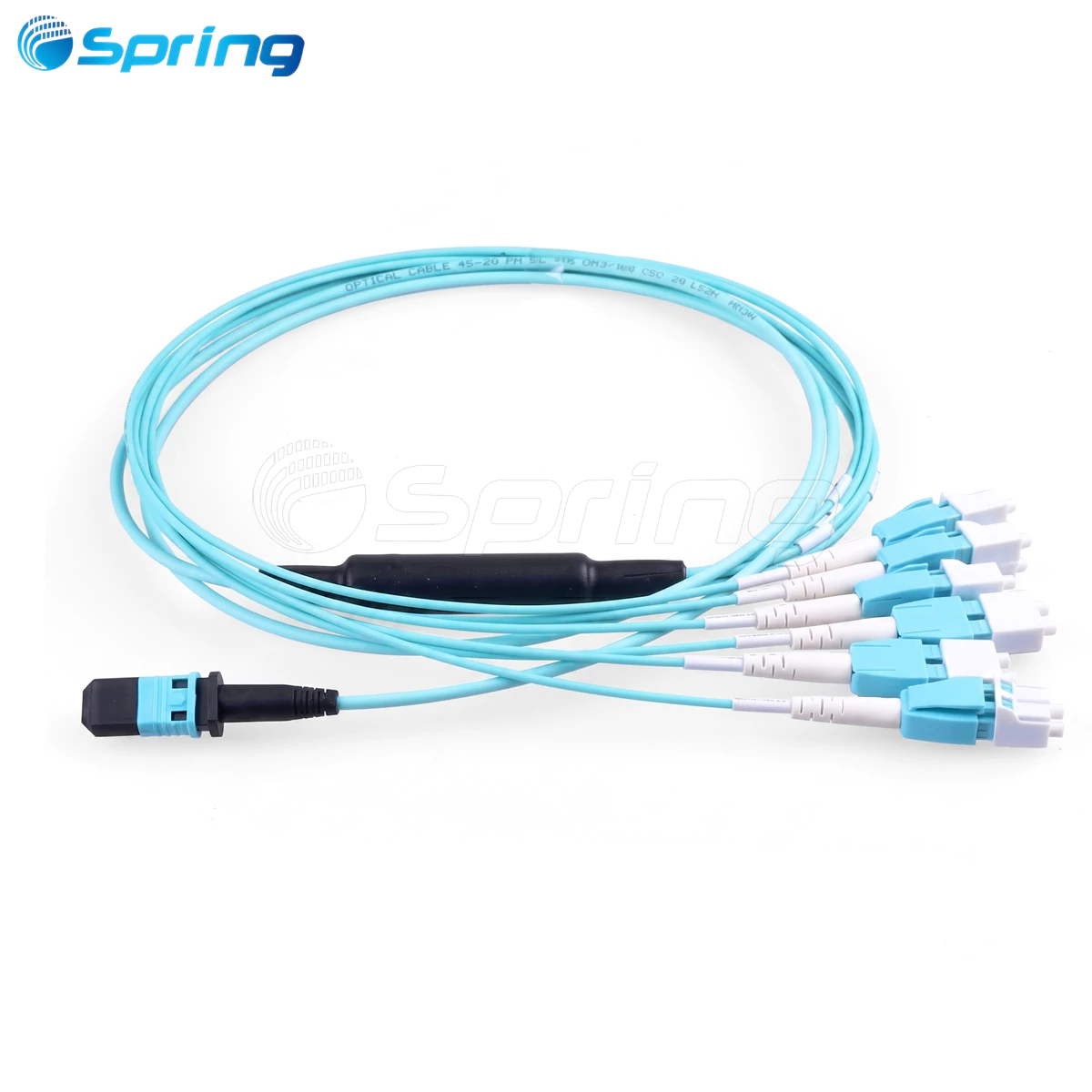
Hyperscale and enterprise data centers demand ultra-high-density fiber connectivity. These facilities rely on custom commercial broadband solutions involving pre-terminated MTP/MPO breakout patch cords, high-density fiber patch panels, and multi-fiber trunking to support massive AI workloads, cloud computing architectures, and heavy server-to-server traffic.
High-Performance ODN Infrastructure & Component Engineering
To ensure a low-loss, future-proof broadband deployment, network engineers must select passive components built to precise mechanical and optical standards.
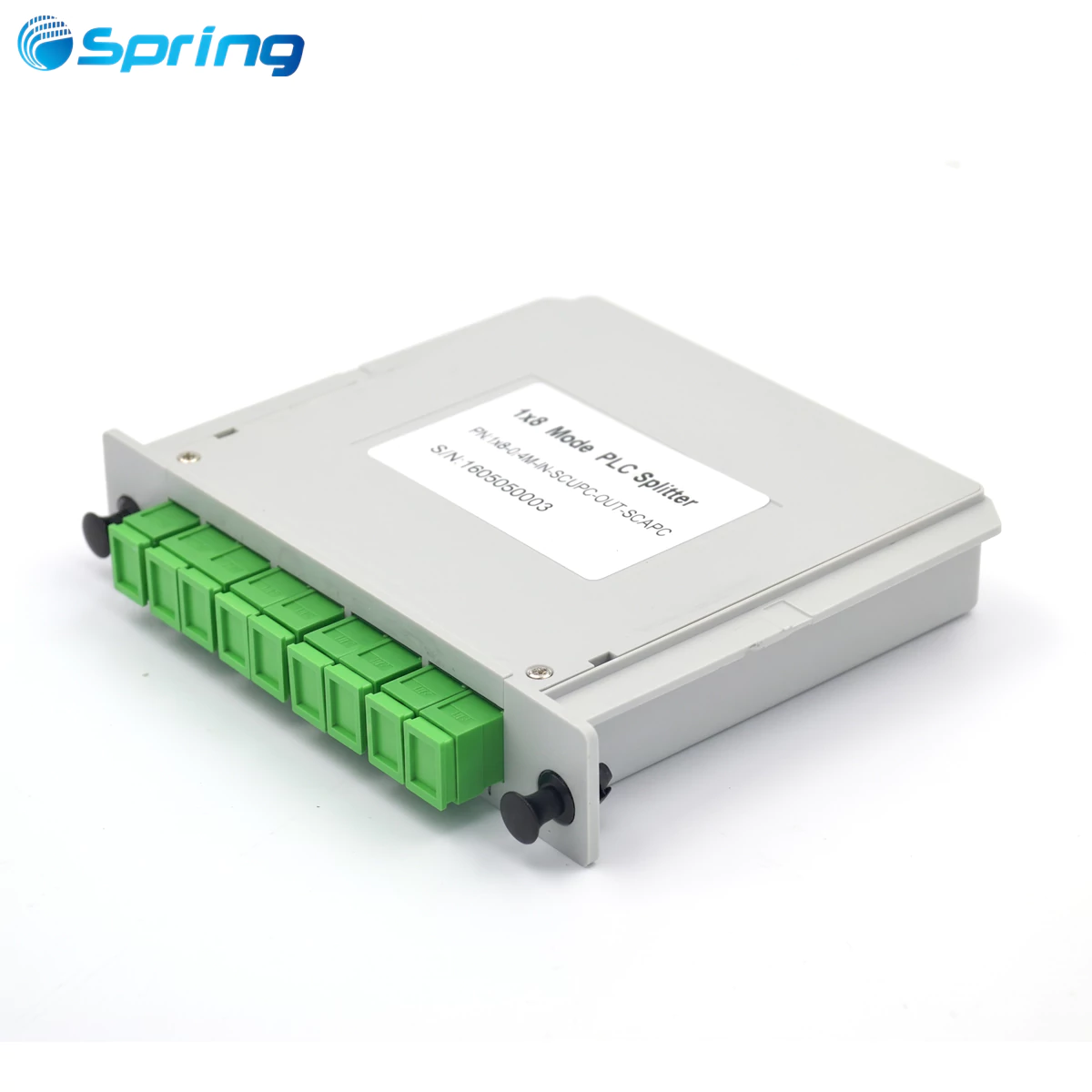
High-Performance PLC Splitters: Essential for splitting a single optical signal into up to 64 distinct paths. Premium splitters feature an ultra-low insertion loss ($\le 0.3\text{ dB}$) and excellent uniformity across all channels to prevent signal dropouts at remote subscriber sites.
IP68 Hardened Connectors & Waterproof Jumpers: Last-mile connections require extreme weatherproofing. Utilizing IP68-rated, OptiTap-compatible hardened connectors ensures complete protection against water ingress, moisture, dust, and UV degradation in harsh outdoor environments.
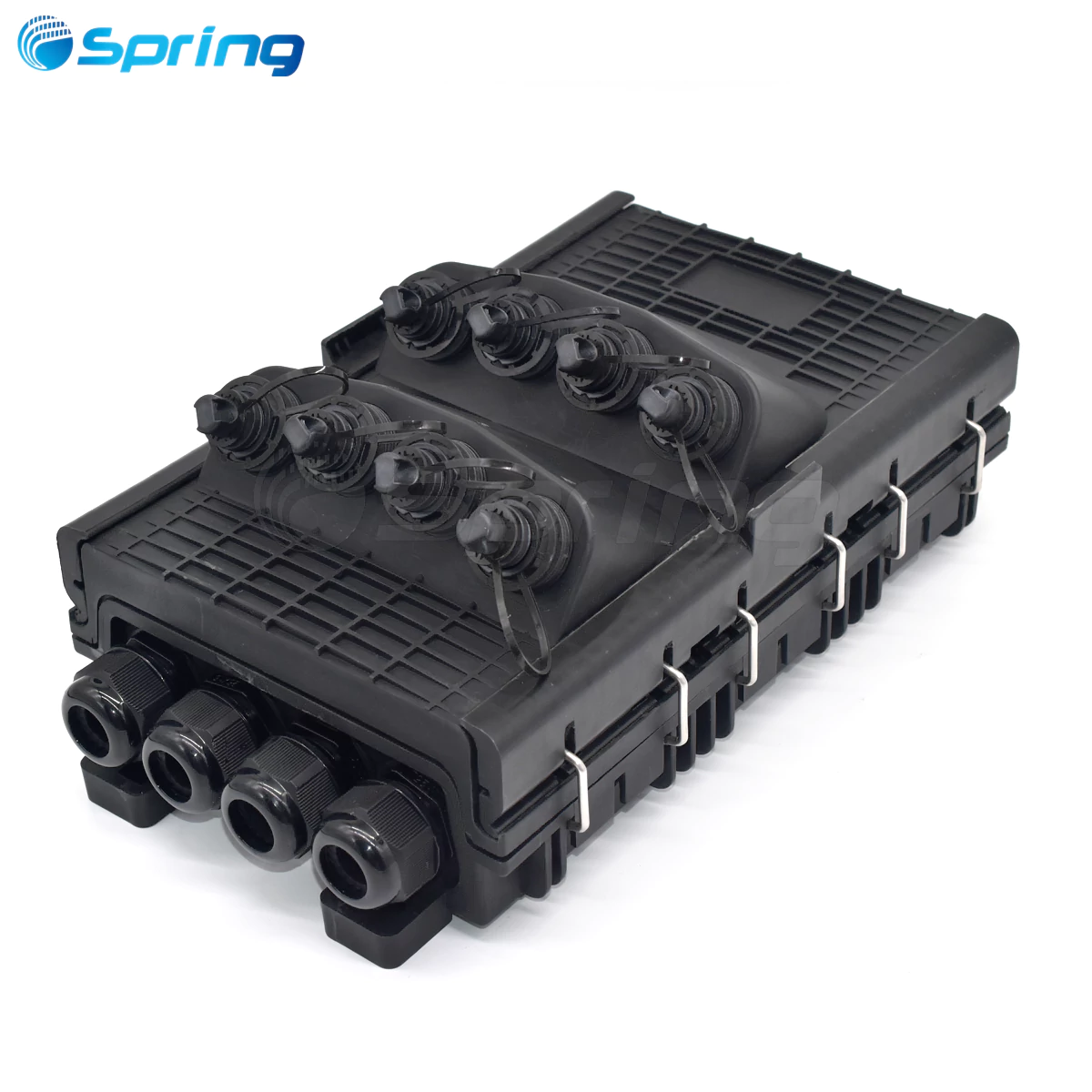
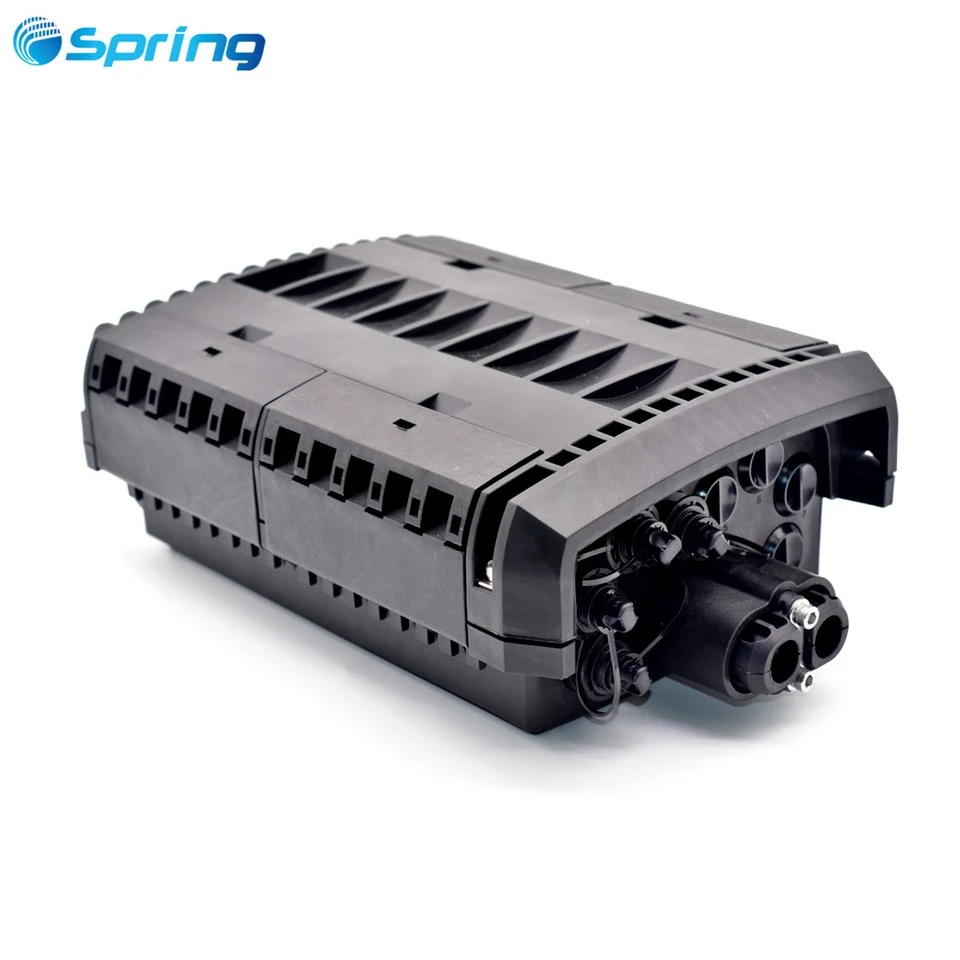
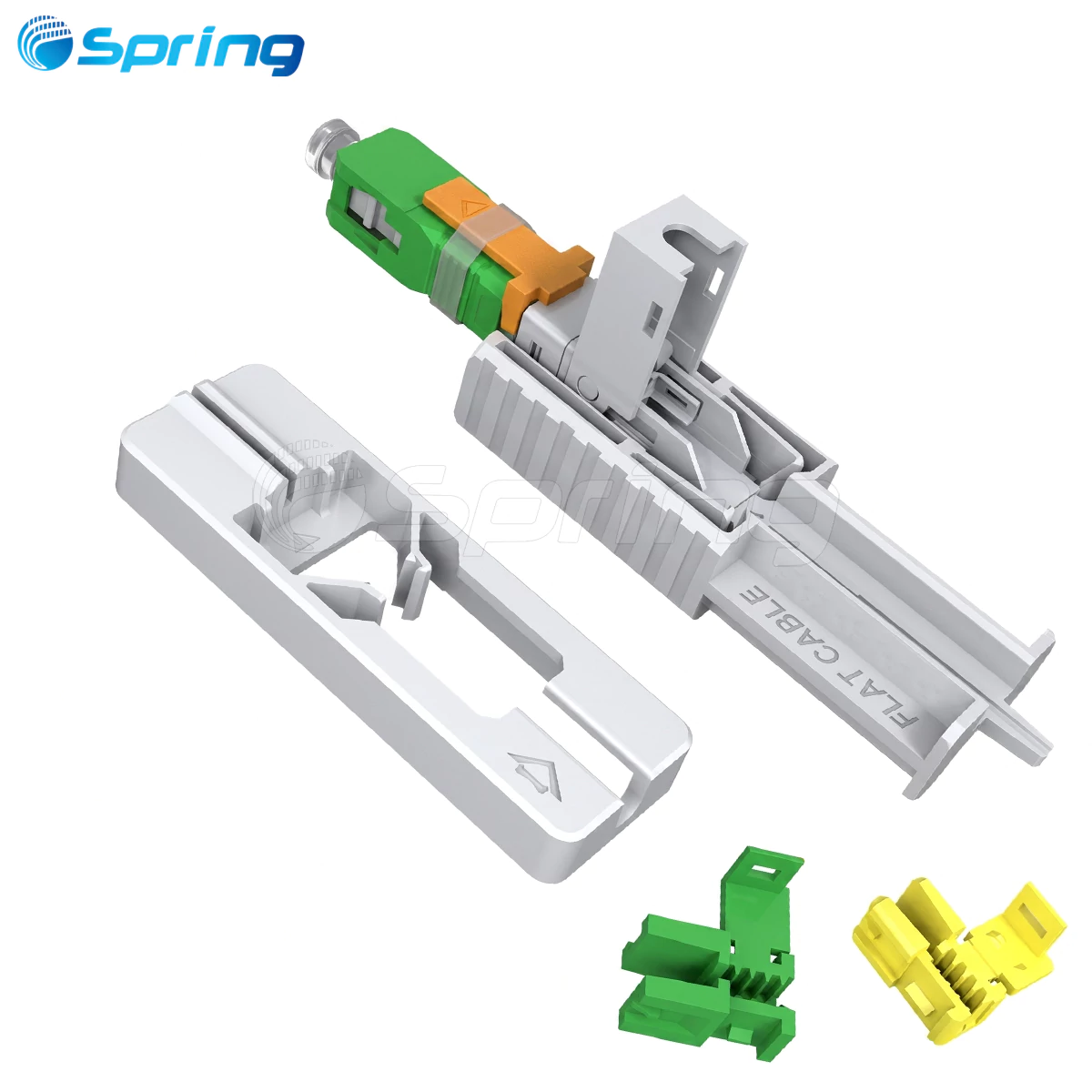
Rugged Multiport Service Terminals (MST): These pre-terminated access nodes protect internal splitter connections and feature hardened adapters, transforming complex field splicing into simple, error-free plug-and-play connections.
Factory-Polished Pre-Terminated Assemblies: By shifting termination from the mud and dust of the field to a controlled cleanroom environment, pre-terminated fiber assemblies achieve superior geometric compliance and return loss ($\text{RL} \ge 60\text{ dB}$ for APC connectors), eliminating field-termination failures.
FACTORY-DIRECT PROCUREMENT & COST OPTIMIZATION
Need to scale your FTTx infrastructure while keeping CapEx within budget? Spring Optical manufactures premium, factory-tested ODN passives, IP68 hardened MST boxes, and high-density fiber cabling systems engineered to meet Telcordia GR-326 standards.
📩 Contact Our Engineering Support Team for a Custom RFQ & Free Samples (Average response time: under 2 hours)
Broadband Solutions for New Development with No Cable Infrastructure
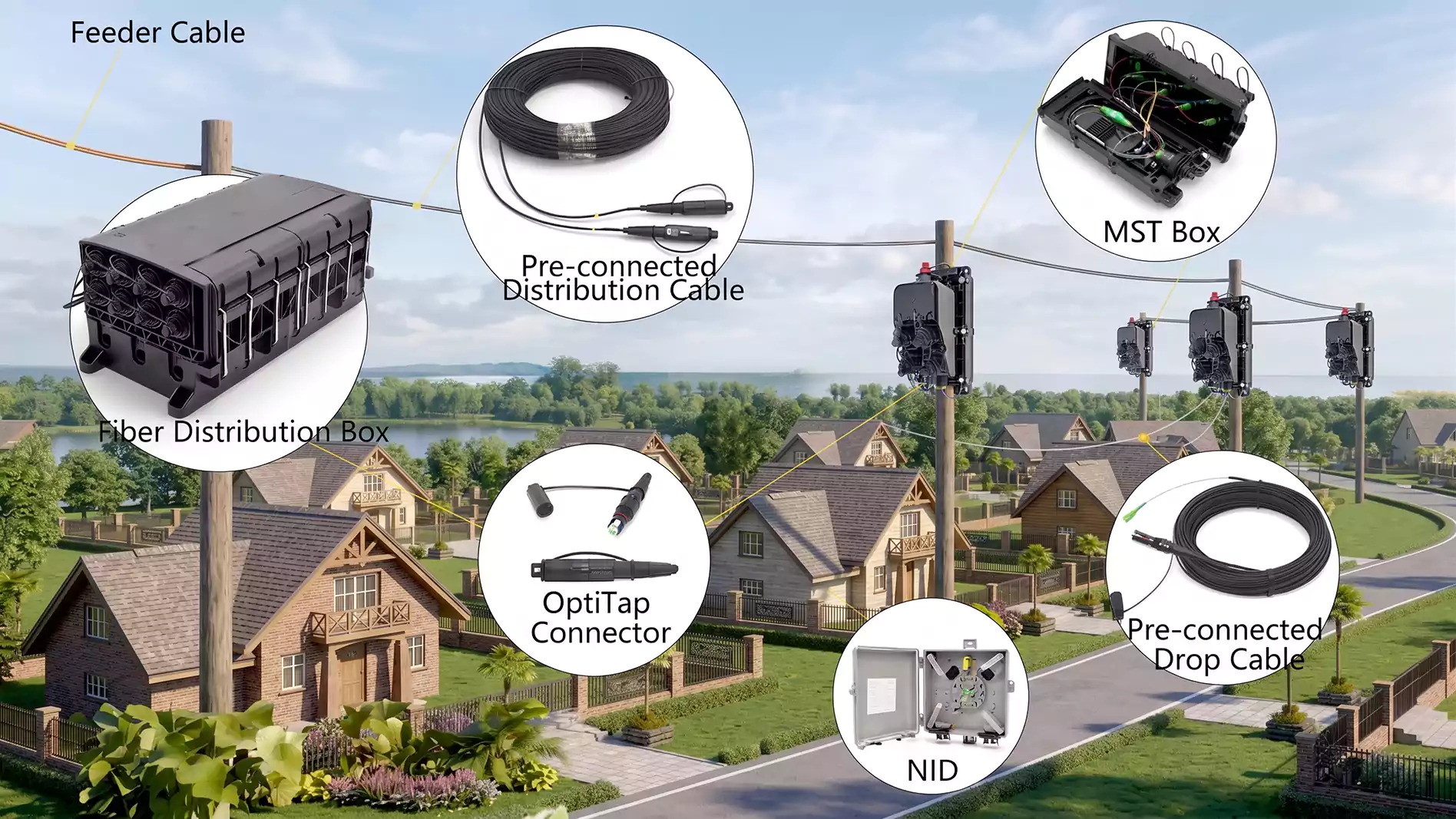
Greenfield projects-such as new residential communities, commercial business parks, and industrial zones-provide a clean slate to deploy optimized, future-proof networks right from the start. Choosing the right broadband solutions for new development with no cable infrastructure is critical to maximizing the long-term asset value of the property.
[Central Office / OLT] → [Fiber Distribution Hub / PLC Splitter] → [Multiport Service Terminal (MST)] → [Plug-and-Play Drop Cable] → [Subscriber ONT]
By avoiding the costs of retrofitting older structures, implementing broadband solutions for new development with no cable infrastructure allows developers to maximize efficiency with a modern deployment strategy:
Integrated Microduct Networks: Laying high-density HDPE microducts alongside primary utilities creates a clean path for blowing in fiber cables as the community expands.
Pre-Connected ODN Topology: Combining pre-terminated distribution boxes with multiport service terminals (MSTs) allows crews to establish network access points without field splicing.
Plug-and-Play Subscriber Activations: Once the main infrastructure is set, field technicians can connect new subscribers in minutes using pre-terminated outdoor drop cables, keeping installation costs to a minimum.
How Pre-Terminated Fiber Solutions Reduce Deployment Costs
Labor shortages and rising field installation costs have changed how networks are built. Factory-assembled, plug-and-play broadband solutions have become an essential tool for keeping projects on schedule and on budget.
70% Reduction in Field Splicing Time: Because connectors are terminated and polished in a controlled factory environment, field crews can skip the meticulous splicing steps for distribution hubs and access drop points.
Up to 40% Savings on Total Labor Costs: Shifting technical tasks from the field to the factory allows installation crews to move faster, meaning smaller teams can complete more connections per day.
Zero Field-Termination Failures: Every pre-terminated component undergoes rigorous factory testing for insertion loss and return loss. This strict quality control prevents troubleshooting delays during subscriber turn-up.
Shorter Project Timelines: Simplified plug-and-play setups allow network operators to activate services faster, shortening the path to generating revenue and improving overall project ROI.
Frequently Asked Questions
What is the difference between broadband and wireless?
To understand what is the difference between broadband and wireless, you have to look at the service versus the medium. Broadband is a high-speed internet connection delivered by your service provider. Wireless is just one specific method used to transmit that connection through the air using radio waves, whereas fiber broadband transmits it via light pulses in glass cables.
What is the difference between broadband and wifi?
When evaluating broadband vs. Wi-Fi, the difference is local versus external. Broadband is the actual internet pipe delivered to your building by an ISP. Wi-Fi is a local wireless network generated by an on-premises router that distributes the existing broadband connection to your personal devices (like phones or laptops) within a short range.
Why are fiber broadband access solutions better for a broadband call center?
A broadband call center relies on zero-packet-loss communication. Fiber optic broadband access solutions deliver ultra-low latency and symmetrical upload/download bandwidth, eliminating the audio lag, jitter, and dropped connections common with copper or wireless setups.
What are the best broadband solutions for new development with no cable infrastructure?
The ideal broadband solutions for new development with no cable infrastructure involve laying underground HDPE microducts and deploying a pre-terminated Passive Optical Network (PON). This plug-and-play architecture completely eliminates the need for expensive field splicing and allows developers to build a future-proof, gigabit-ready community from day one.
Are Spring Optical's hardened connectors compatible with third-party MST terminals?
Yes. Spring Optical's pre-terminated outdoor jumpers and hardened connectors utilize standard geometric form factors (including OptiTap-compatible and Slim-type interfaces), guaranteeing 100% interoperability with major third-party MST terminals and distribution hubs deployed globally.
How do weather conditions impact broadband solutions vs wireless networks?
Fiber-based commercial broadband solutions use heavily insulated glass fibers that are completely immune to atmospheric changes, rain fade, and electromagnetic interference. Conversely, broadband wireless networks are highly susceptible to signal degradation caused by heavy rain, dense fog, and physical obstacles like trees or new buildings.
Conclusion
Modern broadband networks are the foundation of today's digital economy. While cable, DSL, wireless, satellite, and 5G continue to serve important roles, fiber broadband has become the preferred solution for long-term, high-capacity connectivity.
For network operators, developers, and contractors, investing in modern commercial broadband solutions-including Passive Optical Networks, Optical Distribution Networks, and pre-terminated fiber solutions-can significantly reduce deployment costs while improving network performance and scalability.
As broadband demand continues to grow, choosing the right infrastructure today ensures that networks are ready for tomorrow's applications, from AI-driven broadband call centers to smart cities and next-generation communications.
GET A MANUFACTURING QUOTE TODAY
Accelerate your rollout with factory-direct optical components. Explore our technical solutions at www.springoptical.com or email your bill of materials (BOM) to Hayden@springoptic.com for a comprehensive wholesale price sheet within 24 hours.