

Against the backdrop of the artificial intelligence (AI) revolution and the continuous rise of cloud computing, modern data centers house more servers, GPUs, high-performance switches, and storage clusters than ever before. Simultaneously, networking backbones are migrating rapidly to 400Gb and 800Gb speeds to support intense High-Performance Computing (HPC) demands. This massive hardware surge has led to extreme high-density equipment deployment, driving up rack power density and demanding advanced cooling solutions.
Crucially, this architecture has triggered an exponential explosion in fiber counts. Research indicates that AI-driven applications require approximately four times more fiber cabling compared to traditional, general-purpose data center applications. Managing this ultra-high-density, complex infrastructure within confined footprints is becoming a critical bottleneck for network administrators.

Figure 1: High-Density Fiber Optic Cabling and Structured Cable Management inside a Production Data Center Rack.
To keep pace with this trajectory, hyperscalers are building massive new facilities, some exceeding one million square feet. Meanwhile, existing legacy data centers face severe space constraints. Even if they can scale to handle the increased power and thermal loads, they must fully utilize their existing physical footprint to accommodate additional network hardware.
While virtualization, high-density line cards, and advanced cooling layouts assist, savvy operators are uncovering significant real estate savings by optimizing their high-density fiber optic cabling systems. Here are 3 proven ways to achieve maximum density.
1. Implement Fiber Port Breakout Technology
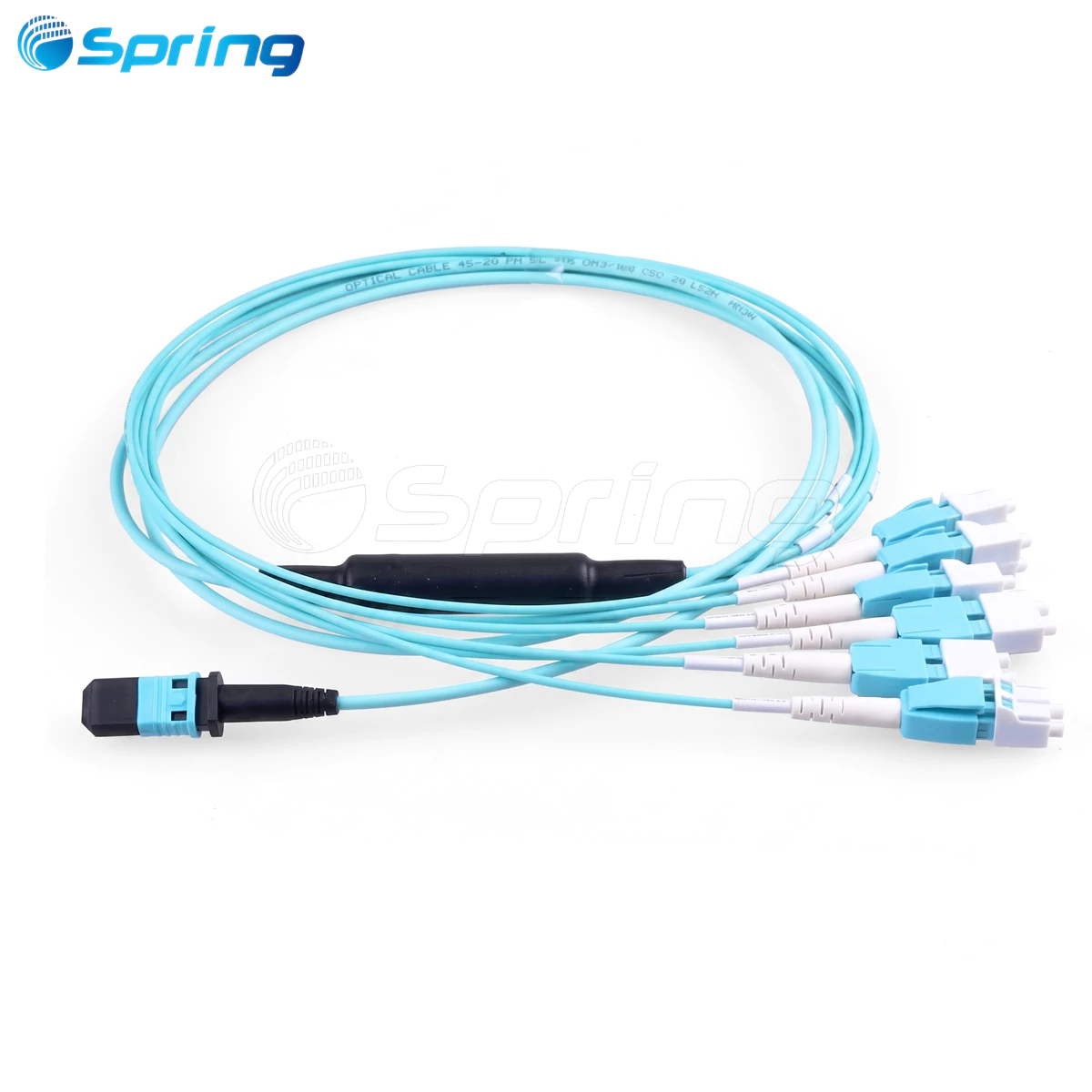
Port Breakout technology stands as one of the most effective structural strategies for space optimization in data center fiber management. It works by configuring a single high-speed switch port (e.g., 400Gb or 800Gb) to split into multiple lower-speed channels (e.g., 25Gb, 50Gb, or 100Gb) that route directly to individual servers or downstream switches. This significantly reduces the overall switch chassis count, saving valuable rack units (RUs), lowering power overhead, and shrinking cable bulk.
Using structural port breakout configurations:
An 8-fiber MTP/MPO interface running at 100Gb, 200Gb, or 400Gb can be broken out into four individual 25Gb, 50Gb, or 100Gb links.
A 16-fiber MTP/MPO interface running at an aggregate speed of 800Gb can be split into eight 100Gb or two 400Gb connections.

Figure 2: Custom MPO-16 breakout cable assembly transitioning to 8 individual duplex LC connectors.
Consider a real-world sizing scenario involving 500 servers that each require a dedicated 100Gb link. Without port breakout technology, a legacy layout requires 500 individual 100Gb switch ports. This demands roughly 8 enterprise switches and consumes 16 RUs of premium rack space, alongside the logistical nightmare of routing 500 distinct optical patch cords.
By shifting to port breakout technology, a single 64-port 800Gb switch can cleanly support all 500 servers while occupying just 2 RUs of space. Technicians only need to route and manage 63 high-density fiber breakout cable assemblies to complete the entire deployment.
Deployment Topologies for Breakout Cables:
Direct Connect (Point-to-Point): Breakout cable assemblies connect directly into the active hardware transceivers on both ends. This approach is highly efficient for short-distance patches within a single rack enclosure or between adjacent racks-common in AI clusters for GPU-to-GPU interconnections. However, for longer spans, direct connect methods risk cable congestion and make structural changes highly labor-intensive.
Structured Cabling: The ideal long-term choice for cross-facility or inter-rack communication. Breakout lines run from active equipment transceivers and terminate into dedicated MTP/MPO adapter panels. While this introduces a patch panel into the link, it yields a highly scalable, neatly organized, and easily maintainable interconnect architecture.
2. Transition to Very Small Form Factor (VSFF) Connectors
Traditional multi-fiber form factors like standard duplex LC and legacy MTP/MPO connectors impose physical hardware constraints due to their structural footprints. To push past these boundaries, next-generation Very Small Form Factor (VSFF) connectors are revolutionizing high-density fiber optic cabling. These ultra-miniature variations-including duplex SN and MDC connectors, alongside multi-fiber SN-MT and MMC alternatives-deliver up to three times the physical density of their traditional counterparts.

Figure 3: Geometric physical size comparison of a standard LC Duplex connector versus ultra-small SN and MDC VSFF options.
For perspective, a standard 1U patch panel loaded with high-density 16-fiber MMC adapters can comfortably accommodate up to 216 individual ports. The exact same panel footprint utilizing legacy 16-fiber MTP/MPO hardware maxes out at just 80 ports.
This phenomenal leap in connection capacity makes VSFF assemblies the gold standard for high-density switches and next-gen AI servers. Furthermore, despite their miniaturized scale, premium VSFF components feature integrated push-pull tabs, allowing engineers to smoothly plug and unplug individual channels even when surrounded by hundreds of tightly packed adjacent lines.

Figure 4: Visual density comparison showing 1,152 fiber terminations in 1RU using MPO-16 adapters versus MMC-16 adapters.
When VSFF connectivity is strategically matched with port breakout technology, space savings compound. For 4x100Gb breakout maps, a harness engineered with a master MTP/MPO connector on one end breaking out into four duplex VSFF lines (such as MDC) minimizes server panel clutter.

Figure 5: 8-Fiber MTP/MPO to 4 Duplex VSFF MDC Breakout Harness designed for high-density 4X100G migration paths.
For more demanding 2x400Gb setups, an MMC-16 to dual 8-fiber MTP/MPO breakout cord is the perfect fit. This specific configuration allows a high-density 72-port switch to seamlessly interface with 144 400Gb ports-creating an unmatched structured cabling solution for massive GPU clustering within high-tier AI networks.
3. Deploy Innovative High-Density Patching Solutions
While point-to-point breakouts and VSFF configurations cleanly resolve short-haul jumper runs, most data centers still prefer to use structured cabling across switch-to-switch and switch-to-server networks to retain flexibility and manageability. This is especially true for longer transmission lines spanning Middle-of-Row (MoR) or End-of-Row (EoR) topologies.
These setups utilize intermediate patch panels inside interconnect or cross-connect racks, allowing technicians to handle easy reconfigurations, line testing, and quick link provisioning via fiber patch cords without risking active device down-time.
To avoid dedicating excessive rack real estate to cross-connects, you should replace wide, flat legacy cassette enclosures with modular, space-saving square fiber cassettes. High-density fiber patch panels running modular square cassette configurations can house up to 96 LC Duplex adapters (yielding 192 fiber terminations) within a strict 1U envelope. Compared to a standard horizontal-strip cassette patch panel which typically maxes out at 72 LC Duplex connectors (144 fibers), this simple physical form factor upgrade nets an immediate 33% increase in patch density.

Figure 6: Structural capacity upgrade gained by transitioning from traditional flat 12-fiber cassettes to high-density square 16-fiber cassettes inside 1RU spaces.
The Synergy: Combining All Three Technologies for Maximum Space Savings
The ultimate architectural victory over data center space constraints occurs when all three methods are combined into a single, cohesive framework: Port Breakouts + VSFF Components + Square Cassette Patch Panels.
The geometric layout of advanced square cassettes natively allows them to accept ultra-miniature VSFF adapters like the duplex MDC or multi-fiber MMC. This convergence means that a highly engineered 1U patch panel can accommodate:
Up to 192 Duplex VSFF Ports (yielding 384 active fibers)
Up to 192 8-fiber or 16-fiber MMC Ports (yielding a staggering 1,536 fibers)
Up to 192 16-fiber MMC Ports configured for pure-density distribution (reaching a peak of 3,072 fibers per RU)
These hyper-dense configurations allow infrastructure teams to systematically break out high-speed switch interfaces to thousands of distributed 100Gb or 400Gb processing pathways. This delivers the massive bandwidth required for AI and cloud environments while reclaiming valuable square footage across the data center floor.

Figure 7: Complete structural schematic showing an 800Gb/s switch linking to 100Gb/s server banks through square 16-port cassettes and VSFF breakout jump lines.
Frequently Asked Questions (FAQ)
Why does AI hardware require more fiber optic cabling than traditional servers?
AI and Machine Learning applications rely on massive GPU clusters that must process and sync vast datasets simultaneously. To prevent bandwidth bottlenecks during High-Performance Computing (HPC) workloads, these architectures demand ultra-fast 400G/800G fabrics and specialized clustering topologies. This next-generation infrastructure requires up to four times more fiber cabling paths compared to standard, general-purpose enterprise data centers.
What is fiber port breakout technology and how does it save physical data center space?
Port breakout technology splits a single high-speed switch port (such as an 800Gb interface) into multiple lower-speed channels (like eight 100Gb connections) using specialized fanout or breakout cable assemblies. By consolidating paths, a single high-density switch can support hundreds of servers, drastically cutting down the number of physical switch chassis and reducing required rack footprint from up to 16 RUs down to just 2 RUs.
How do Very Small Form Factor (VSFF) connectors improve rack density?
VSFF connectors-such as duplex MDC and SN, or multi-fiber MMC-are engineered to be up to three times smaller than traditional duplex LC or legacy MTP/MPO form factors. For instance, transitioning a 1U patch panel to 16-fiber MMC adapters allows it to support up to 216 ports, compared to just 80 ports when using standard MTP/MPO connectors, tripling the density in the same 1U enclosure space.
What is the benefit of using a square cassette design in fiber patch panels?
Traditional fiber patch panels use wide, flat horizontal cassettes that restrict physical capacity. Upgrading to a modular square fiber cassette design allows the panel to distribute ports more efficiently, packing up to 96 LC Duplex connectors (192 fibers) into a strict 1U footprint. This minor mechanical shift yields an immediate 33% capacity increase over legacy 72-port designs.
Can breakout cables be used for long-distance data center connections?
While breakout cables can directly connect active hardware transceivers (Point-to-Point) over short distances inside a rack, using them for long spans can lead to severe cable congestion. For longer inter-rack distances or Middle-of-Row (MoR) / End-of-Row (EoR) topologies, it is highly recommended to run breakout assemblies through a structured cabling system featuring high-density patch panels to maintain flexibility and clean cable management.
Related High-Density Hardware Solutions
If you are upgrading your AI data center to support 400G/800G infrastructure, browse Spring Optical's carrier-grade products featured in this article:
MDC Fiber Optic Patch Cable – Ultra-high-density VSFF patch cords designed for next-generation transceivers and high-density patching.
SN Fiber Optic Patch Cord – Next-gen duplex VSFF patch cables engineered for high-density data center architectures.
CS Fiber Patch Cord – Miniaturized duplex connectors optimized for high-density QSFP-DD/OSFP configurations.
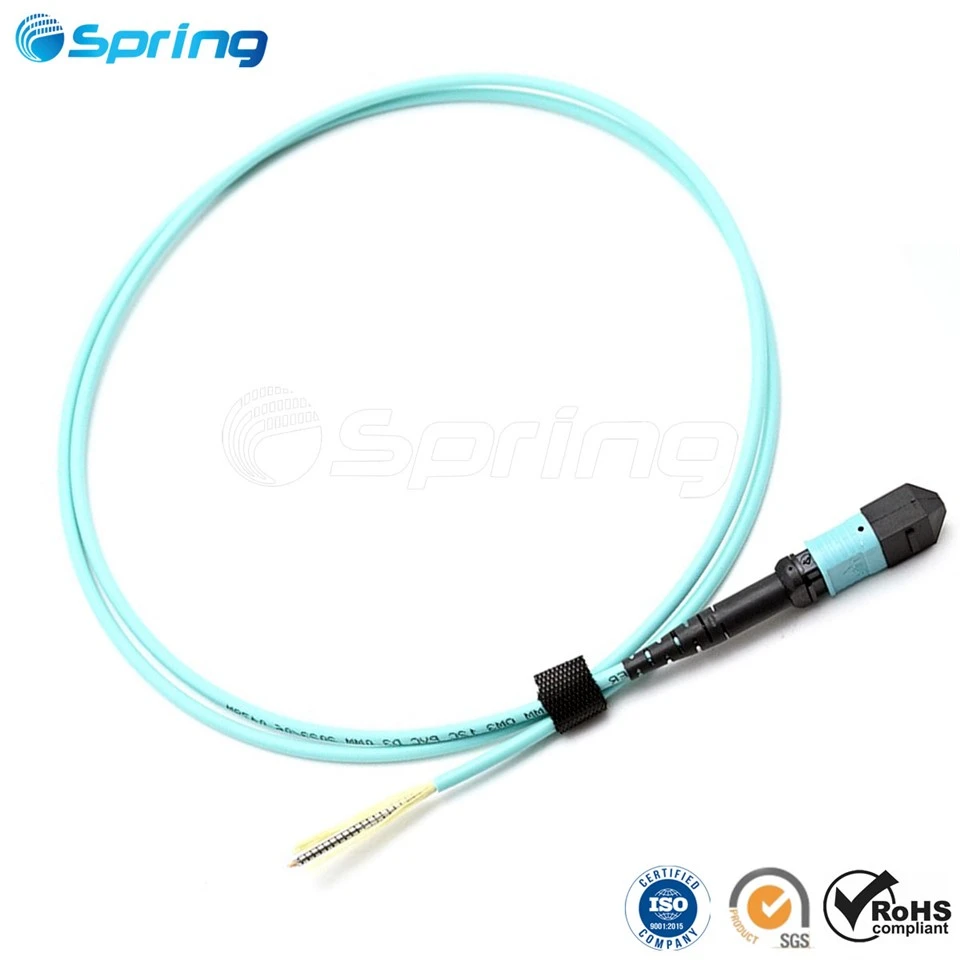
MPO Breakout Cable Assemblies – Premium 8-fiber and 16-fiber fanout cables designed for efficient port breakout applications.
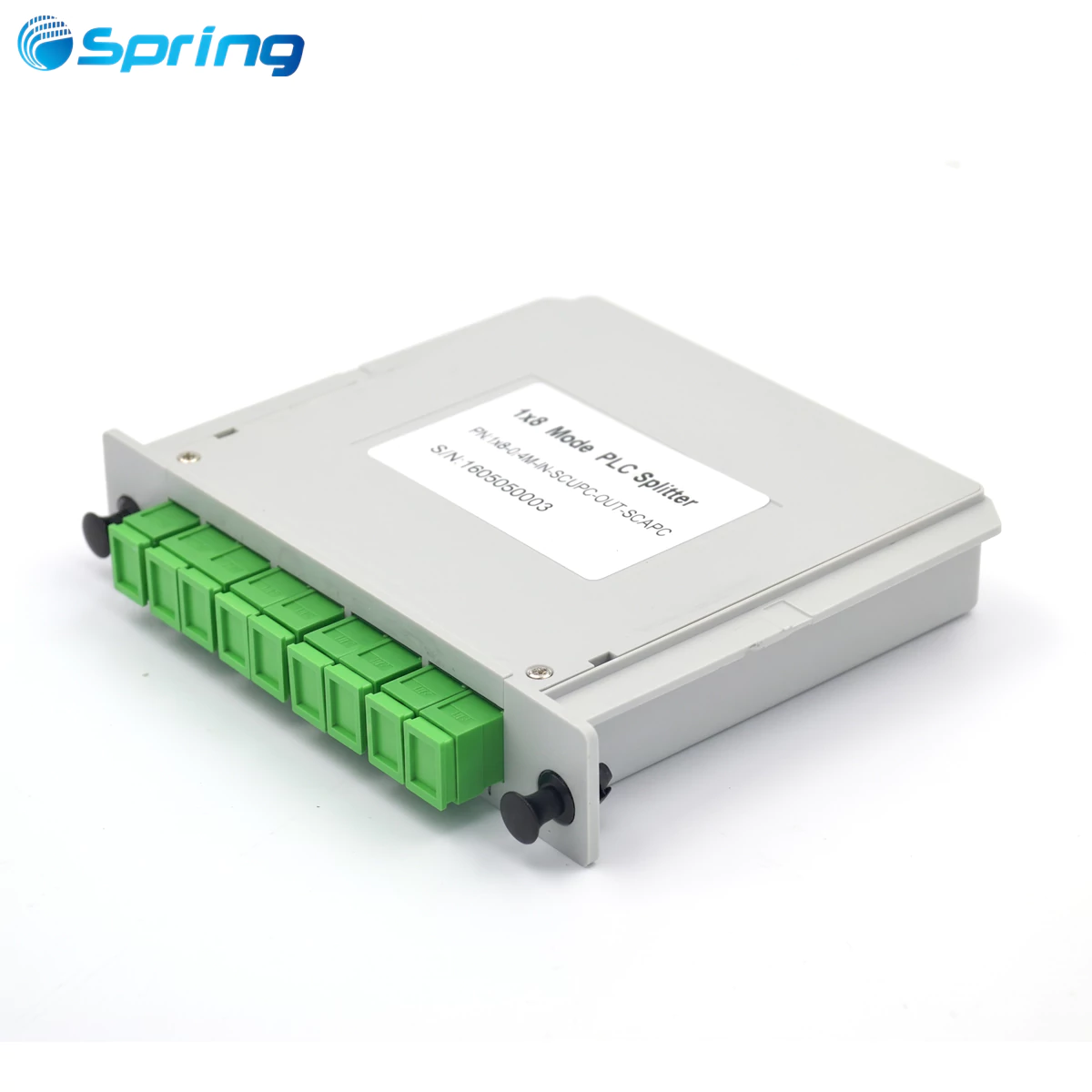
High-Density MPO Patch Panels – Space-saving modular patch panels utilizing innovative square cassette designs to maximize your RU footprint.
Contact Our Fiber Infrastructure Experts Today for a Custom Quote for technical specifications, custom lengths, or bulk wholesale pricing.