

Underground conduit space is becoming one of the biggest limitations in modern fiber network deployment.
As FTTH rollouts, smart city infrastructure, hyperscale data centers, and broadband expansion projects continue to grow, many telecom operators are discovering that their existing conduit systems no longer have enough usable capacity for additional fiber cables.
Traditional HDPE innerduct systems were designed for lower-density cable environments. In today's networks, however, operators often need to deploy:
·288F and 576F ribbon fiber cables
·Multi-operator backbone infrastructure
·Future expansion pathways
·Additional FTTH feeder routes inside occupied ducts
When rigid innerduct systems consume too much conduit volume, contractors are often forced to install new ducts or open additional trenches - significantly increasing project cost and deployment time.
Fabric innerduct solves this problem by maximizing conduit occupancy efficiency inside both new and existing underground pathways.
Unlike rigid HDPE tubes, fabric innerduct uses a collapsible textile structure that conforms to installed cables. This allows operators to create organized multi-cell cable pathways while dramatically improving usable conduit capacity.
In many retrofit deployments, fabric innerduct can increase conduit utilization by up to 300% while reducing trenching, installation labor, and civil construction costs.
In this guide, we'll explain:
·What fabric innerduct is
·How it works in occupied conduits
·Why many operators prefer it over HDPE innerduct
·How it compares with microduct systems and MaxCell®
·Best practices for installation and conduit planning
·How to choose the right configuration for FTTH and underground fiber projects
What Is Fabric Innerduct?
Fabric innerduct is a flexible textile-based conduit partition system used to organize and protect fiber optic cables inside underground telecom conduits.
Instead of using rigid plastic tubes, fabric innerduct creates multiple lightweight cable pathways using woven textile materials such as polyester and aramid-reinforced fibers. These pathways separate fiber cables while allowing the innerduct itself to compress when empty and expand when cables are installed.
This flexible structure helps maximize underground conduit capacity while maintaining organized cable routing and future expansion space.
Fabric innerduct is commonly used in:
FTTH conduit systems
Metro fiber networks
Data center backbone pathways
Campus fiber infrastructure
Municipal broadband deployments
Utility communication systems
Because it performs well inside partially occupied conduits, fabric innerduct has become a popular retrofit conduit solution for urban fiber expansion projects.
How Fabric Innerduct Works
Fabric innerduct improves conduit fill efficiency by reducing the unused space normally created by rigid innerduct systems.
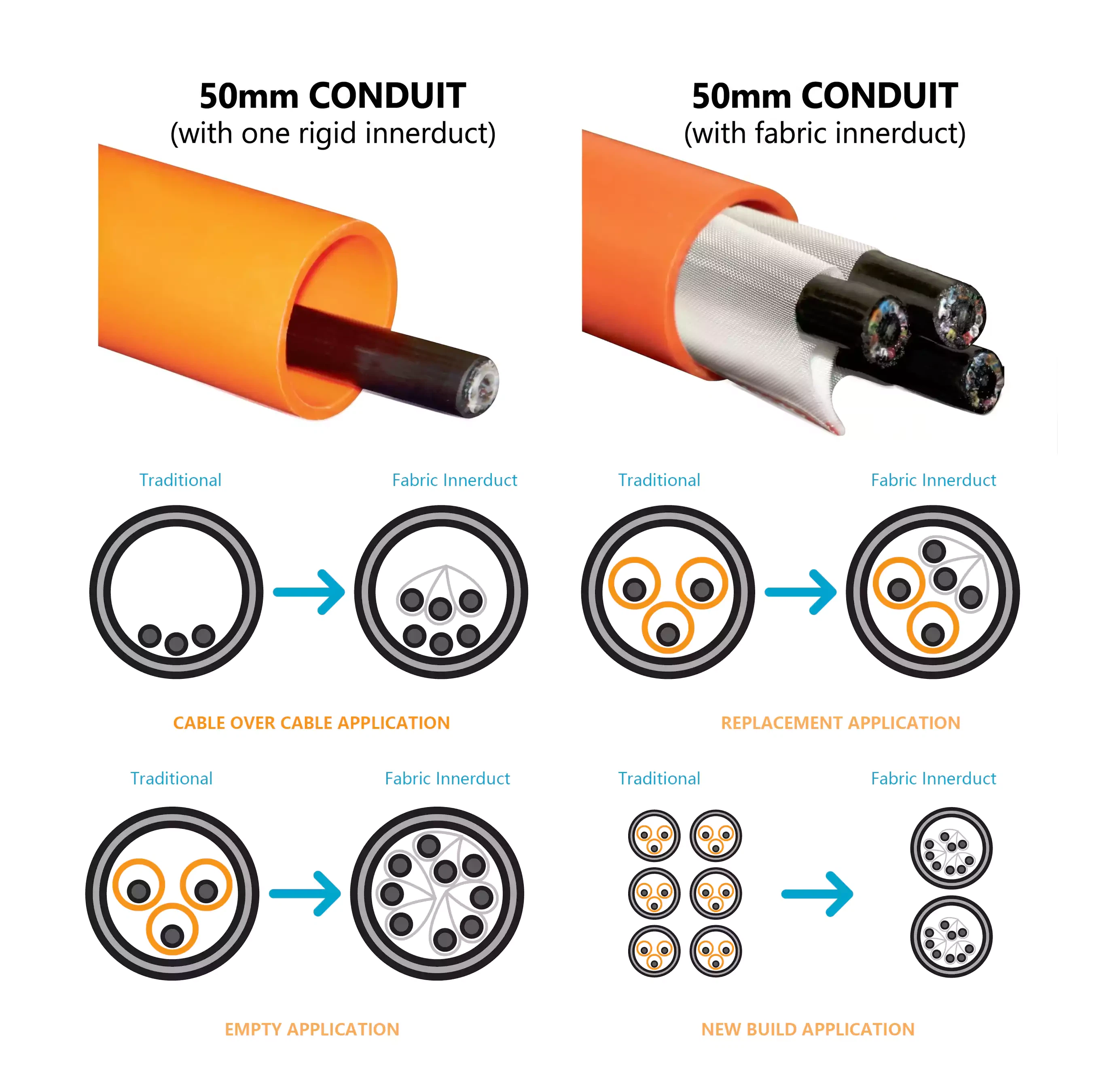
Traditional HDPE innerduct maintains the same circular shape whether cables are installed or not. In occupied conduits, this often creates dead space between the conduit wall and the innerduct itself.
Fabric innerduct works differently.
Its woven textile walls collapse when empty and expand only where cables are present. This allows the pathway to conform closely to the cable shape, significantly improving conduit occupancy ratios.
Example: Occupied 2-Inch Conduit Retrofit
In a partially occupied 2-inch underground conduit, contractors may need to add new FTTH feeder cables without replacing the existing duct bank.
Using a 3-cell fabric innerduct allows installers to:
Create separate organized pathways
Pull multiple fiber cables simultaneously
Reduce cable crossover
Reserve unused cells for future deployment
Avoid new trenching work
This type of retrofit deployment is increasingly common in dense urban telecom environments.
Why Traditional HDPE Innerduct Becomes Inefficient in High-Density Fiber Networks
Rigid HDPE innerduct remains useful for certain low-density conduit applications. However, many modern fiber deployments now require much higher cable density and greater installation flexibility.
As conduit occupancy increases, the limitations of rigid plastic innerduct systems become more significant.
The Problem With Fixed Conduit Geometry
The main limitation of HDPE innerduct is its fixed shape.
Even when partially empty, rigid tubes continue occupying the same conduit volume. This reduces available space for future cable additions and lowers overall conduit efficiency.
In high-density underground fiber conduit systems, this often leads to:
Poor conduit fill ratios
Reduced cable capacity
Difficult cable routing
Increased pulling friction
Limited future expansion space
Fabric innerduct minimizes these issues because the textile structure adapts to both cable shape and conduit conditions.
Conduit Overcrowding in FTTH and Metro Fiber Projects
Conduit overcrowding has become a major challenge in:
Urban FTTH deployments
Municipal broadband systems
Shared telecom infrastructure
Legacy underground duct networks
Modern deployments often involve:
| Deployment Type | Common Fiber Count |
|---|---|
| FTTH Feeder Network | 144F–288F |
| Metro Backbone | 288F–576F |
| Data Center Backbone | 864F+ |
| Utility Communication Network | 144F–432F |
When traditional HDPE innerduct is installed inside already occupied pathways, conduit fill ratios can quickly exceed practical installation limits.
As a result, operators may need to:
Expand conduit systems
Install additional ducts
Open roads and sidewalks
Increase permitting costs
Delay deployment schedules
Fabric innerduct helps maximize underground conduit capacity without replacing existing infrastructure.
Why Fabric Innerduct Is Ideal for Occupied Conduits
One of the biggest advantages of textile innerduct systems is retrofit flexibility.
In many cities, underground conduit infrastructure is decades old and difficult to expand. Excavation may require:
Traffic control
Utility coordination
Permit approval
Road restoration
High labor costs
Fabric innerduct allows contractors to create additional cable pathways inside occupied conduits without removing existing cables or replacing the duct itself.
This makes it highly effective for:
FTTH expansion
Smart city upgrades
Campus network modernization
Municipal broadband retrofits
Utility communication infrastructure
Key Benefits of Fabric Innerduct
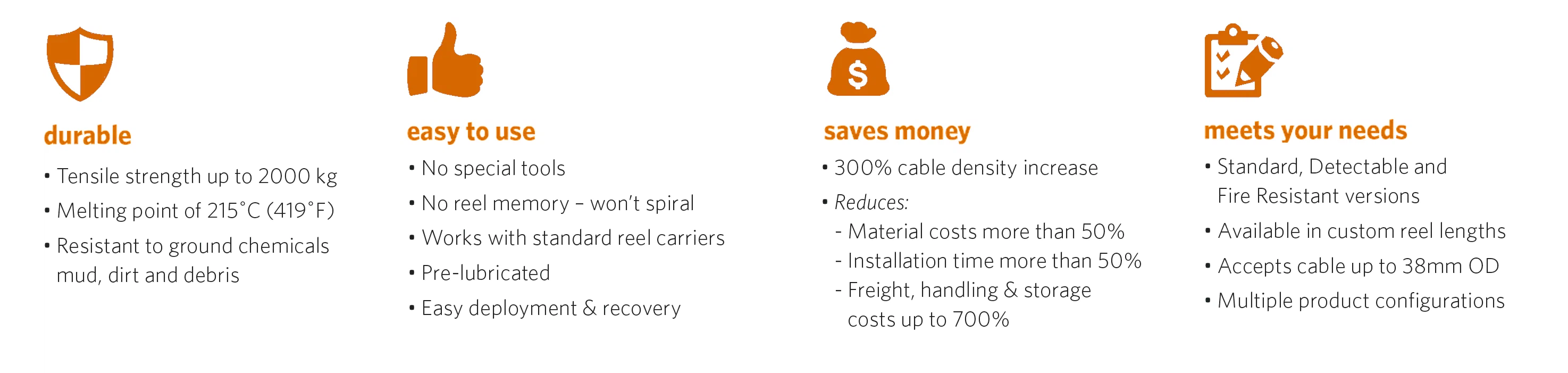
Increase Conduit Capacity by Up to 300%
Fabric innerduct can dramatically improve conduit space utilization because its collapsible textile walls minimize unused conduit volume.
Compared with rigid HDPE systems, flexible textile innerduct allows operators to install more fiber cables inside the same underground pathway.
Typical Benefits Include:
Higher conduit occupancy efficiency
Better cable organization
More future expansion capacity
Reduced dead space
Improved pathway management
In many telecom retrofit projects, this eliminates the need for expensive conduit expansion.
Reduce Trenching and Civil Construction Costs
Civil construction is often the most expensive part of fiber deployment.
By improving existing conduit utilization, fabric innerduct can help operators avoid:
New trenching
Additional duct banks
Sidewalk restoration
Traffic disruption
Utility relocation
Example:
A city FTTH expansion project may avoid hundreds of meters of additional excavation simply by reorganizing occupied conduit pathways with multi-cell fabric innerduct.
For urban deployments, the reduction in labor and permitting costs can be substantial.
Improve Cable Installation Efficiency
Fabric innerduct is lightweight and highly flexible, making installation easier in congested telecom pathways.
Compared with rigid HDPE systems, it performs better in:
Tight conduit bends
Irregular pathways
Long underground runs
Occupied conduits
Many systems also include low-friction liners that reduce cable drag during pulling operations.
Installation Advantages
| Feature | Fabric Innerduct | HDPE Innerduct |
|---|---|---|
| Retrofit Flexibility | Excellent | Limited |
| Bend Adaptability | High | Moderate |
| Cable Pull Friction | Lower | Higher |
| Occupied Conduit Installation | Excellent | Difficult |
| Conduit Fill Efficiency | High | Moderate |
Support Future Network Expansion
Telecom infrastructure must support long-term network growth.
By dividing conduits into organized pathways, fabric innerduct allows operators to reserve unused cells for future cable deployment.
This improves long-term cable pathway management while reducing future construction disruption.
For growing FTTH conduit systems, scalable conduit planning is becoming increasingly important.
Protect High-Count Fiber Cables
High-count fiber cables are expensive and difficult to replace.
Fabric innerduct helps improve fiber cable protection by:
Reducing cable crossover
Minimizing friction during pulling
Improving cable separation
Organizing high-density pathways
This is particularly important for ribbon fiber installations and backbone cable routes where cable damage can lead to costly outages.
Fabric Innerduct vs HDPE Innerduct vs Microduct
Different conduit systems are designed for different deployment environments. Choosing the correct solution depends on conduit occupancy, cable density, and future expansion requirements.
Space Utilization Comparison
| Feature | Fabric Innerduct | HDPE Innerduct | Microduct |
|---|---|---|---|
| Conduit Fill Efficiency | Excellent | Moderate | High |
| Occupied Conduit Retrofit | Excellent | Limited | Moderate |
| Dead Space Reduction | Excellent | Poor | Moderate |
| High-Density Fiber Support | Excellent | Moderate | Excellent |
| Flexibility in Tight Bends | High | Low | Moderate |
For occupied underground telecom pathways, fabric innerduct typically provides the best balance between conduit efficiency and deployment flexibility.
Installation Flexibility
Fabric innerduct performs especially well in retrofit environments because its flexible structure adapts easily to existing conduit conditions.
Best Applications for Each System
Fabric Innerduct
Best for:
Occupied conduits
FTTH retrofits
Urban telecom pathways
High-density fiber routing
HDPE Innerduct
Best for:
Basic cable separation
Simple low-density installations
Straight conduit routes
Microduct
Best for:
Air blown fiber systems
New-build infrastructure
Controlled pathway environments
Total Deployment Cost Comparison
Focusing only on product price can create misleading comparisons.
The actual deployment cost also includes:
Trenching
Labor
Freight
Permit costs
Installation time
Future upgrade expenses
In many retrofit telecom projects, fabric innerduct reduces overall project cost because it minimizes civil construction requirements.
Fabric Innerduct vs MaxCell®: What Should Buyers Consider?
MaxCell® is one of the best-known brands in the fabric innerduct market. However, many telecom operators, distributors, and contractors now evaluate alternative manufacturers that offer similar performance with greater customization flexibility and lower procurement cost.
What Makes a Good MaxCell Alternative?
A high-quality fabric innerduct alternative should provide:
Similar conduit fill performance
Reliable tensile strength
Low-friction cable installation
Multi-cell organization
Standard conduit compatibility
Performance depends more on engineering quality and material construction than on branding alone.
Material and Structural Differences
Manufacturers may use different combinations of:
Polyester textile construction
Aramid reinforcement
Pull tapes
Inner liners
Abrasion-resistant coatings
Some projects may also require additional reinforcement for:
Bridge crossings
Long pulling distances
Utility infrastructure
Harsh underground environments
OEM and Customization Advantages
Working directly with a manufacturer often provides greater flexibility for large telecom projects.
Typical OEM Options Include:
Custom spool lengths
OEM branding
Sequential footage markings
Pull tape integration
Color-coded pathways
Project-specific packaging
These features are especially useful for contractors, ISPs, and distributors managing large-scale deployments.
Looking for a cost-effective MaxCell alternative for your project?
Our engineering team can recommend compatible fabric innerduct solutions based on your conduit size, cable count, and deployment requirements.
Typical Applications of Fabric Innerduct
FTTH Networks
Fabric innerduct is widely used in FTTH conduit systems where underground pathways are already congested.
Typical applications include:
Feeder conduit routing
Distribution backbone pathways
Multi-operator conduit systems
Urban underground duct networks
Related solutions:
FTTH Solution
MST Box
ODN Solution
Data Centers
Modern data centers require scalable cable pathway management for high-density fiber routing.
Fabric innerduct helps improve:
Backbone organization
Future cable expansion
Pathway separation
Cable protection
Related solutions:
Data Center Cabling
Fiber Optic Cable
Campus Backbone Infrastructure
Universities, hospitals, airports, and corporate campuses often need to upgrade existing conduit systems without large-scale excavation.
Fabric innerduct provides a practical retrofit pathway solution for these environments.
Utility and Smart City Infrastructure
Utility communication systems and smart city deployments often share underground pathways with multiple cable types.
Fabric innerduct improves:
Cable organization
Conduit efficiency
Future expansion capability
How to Choose the Right Fabric Innerduct
Selecting the correct fabric innerduct depends on conduit occupancy, cable count, installation distance, and future expansion planning.
Step 1: Evaluate Conduit Occupancy
Before selecting innerduct, inspect:
Existing cable count
Conduit diameter
Available free space
Bend conditions
Pulling distance
This helps determine the correct conduit fill strategy.
Step 2: Select the Correct Cell Configuration
| Configuration | Best Application |
|---|---|
| 1-Cell | Retrofit overlays |
| 2-Cell | Medium-density pathways |
| 3-Cell | FTTH backbone systems |
| Custom Multi-Cell | Large infrastructure projects |
Future expansion should always be considered during conduit planning.
Step 3: Match Conduit Size
Most fabric innerduct systems support conduit sizes ranging from approximately 1 inch to 6 inches.
Engineers should evaluate:
Cable outer diameter
Pulling tension
Future reserve capacity
Existing occupancy ratio
Step 4: Consider Tensile Strength Requirements
Higher tensile strength may be required for:
Long-distance conduit pulls
Bridge crossings
Utility pathways
Large ribbon fiber installations
Aramid-reinforced fabric innerduct is commonly used for these environments.
Fabric Innerduct Installation Best Practices
Proper installation is essential for long-term network reliability and cable protection.
Recommended Installation Process
Step 1 - Inspect the Conduit
Check for:
Debris
Water intrusion
Sharp edges
Existing cable congestion
Step 2 - Measure Conduit Occupancy
Calculate:
Existing cable volume
Remaining usable space
Planned cable additions
Step 3 - Select the Proper Pulling Method
Common methods include:
Pull rope installation
Pull tape systems
Winch-assisted pulling
Step 4 - Use Lubrication When Necessary
Lubrication is often recommended for:
Long conduit runs
Tight bends
Large fiber bundles
Step 5 - Verify Cable Separation
After installation:
Inspect pathway organization
Confirm cable separation
Document conduit occupancy
Bend Radius and Pull Tension Recommendations
To reduce cable stress during installation:
Avoid excessive bend angles
Maintain controlled pulling speed
Monitor cable tension continuously
Use compatible cable lubricant when necessary
Flexible textile innerduct typically performs better than rigid HDPE systems in tight conduit environments.
Real Deployment Case Study
288F Fiber Upgrade in an Occupied 2-Inch Conduit
A telecom contractor in Spain needed to deploy additional 288F ribbon fiber cables inside an already occupied underground conduit system.
Installing new duct banks would have required major excavation, road restoration, and permit approvals.
Instead, the contractor used a 3-cell fabric innerduct system to reorganize the existing pathway and create dedicated cable channels for multiple high-count fiber cables.
Deployment Results
| Result | Improvement |
|---|---|
| Infrastructure Cost | Reduced by up to 70% |
| Installation Time | Reduced by approximately 60% |
| New Trenching | Eliminated |
| Cable Organization | Improved |
| Future Expansion Capacity | Reserved |
This project demonstrated how fabric innerduct can help operators maximize underground conduit infrastructure while minimizing deployment disruption.
Need help planning a similar retrofit project?
We provide:
Free conduit sizing support
OEM customization
Bulk project quotations
Engineering consultation
Sample evaluation support
Frequently Asked Questions About Fabric Innerduct
What is fabric innerduct used for?
Fabric innerduct is used to create organized cable pathways inside underground conduits while improving conduit fill efficiency and future expansion capacity.
Is fabric innerduct better than HDPE innerduct?
For occupied conduits and high-density fiber deployments, fabric innerduct typically provides better conduit utilization and installation flexibility than rigid HDPE systems.
Can fabric innerduct replace MaxCell®?
Yes. Many manufacturers provide compatible textile innerduct systems that offer similar performance with additional customization flexibility and competitive pricing.
What conduit fill ratio is recommended?
The recommended fill ratio depends on cable diameter, conduit condition, and future expansion requirements. Many telecom engineers reserve additional pathway capacity for future cable growth.
Can fabric innerduct support air blown fiber?
Some textile innerduct systems can be used alongside air blown fiber infrastructure depending on conduit design and deployment requirements.
How many cables fit inside a 2-inch conduit?
The exact capacity depends on: Cable diameter, Existing occupancy, Cell configuration, Pulling requirements,Fabric innerduct can significantly improve usable cable density compared with rigid HDPE systems.
Is fabric innerduct suitable for FTTH deployment?
Yes. Fabric innerduct is widely used in FTTH feeder and backbone conduit systems because it improves conduit utilization in congested underground pathways.
Can fabric innerduct be installed in occupied conduits?
Yes. This is one of its biggest advantages. Fabric innerduct allows contractors to create new cable pathways inside existing underground ducts without replacing the conduit.
Conclusion
As underground conduit systems become increasingly congested, telecom operators need more efficient ways to expand fiber infrastructure without increasing civil construction costs.
Rigid HDPE innerduct systems often struggle in occupied conduit environments where space efficiency and future scalability are critical.
Fabric innerduct provides a more flexible alternative by improving conduit occupancy, simplifying retrofit deployment, reducing trenching requirements, and supporting high-density fiber routing.
Whether you are expanding FTTH networks, upgrading municipal broadband systems, or improving underground cable management in data centers and utility infrastructure, fabric innerduct offers a scalable solution for modern telecom deployment.
Looking for a reliable and cost-effective MaxCell alternative?
Our team provides OEM fabric innerduct solutions with fast lead times, engineering support, and customizable configurations for global telecom infrastructure projects.