

As modern networks continue evolving toward FTTH, 5G, cloud computing, AI clusters, and 400G/800G transmission, selecting the right Fiber Optic Cable solution has become increasingly important for long-term network performance and scalability.
In most modern outdoor and future-ready optical networks, OS2 fiber is generally preferred over OS1 fiber because it provides lower attenuation, longer transmission distance, better CWDM/DWDM compatibility, and stronger support for high-capacity infrastructure.
However, OS1 fiber still remains useful in certain indoor enterprise and structured cabling environments.
So what is the actual difference between OS1 and OS2 fiber, and which one should you choose for your network deployment?
This guide explains:
OS1 vs OS2 fiber differences
Indoor vs outdoor deployment considerations
Transmission distance and attenuation comparison
G652D vs G657 relationship
FTTH and data center applications
400G/800G future-proofing strategies
Whether you are designing an FTTH access network, upgrading a campus backbone, or planning AI-ready data center infrastructure, understanding the differences between OS1 and OS2 single mode fiber is critical for long-term optical network performance.
What Is OS1 Fiber?
OS1 fiber is an indoor single mode fiber optic cable primarily designed for controlled indoor environments and relatively short transmission distances. Most OS1 solutions are commonly used in Indoor Fiber Optic Cable applications such as enterprise buildings, telecom rooms, and indoor backbone systems.
In structured cabling systems, OS1 fiber has traditionally been used for:
Enterprise building backbones
Indoor telecom rooms
Campus building interconnects
Server room communication links
Indoor riser applications
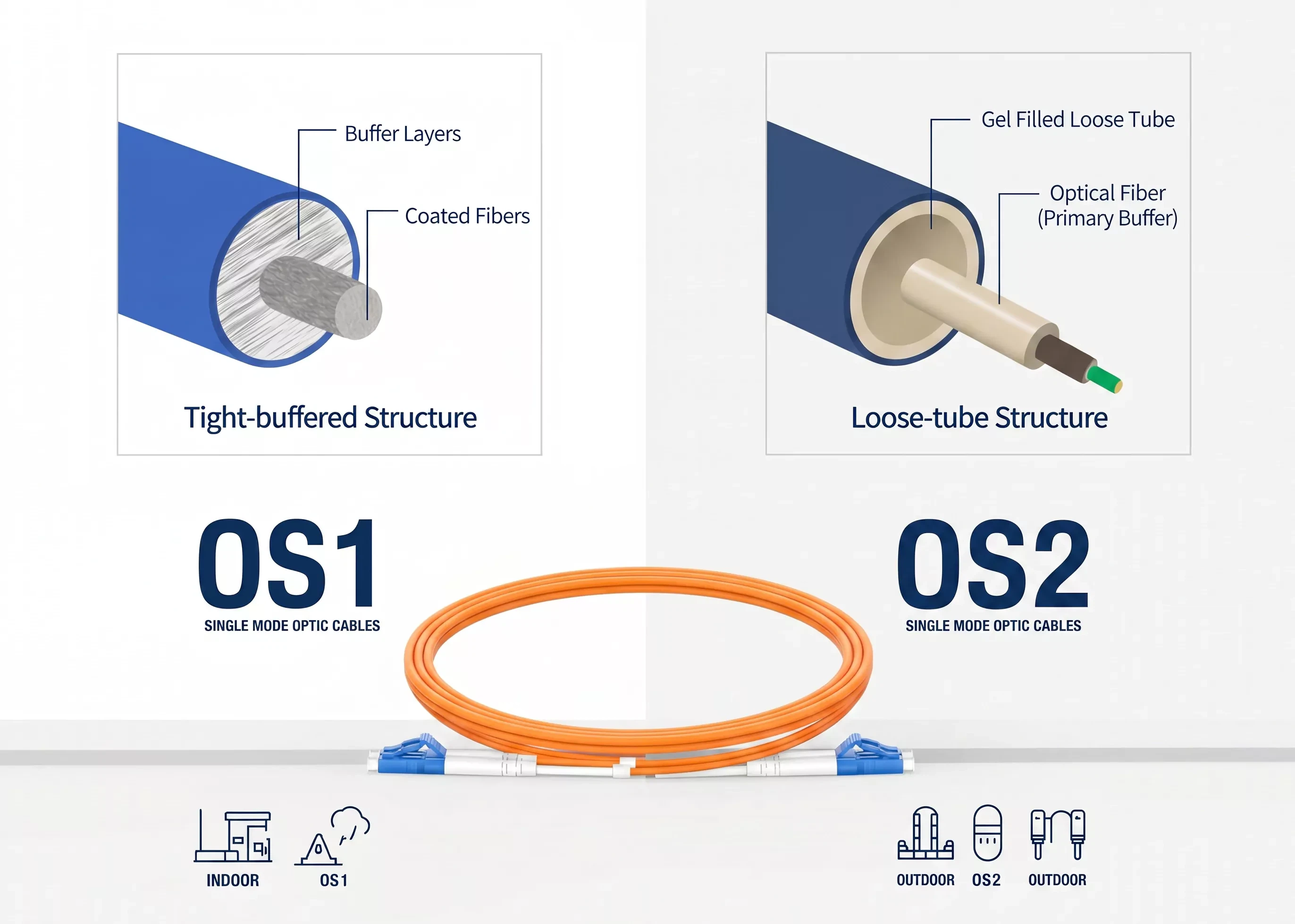
Unlike outdoor optical cables, most OS1 cables use tight-buffered construction, making them easier to terminate, route, and manage inside buildings.
Although OS1 fiber is no longer the preferred choice for most large-scale outdoor communication systems, it still provides a practical and cost-effective solution for many indoor enterprise deployments.
OS1 Standards and Specifications
OS1 fiber is standardized under IEC and ITU-T specifications for indoor single mode transmission systems.
Typical OS1 attenuation is approximately:
≤1.0 dB/km at 1310 nm
≤1.0 dB/km at 1550 nm
Compared with modern OS2 fiber, this attenuation level is relatively high, which limits long-distance transmission capability.
According to IEC and ITU-T classifications, OS1 fiber is mainly optimized for:
Short-distance indoor transmission
Structured cabling systems
Controlled environmental conditions
In practical deployments, higher attenuation means:
Shorter transmission reach
Higher signal loss
Reduced efficiency in DWDM systems
Less scalability for future network expansion
This is one reason why modern telecom operators and hyperscale data centers increasingly prefer OS2 fiber infrastructure.
OS1 Cable Construction
Most OS1 cables use tight-buffered cable construction.
This structure offers several advantages for indoor deployment:
Easier cable termination
Better flexibility for routing
Smaller cable diameter
Simplified patch panel management
Improved indoor handling
Common OS1 cable types include:
Plenum fiber cable
Riser fiber cable
Indoor distribution cable
Tight-buffered simplex and duplex cable
However, tight-buffered structures are generally less suitable for:
Long outdoor routes
Underground ducts
Aerial installations
High-moisture environments
Extreme temperature fluctuations
Common Mistake
Many users assume OS1 fiber is completely obsolete. In reality, OS1 still remains suitable for short-distance indoor enterprise networks where long-haul transmission and outdoor durability are not required.
Typical OS1 Applications
OS1 fiber is commonly deployed in:
Enterprise office buildings
Indoor campus networks
Telecom equipment rooms
Indoor building risers
Short-distance server room interconnects
For example, a commercial office tower may use OS1 indoor backbone fiber between telecom closets on different floors because the transmission distance remains relatively short and the environment is fully controlled.
However, when networks require:
Outdoor deployment
CWDM/DWDM transmission
Long-distance communication
FTTH scalability
400G migration
OS2 fiber is generally the better long-term solution.
What Is OS2 Fiber?
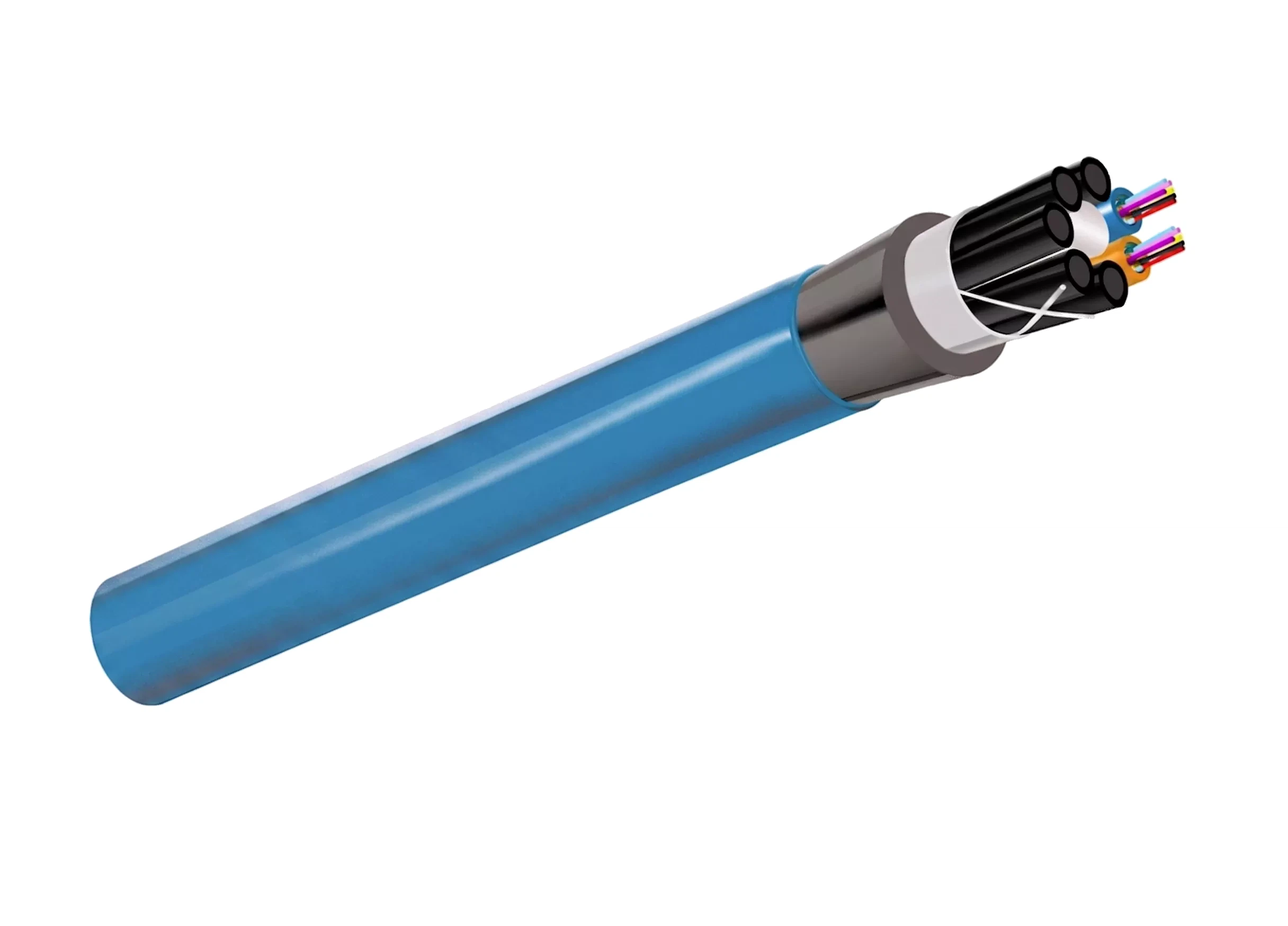
OS2 fiber is a low-loss single mode fiber designed for long-distance, high-bandwidth, and future-ready optical communication networks. It is widely deployed in Outdoor Fiber Optic Cable infrastructure including FTTH, metro backbone, and aerial optical networks.
Today, OS2 single mode fiber is widely used in:
FTTH access networks
Metro backbone systems
Data center interconnects
5G fronthaul and backhaul
Cloud infrastructure
AI data center architecture
Long-haul optical transmission
Compared with OS1 fiber, OS2 supports:
Lower attenuation
Longer transmission distance
Wider wavelength operation
Better DWDM/CWDM compatibility
Improved future scalability
As a result, OS2 has become the default standard for most newly deployed single mode optical networks worldwide.
OS2 Standards and Low-Water-Peak Technology
OS2 fiber is generally the preferred choice for modern backbone and CWDM/DWDM networks because it supports low-water-peak transmission technology.
Traditional single mode fibers suffered from increased attenuation around the 1383 nm wavelength due to water absorption peaks inside the fiber core.
OS2 fiber significantly reduces this attenuation, enabling:
Wider wavelength usability
Improved spectral efficiency
Better wavelength multiplexing
Longer optical transmission spans
This low-water-peak characteristic is especially important for:
CWDM systems
DWDM networks
Long-haul transmission
Metro optical infrastructure
High-capacity backbone networks
Most modern OS2 fibers comply with:
ITU-T G.652.D
IEC OS2 standards
TIA-492CAAB
ITU-T G.657.A1/A2 (bend-insensitive variants)
Typical OS2 attenuation values include:
≤0.4 dB/km at 1310 nm
≤0.3 dB/km at 1550 nm
Lower attenuation allows:
Longer transmission distances
Reduced amplifier requirements
Lower signal degradation
Better long-term network efficiency
OS2 Cable Structure
Unlike OS1 fiber, OS2 cables are commonly optimized for outdoor deployment and harsh operating environments.
Typical OS2 cable structures include:
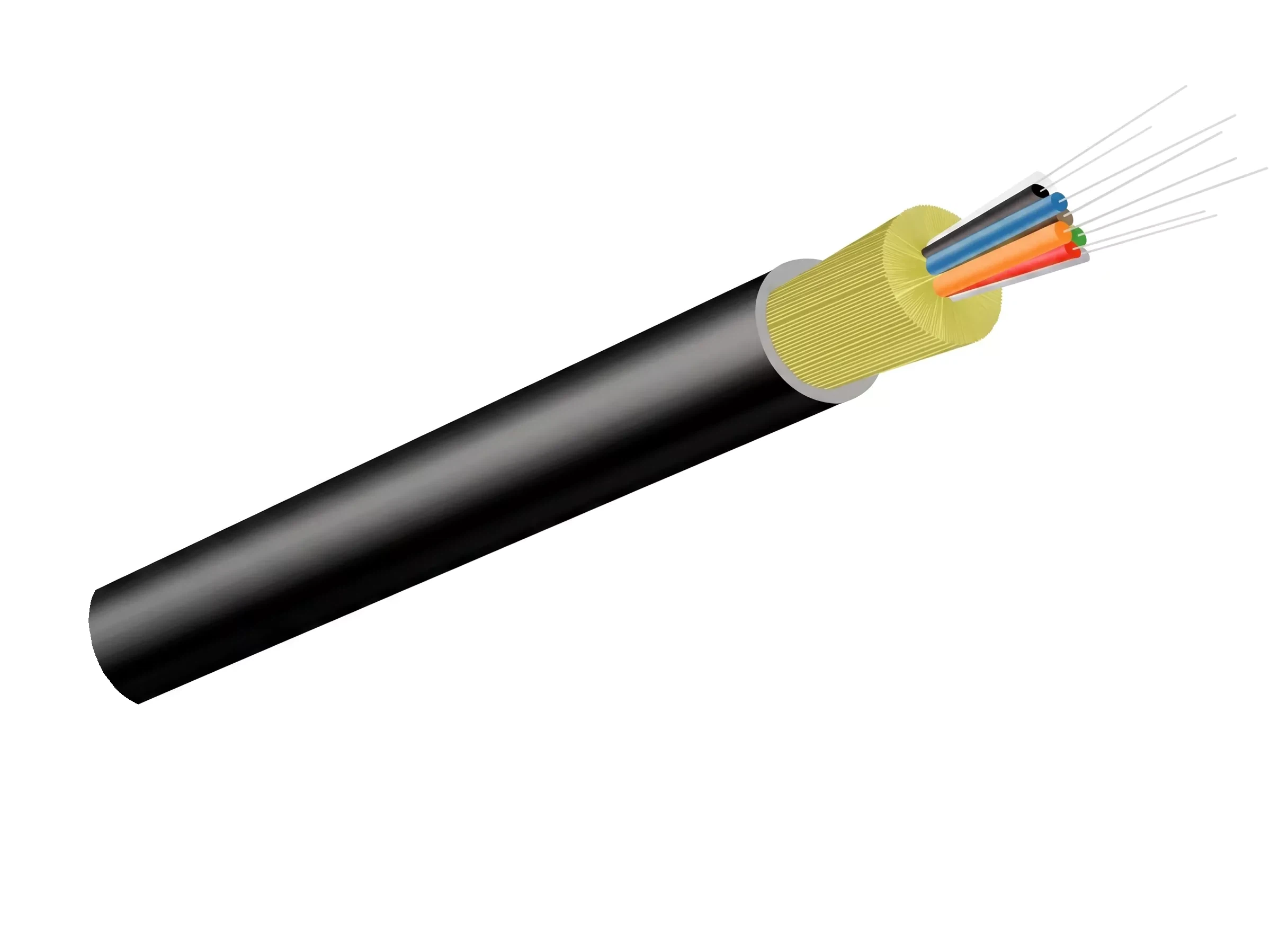
Loose tube construction
Gel-filled protection
Water-blocking yarn
Corrugated steel armor
UV-resistant jackets
Rodent-resistant designs
These features allow OS2 fiber to operate reliably in:
Underground duct systems
Aerial fiber routes
Outdoor backbone networks
FTTH distribution infrastructure
Campus inter-building connections
Practical Deployment Example
In suburban FTTH aerial deployment, telecom operators often use OS2 loose tube cable for feeder and distribution segments because it provides better moisture resistance and long-span transmission capability.
It is also important to understand:
OS2 is not limited to outdoor applications.
Many modern indoor-outdoor hybrid cables use OS2 fiber to standardize infrastructure and simplify future upgrades.
Why OS2 Has Become the Industry Standard
OS2 fiber has become the industry standard because modern networks increasingly require:
Longer transmission distance
Higher bandwidth
Better wavelength scalability
Outdoor deployment flexibility
400G/800G readiness
Several global infrastructure trends are accelerating OS2 adoption.
FTTH Expansion
Modern FTTH deployment requires low-loss outdoor fiber capable of supporting:
10G PON
XGS-PON
Long-distance splitter architecture
Future bandwidth growth
OS2 fiber, especially G657-based variants, is now widely used in:
Feeder cables
Distribution cables
FTTH drop networks
5G and Metro Optical Networks
5G backhaul and metro aggregation networks require:
Low attenuation
High-capacity wavelength transmission
Stable long-distance optical performance
OS2 fiber provides better support for:
Dense urban backbone routes
CWDM/DWDM systems
Carrier-grade optical transmission
AI and Hyperscale Data Centers
Modern AI clusters and hyperscale cloud facilities increasingly rely on OS2 single mode fiber for:
Spine-leaf architecture
Data center interconnects (DCI)
400G DR4/FR4 optical links
Long-distance inter-row transmission
Compared with multimode fiber, OS2 supports greater scalability for AI-ready infrastructure.
Future-Proof Network Design
One of the biggest reasons enterprises now standardize on OS2 fiber is future-proofing.
Many organizations deploy OS2 even for short indoor links because it:
Simplifies inventory management
Reduces future migration costs
Supports higher-speed upgrades
Maintains compatibility with outdoor backbone systems
OS1 vs OS2 Fiber: Key Differences
OS1 and OS2 are both single mode fibers, but they differ significantly in attenuation, deployment environment, cable structure, transmission capability, and long-term scalability.
For most modern outdoor and high-capacity optical networks, OS2 is generally the preferred choice.
Attenuation Comparison
OS2 fiber provides lower attenuation than OS1 fiber, making it better suited for long-distance optical communication.
Typical attenuation values:
| Fiber Type | Typical Attenuation |
|---|---|
| OS1 | ~1.0 dB/km |
| OS2 | ~0.4 dB/km |
Lower attenuation means:
Longer transmission reach
Fewer repeaters and amplifiers
Better DWDM efficiency
Reduced signal degradation
For metro backbone and long-haul transmission systems, OS2 offers significantly better optical performance.
Transmission Distance
OS1 fiber is primarily designed for short indoor communication links.
OS2 fiber supports:
Campus backbone transmission
FTTH distribution
Metro optical networks
Long-haul communication
DCI applications
Quick Answer
If the network requires outdoor deployment, future 400G migration, or long-distance communication, OS2 is generally the recommended choice.
Cable Construction
OS1 commonly uses:
Tight-buffered structures
Indoor flame-retardant jackets
OS2 commonly uses:
Loose tube construction
Water-blocking protection
Outdoor-grade jackets
Armored cable options
These structural differences directly impact:
Environmental resistance
Cable lifespan
Outdoor reliability
Installation flexibility
Indoor vs Outdoor Deployment
OS1 fiber is mainly optimized for indoor structured cabling systems.
OS2 fiber supports:
Outdoor backbone deployment
Underground duct systems
Aerial installations
Indoor-outdoor hybrid cabling
FTTH distribution architecture
Common Mistake
Many users mistakenly believe OS2 is only for outdoor deployment. In reality, many enterprises now standardize on OS2 even indoors for better future scalability.
CWDM/DWDM Compatibility
OS2 fiber is generally preferred for CWDM and DWDM systems because its low-water-peak design supports wider wavelength operation.
Advantages include:
Higher channel density
Better wavelength multiplexing
Longer optical spans
Improved backbone scalability
OS1 fiber is less optimized for modern wavelength-division multiplexing infrastructure.
Bend Performance
Modern OS2 fibers often incorporate bend-insensitive G657 technology.
This improves:
FTTH indoor routing
Wall corner installation
High-density cable management
Patch panel flexibility
G657-based OS2 fiber is now widely used in:
FTTH drop cable
Indoor access networks
High-density telecom cabinets
Cost Comparison
OS1 may initially appear less expensive for short indoor links.
However, network planners should evaluate:
Long-term scalability
Future migration costs
Replacement expenses
Optical efficiency
Lifecycle performance
Practical Advice
For organizations planning long-term infrastructure upgrades, OS2 often delivers better total cost of ownership (TCO) despite slightly higher initial material costs.
OS1 vs OS2 Comparison Table
| Feature | OS1 Fiber | OS2 Fiber |
|---|---|---|
| Fiber Type | Single Mode | Single Mode |
| Typical Attenuation | ~1.0 dB/km | ~0.4 dB/km |
| Deployment Environment | Indoor | Indoor & Outdoor |
| Cable Structure | Tight-buffered | Loose tube |
| Transmission Distance | Shorter | Longer |
| CWDM/DWDM Support | Limited | Excellent |
| Bend Performance | Standard | Bend-insensitive options |
| Common Standards | IEC OS1 | G652D / G657 |
| Typical Applications | Enterprise indoor cabling | FTTH, DCI, backbone |
| Future Scalability | Moderate | High |
Quick Conclusion
OS1 is mainly used for short-distance indoor enterprise cabling, while OS2 is preferred for modern long-distance indoor and outdoor optical networks.
How to Choose Between OS1 and OS2 Fiber
Choosing between OS1 and OS2 depends on:
Deployment environment
Transmission distance
Future upgrade plans
Bandwidth requirements
Infrastructure scalability
For Indoor Enterprise Cabling
If the network only requires short-distance indoor building links, OS1 can still provide a cost-effective solution.
However, many enterprises now deploy OS2 indoors because it:
Simplifies future upgrades
Maintains compatibility with outdoor systems
Supports higher transmission capacity
For FTTH Deployment
OS2 fiber, especially G657 bend-insensitive variants, is generally recommended for FTTH deployment.
Modern FTTH architecture typically uses:
OS2 feeder cable
OS2 distribution cable
G657 drop cable
This improves:
Outdoor durability
Pole-to-home routing flexibility
Indoor wall routing
Long-term bandwidth scalability
For Data Center Interconnects
Modern data centers increasingly use OS2 fiber for:
100G/400G transmission
Spine-leaf architecture
DR4 and FR4 optics
AI cluster interconnects
DCI infrastructure
OS2 provides better scalability for hyperscale and AI-ready data center environments.
For Campus Backbone Networks
Campus networks often require outdoor fiber routing between buildings.
OS2 fiber is generally preferred because it provides:
Longer transmission reach
Better weather resistance
Easier future expansion
Improved backbone reliability
For 400G/800G Upgrades
AI infrastructure and next-generation optical systems strongly favor OS2 fiber because they require:
Low attenuation
High-speed wavelength compatibility
Long-distance transmission stability
Better future scalability
For modern 400G and 800G optical networks, OS2 is typically the recommended long-term solution.
OS2 vs G652D vs G657 Fiber
Many users confuse OS2, G652D, and G657 because they belong to different classification systems.
Quick Answer
OS2 is an IEC single mode fiber category
G652D is an ITU-T low-water-peak fiber specification
G657 is an ITU-T bend-insensitive fiber specification
In many cases:
G652D fibers are classified as OS2
G657A1/A2 fibers are also classified as OS2
The primary difference is bend performance.
| Standard | Main Feature | Typical Use |
|---|---|---|
| G652D | Low-water-peak transmission | Backbone & metro networks |
| G657A1/A2 | Bend-insensitive performance | FTTH & indoor routing |
Common Mistake
G657 is not a separate fiber category replacing OS2. Most G657 fibers are actually classified under OS2 single mode fiber.
Can OS1 and OS2 Be Used Together?
Yes, OS1 and OS2 fibers are generally compatible and can operate within the same optical network.
However:
Overall link performance may be limited by the OS1 segment
Long-distance transmission efficiency may decrease
Future scalability may become inconsistent
Practical Upgrade Scenario
Many enterprises upgrading legacy building infrastructure gradually replace older OS1 backbone links with OS2 fiber to support:
Higher transmission capacity
Outdoor backbone expansion
Future 400G migration
For new network deployments, maintaining unified OS2 infrastructure is usually simpler and more scalable.
Why Modern Networks Are Moving Away From OS1
OS1 is not obsolete, but its limitations become increasingly apparent in modern high-capacity optical infrastructure.
Compared with OS2, OS1 offers:
Higher attenuation
Reduced wavelength flexibility
Shorter transmission distance
Less outdoor deployment capability
Lower scalability for AI and 400G infrastructure
As a result, modern telecom operators, cloud providers, and enterprise backbone networks increasingly standardize on OS2-based infrastructure.
Real Deployment Examples
FTTH ISP Project
A regional ISP deploying FTTH across suburban residential communities may use:
OS2 loose tube feeder cable
1:32 optical splitter architecture
G657A2 FTTH drop cable
Pole-to-home aerial routing
This deployment improves:
Long-distance signal stability
Outdoor durability
Installation flexibility
Future XGS-PON scalability
Campus Backbone Migration
A university upgrading legacy indoor infrastructure may replace older OS1 inter-building links with OS2 armored outdoor cable.
Benefits include:
Better environmental resistance
Simplified future upgrades
Support for higher-capacity backbone transmission
Improved network standardization
Data Center Single Mode Upgrade
A hyperscale data center migrating toward 400G spine-leaf architecture may deploy:
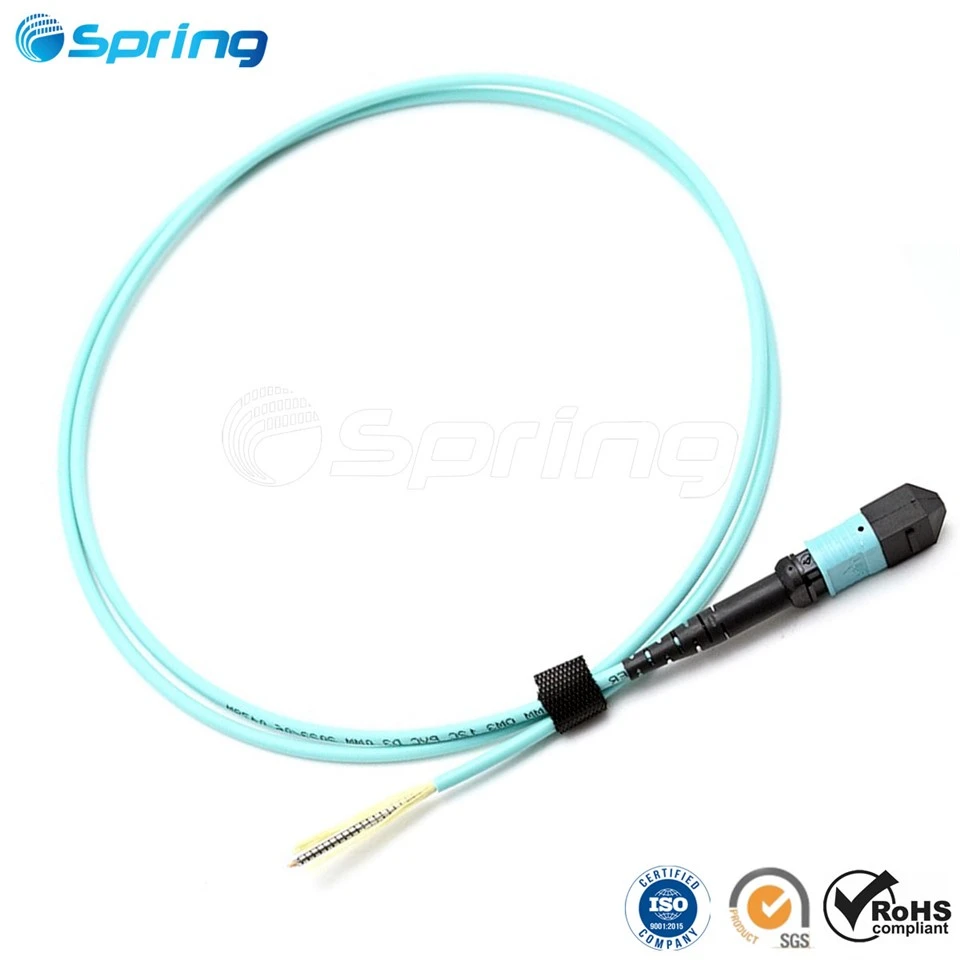
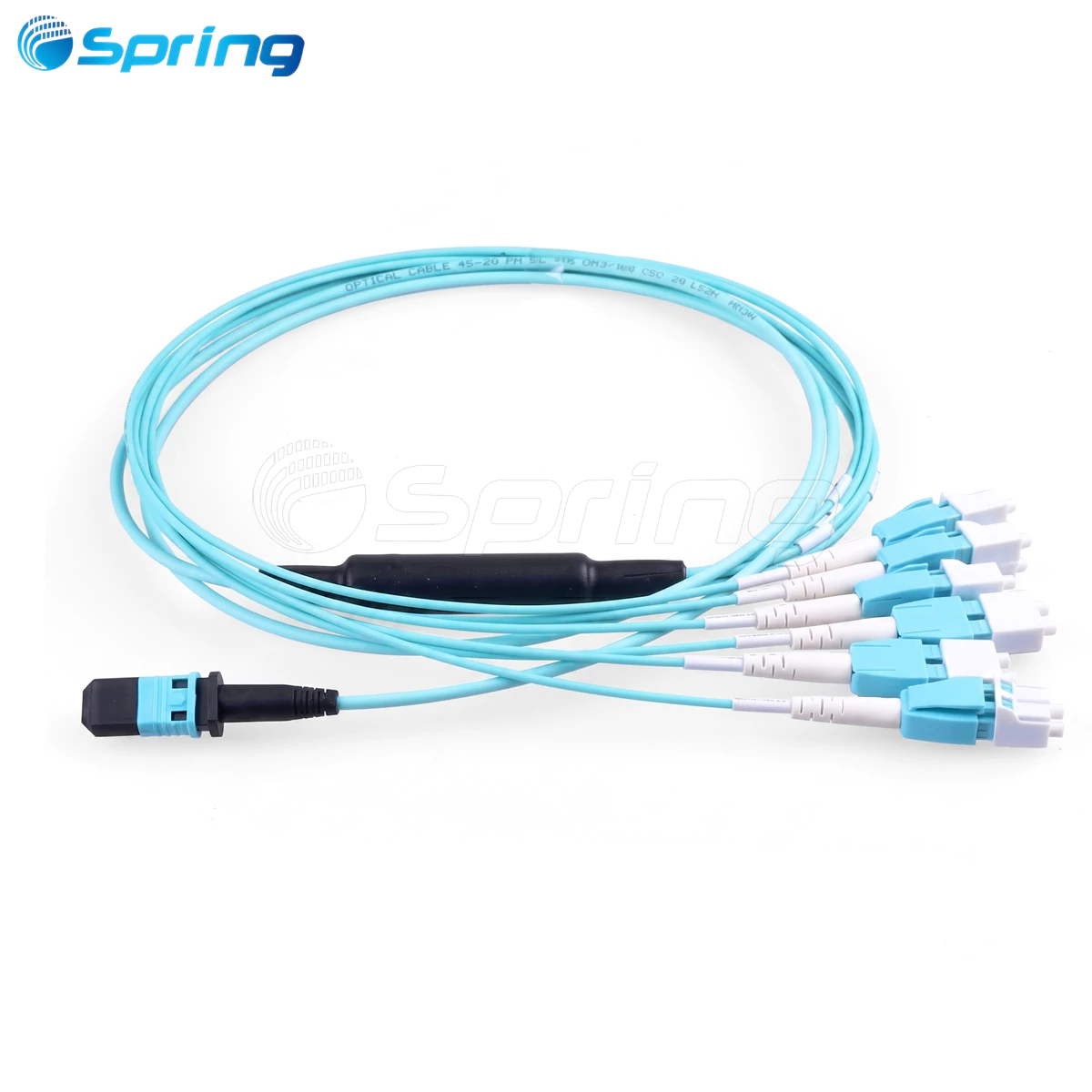
OS2 MPO trunk cable
DR4/FR4 optics
Single mode DCI links
High-density patch panel systems
OS2 fiber supports:
Longer-distance interconnects
Lower attenuation
Better AI workload scalability
Future 800G migration readiness
Conclusion
Both OS1 and OS2 are important single mode fiber technologies, but they are designed for different deployment environments and network requirements.
OS1 fiber still provides practical value for:
Indoor enterprise cabling
Building riser systems
Short-distance structured cabling
However, modern optical infrastructure increasingly requires:
Longer transmission distance
Better wavelength scalability
Outdoor deployment capability
400G/800G readiness
Future-proof network architecture
For these reasons, OS2 fiber has become the preferred standard for most new FTTH, telecom, campus backbone, and AI-driven data center deployments.
In addition, G657 bend-insensitive OS2 fiber is becoming increasingly important in FTTH and high-density routing environments where installation flexibility matters.
Need help selecting the right OS1 or OS2 fiber solution for your project?
Spring Optical provides:
OS2 outdoor fiber optic cable
G657 bend-insensitive fiber solutions
FTTH feeder and distribution cable
Indoor and outdoor backbone cable
Data center single mode cabling systems
Custom MPO/MTP optical solutions
You can also request:
Technical datasheets
Fiber selection guidance
OEM/ODM quotation
Custom cable design support
FAQ
Is OS2 better than OS1?
For most modern outdoor and future-ready networks, OS2 is generally the better choice because it provides lower attenuation, longer transmission distance, and stronger support for CWDM/DWDM systems.
Can OS2 fiber be used indoors?
Yes. Many modern enterprise and data center networks deploy OS2 indoors to simplify future upgrades and maintain compatibility with outdoor backbone infrastructure.
Can OS1 and OS2 work together?
Yes, they are compatible. However, overall optical performance may be limited by the OS1 portion of the network link.
Is OS1 obsolete?
No. OS1 still remains suitable for short-distance indoor enterprise and structured cabling applications.
Does OS2 support 400G and 800G transmission?
Yes. OS2 fiber is widely used in 400G and emerging 800G optical transmission environments, especially in hyperscale data centers and AI infrastructure.
What is the difference between OS2 and G652D?
OS2 is a fiber category, while G652D is an ITU-T low-water-peak single mode fiber specification commonly classified under OS2.
Is G657 fiber considered OS2?
In most cases, yes. G657 bend-insensitive fibers are commonly classified as OS2 single mode fiber.
Which fiber is better for FTTH?
OS2 fiber, especially G657A1/A2 bend-insensitive variants, is generally preferred for FTTH deployment because it supports better bending performance and outdoor compatibility.
Which fiber should I use for data centers?
Modern hyperscale and AI-ready data centers increasingly prefer OS2 single mode fiber for 100G, 400G, and future 800G transmission infrastructure.
Does OS2 cost more than OS1?
OS2 may have slightly higher initial costs, but it often provides better long-term value because of its scalability, outdoor compatibility, and future upgrade capability.