

Introduction
Modern optical communication systems require efficient signal management to achieve higher performance with fewer fiber resources. As network architectures become more complex, components that can control optical signal direction while maintaining low loss and high reliability have become increasingly important.
An optical fiber circulator is a passive optical component designed to route light signals between multiple ports in a specific direction. It enables functions such as single-fiber bidirectional transmission, optical signal separation, laser protection, and reflected signal detection.
Unlike conventional optical components that simply transmit or split optical power, an optical circulator uses non-reciprocal optical characteristics to control the direction of light propagation.
This article explains what an optical fiber circulator is, how it works, common types, major applications, key specifications, and how to select the right solution for your optical system.
What Is an Optical Fiber Circulator?
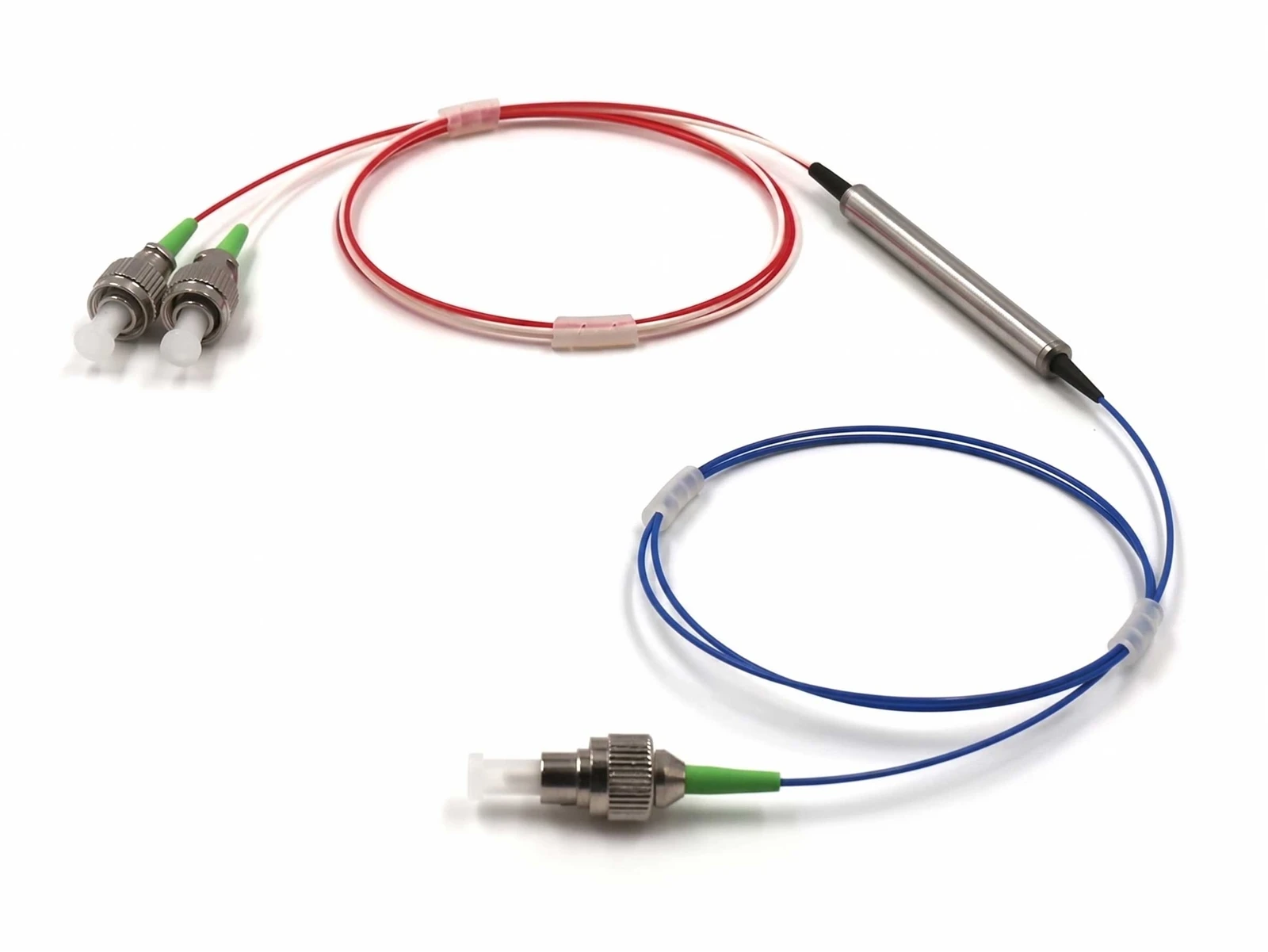
An optical fiber circulator is a passive, non-reciprocal optical device that transfers optical signals from one port to the next in a predefined direction.
The most common configuration is a 3-port optical circulator, where the signal path follows:
Port 1 → Port 2 → Port 3
The device allows optical signals traveling in different directions to use the same fiber while preventing interference between transmitted and received signals.
For example, in a bidirectional fiber communication system:
The transmitter sends an optical signal through Port 1 to Port 2.
The signal travels through the fiber network.
The returning signal enters Port 2 and is redirected to Port 3 for reception.
This directional routing capability makes optical circulators widely used in:
Fiber optic communication systems
FTTH networks
Optical sensing systems
OTDR testing equipment
Fiber laser systems
How Does an Optical Fiber Circulator Work?
Optical Circulator Working Principle
The working principle of an optical fiber circulator is based on the Faraday magneto-optic effect.
Unlike normal optical devices, which are reciprocal and behave the same way in both directions, an optical circulator uses a non-reciprocal optical structure to control signal paths.
Inside an optical circulator, key components typically include:
Magneto-optic crystals
Polarization beam splitters
Wave plates
Fiber coupling components
The magneto-optic crystal changes the polarization direction of light when it passes through a magnetic field. This allows optical signals traveling in different directions to follow different paths.
Signal Routing Process of a 3-Port Optical Circulator
Forward Signal Transmission
When an optical signal enters from Port 1, it passes through the internal optical structure and exits from Port 2.
The transmission path is:
Port 1 → Optical Circulator → Port 2 → Fiber Link
The signal experiences low insertion loss while maintaining transmission quality.
Return Signal Routing
When a reflected or returning optical signal enters from Port 2, the circulator does not send it back to Port 1.
Instead, the non-reciprocal characteristics redirect the signal to Port 3.
The return path is:
Fiber Link → Port 2 → Optical Circulator → Port 3 → Receiver
This separation allows one fiber to support both transmission and reception without signal interference.
Optical Fiber Circulator vs Optical Isolator
Optical circulators and optical isolators are both based on the Faraday effect, but their functions are different.
| Feature | Optical Fiber Circulator | Optical Isolator |
|---|---|---|
| Main Function | Routes optical signals between ports | Blocks reverse optical signals |
| Signal Direction | Multi-port directional routing | One-way transmission |
| Common Ports | 3-port / 4-port | Usually 2-port |
| Reverse Signal | Redirected to another port | Blocked or absorbed |
| Applications | Bidirectional transmission, sensing, OTDR | Laser protection |
The main difference is:
An optical isolator blocks unwanted reflected light, while an optical circulator redirects returned light to another optical path.
Therefore, when the returning optical signal contains useful information, such as in sensing or testing systems, an optical circulator is usually the better choice.
Types of Optical Fiber Circulators
Optical circulators are available in different configurations depending on system requirements.
3-Port Optical Circulator
A 3-port optical circulator is the most commonly used type.
Signal direction:
Port 1 → Port 2 → Port 3
It is widely used in:
Bidirectional optical transmission
Fiber sensing
OTDR systems
Laser protection applications
Advantages:
Compact design
Low insertion loss
Easy system integration
Cost-effective solution
For most telecom and sensing applications, the 3-port circulator provides the best balance between performance and cost.
4-Port Optical Circulator
A 4-port optical circulator provides additional routing capability for more complex optical systems.
It is suitable for:
Advanced optical networks
Laboratory testing systems
Complex fiber routing applications
Compared with 3-port models, 4-port circulators provide more flexibility but require more complicated system design.
Polarization Maintaining Optical Circulator
A polarization maintaining (PM) optical circulator is designed for applications where polarization stability is critical.
It is commonly used in:
Coherent optical communication
Fiber optic gyroscopes
Precision sensing systems
Important parameters include:
Polarization-dependent loss (PDL)
Polarization extinction ratio (PER)
Main Applications of Optical Fiber Circulators
1. Single-Fiber Bidirectional Transmission
One of the most important applications of an optical fiber circulator is enabling two-way communication through a single optical fiber.
Traditional systems often require separate fibers for:
Transmitting signals
Receiving signals
This increases:
Fiber usage
Installation costs
Network complexity
An optical circulator solves this problem by separating the outgoing and incoming optical signals.
Benefits include:
Reduced fiber resource consumption
Simplified cable management
Improved network flexibility
This technology is useful in:
FTTH networks
Access networks
Metro optical systems
2. Fiber Optic Sensing Systems
Fiber sensing applications rely on detecting reflected or backscattered optical signals.
Examples include:
Temperature monitoring
Structural monitoring
Industrial sensing
Distributed fiber sensing
An optical circulator separates:
The outgoing measurement signal
The returning sensing signal
This allows the system to send optical signals into the sensing fiber while collecting the reflected information through a separate receiver path.
3. OTDR Testing Systems
Optical Time Domain Reflectometer (OTDR) systems use optical circulators to separate transmitted pulses from returned signals.
The circulator enables:
OTDR Source → Fiber → Reflected Signal → OTDR Receiver
Applications include:
Fiber fault detection
Connector inspection
Splice loss measurement
Network maintenance
By improving signal separation, optical circulators help increase OTDR measurement accuracy.
4. Fiber Laser and Optical Source Protection
Optical transmitters and fiber lasers can be affected by reflected optical signals.
Back reflections may cause:
Output instability
Increased noise
Reduced laser performance
An optical circulator routes reflected signals away from the laser source, improving system stability.
Common applications include:
Fiber lasers
Optical amplifiers
High-performance optical systems
Key Specifications When Choosing an Optical Fiber Circulator
Selecting the correct optical circulator requires evaluating several technical parameters.
Insertion Loss (IL)
Insertion loss refers to the optical power lost when the signal passes through the circulator.
A lower insertion loss provides:
Better transmission efficiency
Higher optical power budget
Improved system performance
Typical high-performance optical circulators provide:
IL ≤ 1.0 dB
Isolation
Isolation measures how effectively the circulator prevents unwanted optical transmission in the wrong direction.
Higher isolation helps reduce:
Optical feedback
Signal interference
System instability
Typical values:
Isolation ≥ 40 dB
Return Loss (RL)
Return loss indicates the ability of the device to suppress reflected optical signals caused by internal interfaces.
High return loss helps:
Reduce signal distortion
Improve laser stability
Increase reliability
Polarization Dependent Loss (PDL)
PDL describes the difference in insertion loss between different polarization states.
Low PDL is important for:
Coherent communication systems
Precision measurement
Polarization-sensitive applications
Operating Wavelength
The wavelength should match the optical system.
Common wavelength options include:
| Wavelength | Application |
|---|---|
| 850nm | Short-distance optical systems |
| 1310nm | Telecom and access networks |
| 1550nm | Long-distance transmission and sensing |
| 1064nm | Laser applications |
How to Choose an Optical Fiber Circulator Manufacturer?
For telecom operators, distributors, and equipment manufacturers, choosing a reliable optical circulator manufacturer is critical.
Important factors include:
Manufacturing Experience
A professional manufacturer should understand:
Optical component design
Telecom requirements
Application-specific performance needs
Customization Capability
OEM customers may require:
Customized wavelengths
Different fiber types
Connector options
Fiber length configurations
Special packaging designs
A manufacturer with strong customization capability can support different project requirements.
Quality Control
Reliable optical circulator suppliers should perform:
Insertion loss testing
Isolation testing
Return loss testing
Environmental reliability testing
Strict quality control ensures stable optical performance.
Supply Capability
For large-scale projects, consider:
Production capacity
Delivery stability
Technical support
Long-term cooperation capability
FAQ About Optical Fiber Circulators
What is an optical fiber circulator used for?
An optical fiber circulator is used to control optical signal direction, separate transmitted and received signals, and enable bidirectional transmission through a single fiber.
How does a 3-port optical circulator work?
A 3-port optical circulator routes signals in one direction:
Port 1 → Port 2 → Port 3
Signals entering Port 1 exit Port 2, while return signals entering Port 2 are redirected to Port 3.
Is an optical circulator the same as an optical splitter?
No. An optical splitter divides optical power into multiple outputs, while an optical circulator controls signal direction between different ports.
What is the difference between an optical circulator and an isolator?
An optical isolator blocks backward optical signals, while an optical circulator redirects them to another port.
What applications use optical circulators?
Common applications include:
Fiber communication
FTTH networks
OTDR testing
Fiber sensing
Fiber laser systems
Conclusion
An optical fiber circulator is a critical passive optical component that enables directional signal routing in modern fiber networks.
By using non-reciprocal optical technology, it provides key advantages:
Single-fiber bidirectional transmission
Optical signal separation
Laser protection
Accurate reflected signal detection
When selecting an optical circulator, engineers should consider:
Operating wavelength
Port configuration
Fiber type
Optical performance
Application requirements
Spring Optical provides reliable optical fiber circulators and passive fiber optic solutions for telecom, sensing, and optical system applications.
With OEM customization capabilities and project-based support, Spring Optical helps customers develop efficient and reliable optical communication solutions.
Contact Spring Optical to discuss your optical fiber circulator requirements.