

Quick Summary / Key Takeaways for Network Engineers & Buyers:
Standard vs. Brand: MPO (Multi-Fiber Push-On) is an open international standard connector (IEC 61754-7). MTP® is a patented, high-performance optical brand manufactured by US Conec that exceeds generic MPO performance.
Compatibility: 100% Intermateable. You can plug an MTP connector directly into an MPO connector interface.
Engineering Advantages: MTP features a removable housing (for field rework), floating ferrule (avoids optical dropouts under load), elliptical metal guide pins (reduce wear), and lower insertion loss (≤0.35 dB vs MPO's 0.50–0.75 dB).
Best Application Fit: Choose MTP for high-density 400G / 800G / 1.6T AI clusters and critical data center backbones. Choose generic MPO for budget-sensitive, static, low-speed (10G/40G) legacy cabling.
Introduction: Why MTP vs MPO Matters in High-Speed Networks
As artificial intelligence (AI) workloads, machine learning (ML) processing clusters, and enterprise cloud data centers push network backbones from 100G and 400G toward 800G and 1.6T speeds, legacy single-fiber connections (like LC or SC) can no longer deliver the density required.
Multi-fiber connectivity components-specifically MTP and MPO fiber optic patch cables-have become the industry standard due to their modular scalability, high optical performance, and space-saving form factor.
However, network installers and procurement managers frequently confuse MTP and MPO connectors. While they look nearly identical on the outside, their internal mechanical engineering, alignment tolerances, and long-term signal stability differ significantly. This guide breaks down those differences to help you select the optimal solution for your infrastructure deployment.


What Is the Difference Between MTP and MPO Connectors?
To eliminate common confusion, let's define both connector standards clearly:
MPO (Multi-Fiber Push-On)
Originally developed by Japan's NTT Corporation in the late 1980s, MPO is an open, generic multi-fiber connector architecture governed by international standards including:
IEC 61754-7
TIA-604-5 (FOCIS 5)
MPO connectors accommodate 8, 12, 16, or 24 optical fibers within a single rectangular ferrule and use male (with alignment pins) and female (with pinholes) mating configurations.
MTP® (Multi-Fiber Termination Push-On)
MTP® is a registered trademark of US Conec. It is an advanced, engineered variant of the generic MPO connector. US Conec improved the traditional MPO mechanical design with multiple patented features to achieve superior mechanical stability and optical transmission performance.
Rule of Thumb: All MTP connectors are MPOs, but not all MPO connectors are genuine MTPs.
Can You Connect an MTP Cable to an MPO Cable?
Yes. MTP connectors are fully compliant with MPO standards (IEC 61754-7 and TIA-604-5), making them 100% physically interoperable.
An MTP patch cord will plug directly into an MPO adapter, cassette, or transceiver.
Critical Considerations When Mixing MTP and MPO:
Optical Loss Accumulation: While physical mating works smoothly, plugging a generic high-loss MPO connector into an ultra-low-loss MTP system creates an optical loss bottleneck at the mating interface.
Wear & Tear: Standard MPO guide pins can cause physical wear inside the precision pinholes of an MTP ferrule over repeated insertion cycles.
For mission-critical 400G/800G networks, maintaining end-to-end MTP component continuity is recommended to protect tight insertion loss budgets.
Mechanical Engineering Differences: Why MTP Performs Better
The technical superiority of an MTP connector over a generic MPO connector lies in six patented internal mechanical features:
| Mechanical Feature | Generic MPO Connector | US Conec MTP® Connector | Technical Benefit of MTP |
| Origin / Patent | NTT (Open Standard) | US Conec (Patented) | Engineered for tight-tolerance, low-loss links |
| Housing Design | Fixed Housing | Removable Housing | Allows field re-polishing, gender change & polarity correction |
| Ferrule Design | Fixed / Limited Float | Fully Floating Ferrule | Maintains physical contact under cable load |
| Guide Pin Shape | Flat Chamfered Ends | Elliptical Polished Steel | Prevents wear, scratches, and alignment debris |
| Pin Clamp Material | Plastic Pin Clamp | Durable Metal Clamp | Eliminates pin breakage during frequent matings |
| Spring Mechanism | Oval Spring | Centered Elliptical Spring | Protects ribbon fiber from internal spring wear |


Key Mechanical Highlights:
Removable Housing: Unlike fixed-housing MPO cables, MTP housings can be removed on-site. This allows technicians to clean end-faces, change gender (male to female), or swap polarity without re-terminating the cable assembly.
Floating Ferrule Technology: When two connectors are mated, external cable load or twisting can displace standard MPO ferrules. The MTP floating ferrule allows internal movement, ensuring continuous physical contact even under mechanical strain.
Elliptical Steel Guide Pins: MPO flat-ended pins can collide during blind mating, creating microscopic debris inside pinholes that degrades signal quality. MTP elliptical pins slide smoothly, reducing wear and maintaining alignment precision across 1,000+ insertion cycles.
Optical Performance & Testing Metrics
A primary advantage of MTP's mechanical engineering is consistent, low optical loss across multi-fiber links.
| Technical Parameter | Standard Generic MPO | Standard MTP Connector | Premium MTP Elite® |
| Typical Insertion Loss (IL) | 0.50 dB – 0.75 dB | ≤ 0.35 dB | ≤ 0.25 dB (Ultra-Low Loss) |
| Return Loss (APC Polish) | ≥ 50 dB | ≥ 60 dB | ≥ 65 dB |
| Mating Durability | ~200 – 500 cycles | Over 1,000 cycles | Over 1,000 cycles |
| Operating Temperature | -20°C to +70°C | -40°C to +85°C | -40°C to +85°C (Industrial) |

At Spring Optical's manufacturing facility, 100% of MTP/MPO cable assemblies undergo 3D Interferometer inspection and Optical Return Loss (ORL) testing to ensure zero-defect delivery.
MTP/MPO Cable Types & Polarity Management
Multi-fiber cabling infrastructure relies on modular components:
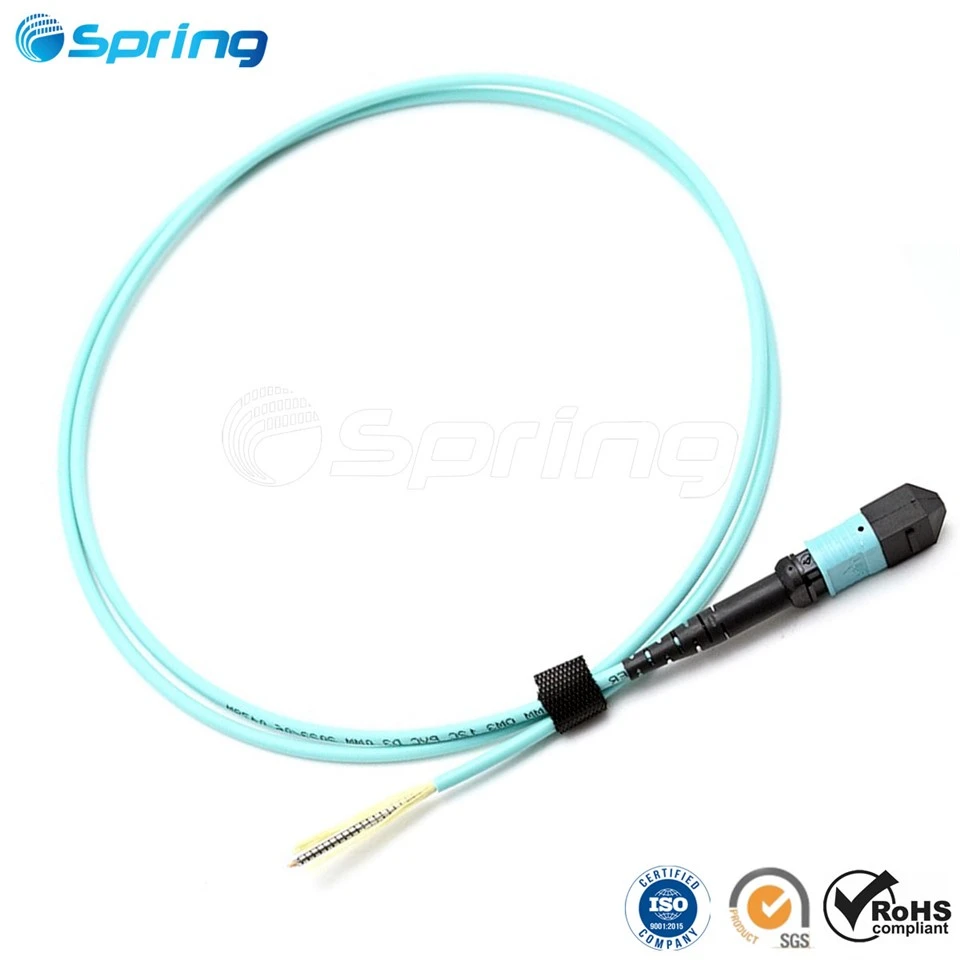
MTP/MPO Trunk Cables: Backbone connection cables (12, 24, 48, or 72 fibers).
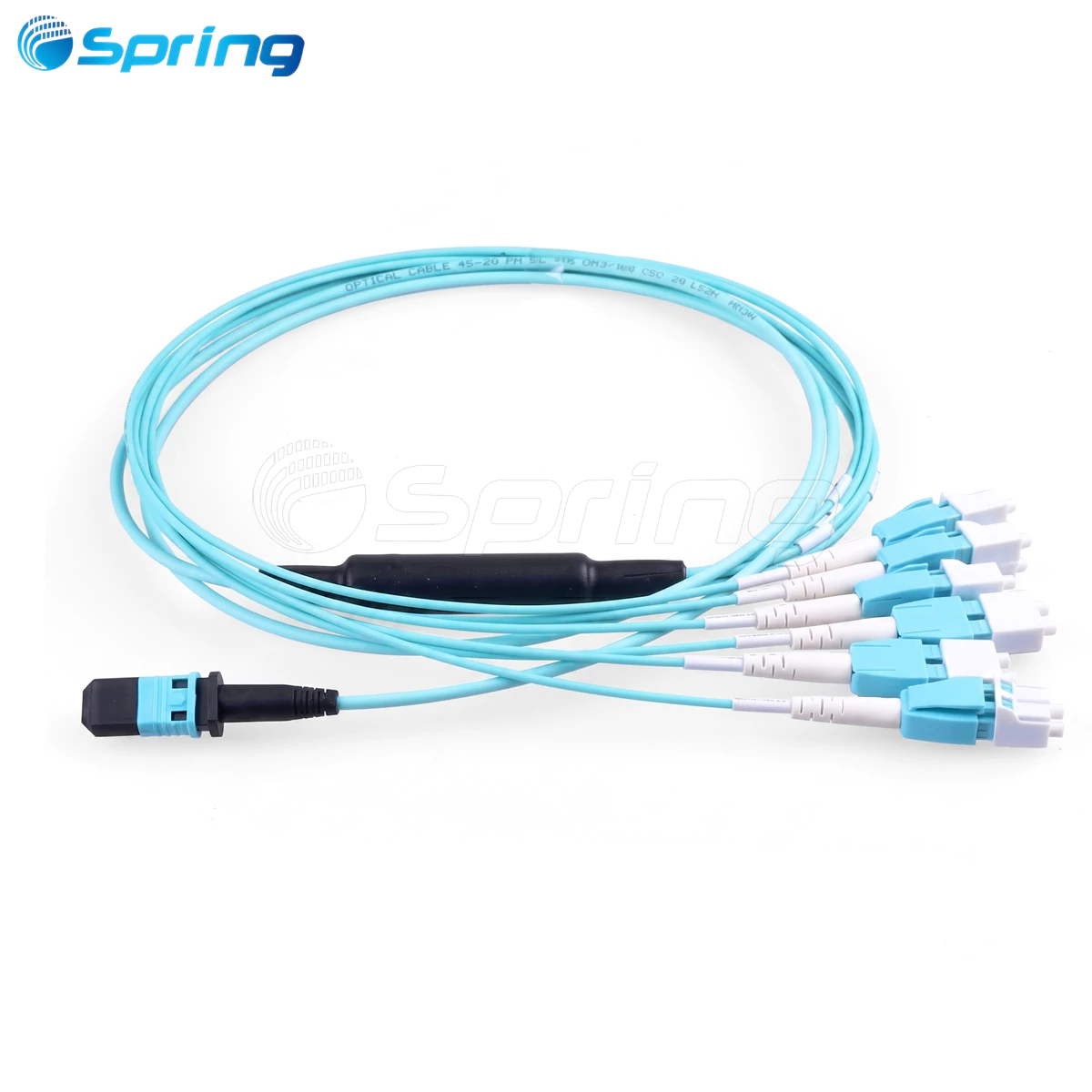
MTP/MPO Breakout Cables: Fan-out cables splitting multi-fiber connectors into LC/SC duplex paths.
MTP/MPO Cassettes & MTP/MPO Patch Panels: High-density modular enclosures for cross-connect fields.
Understanding Polarity Methods (TIA-568 Standard)
To transmit optical signals correctly, Fiber 1 (Tx) at one end must land on Fiber 1 (Rx) at the receiving active equipment. TIA-568 defines three polarity methods:
Type A (Straight-Through): Key-Up to Key-Down adapters. Fiber 1 on end A maps to Fiber 1 on end B.
Type B (Crossover): Key-Up to Key-Up adapters. Fiber 1 maps to Fiber 12 (or 24). This is the primary standard for 400G/800G direct transceiver connections.
Type C (Flipped Pairs): Key-Up to Key-Down adapters with adjacent pairs flipped (1-2 becomes 2-1). Common in legacy 10G duplex infrastructures.
MTP/MPO in 800G and 1.6T AI Data Center Architectures
The explosion of Generative AI clusters (using platforms like NVIDIA Quantum InfiniBand or RoCE v2 Ethernet) requires massive parallel processing power and ultra-dense connectivity.
800G AI Optical Connectivity Architecture
800G OSFP Transceiver → Base-16 MTP Connector→16-Fiber MTP Single-Mode Trunk Cable→High-Density Spine-Leaf Switch Field
Connectivity Requirements for AI Optics:
| Network Speed | Transceiver Type | Fiber Format Required | Recommended Solution |
| 400G Ethernet | 400G DR4 / SR4 | 8-Fiber MTP/MPO | MTP-8 or MTP-12 Method B Single-Mode Trunk |
| 800G AI Networks | 800G SR8 / DR8 | 16-Fiber MTP/MPO | Base-16 MTP Single-Mode / OM5 Assemblies |
| 1.6T Next-Gen | 1.6T OSFP-XD / CPO | Parallel Multi-Core MTP | Ultra-Low Loss MTP Elite® Custom Assemblies |
Why MTP is Crucial in AI Racks: High-density AI GPU servers generate micro-vibrations and heat. Standard MPO connectors are susceptible to alignment slippage under thermal stress, while MTP's floating ferrule and stainless steel guide pins eliminate micro-disconnections and Bit Error Rate (BER) spikes.
Commercial Decision Matrix: Should You Choose MTP or MPO?
While MTP connectors offer superior technical specs, they carry a higher component price due to US Conec patent licensing. Use this practical guide to choose the right cable for your budget:
Choose Generic MPO Cables If:
Budget Sensitivity is Paramount: Project material costs must be kept strictly minimal.
Low-Speed Legacy Infrastructure: Running 10G or standard 40G links where optical insertion loss tolerances are forgiving.
Static Installations: The cabling will be installed once and remain untouched for years (no routine Moves, Adds, and Changes).
Choose Premium MTP® Cables If:
High-Speed Infrastructure (400G / 800G / 1.6T): You are building critical data center links where insertion loss budgets are extremely tight.
Frequent MACs (Moves, Adds, Changes): Your field technicians need to change cable gender or polarity on-site using removable housings.
AI & High-Performance Computing (HPC): Operating in liquid-cooled or vibration-prone server environments requiring long-term link stability.
Frequently Asked Questions (FAQ) About MTP vs MPO
Is MTP fully compatible with generic MPO?
Yes, MTP and MPO connectors are 100% physically intermateable. MTP complies with optical standards like IEC 61754-7 and TIA-604-5. However, mixing a standard MPO with a low-loss MTP connector may create an optical insertion loss bottleneck in high-speed 400G/800G links.
Why is MTP more expensive than standard MPO?
MTP connectors are patented high-performance components manufactured by US Conec. They cost 20%–40% more than generic MPO connectors due to precision optical engineering, patented features (like floating ferrules and elliptical guide pins), lower insertion loss guarantees, and patent licensing costs.
What is the difference between MTP Elite and standard MTP?
Standard MTP connectors feature a maximum insertion loss of ≤0.35 dB, while MTP Elite® connectors offer ultra-low insertion loss of ≤0.25 dB (single-mode and multimode). MTP Elite is designed specifically for loss-sensitive 400G/800G/1.6T hyperscale networks.
Can I change MTP connector polarity and gender on-site?
Yes. Unlike generic MPO connectors with fixed housings, MTP connectors feature a removable outer housing. This allows field technicians to change gender (male/female guide pins) and adjust polarity (Type A/Type B) without needing to cut or re-splice the fiber cables.
Which Base architecture (Base-8, Base-12, or Base-16) is best for AI networks?
Base-16 MTP architecture is currently the primary standard for 800G AI GPU clusters (such as NVIDIA OSFP/QSFP112 800G SR8/DR8 transceivers). Base-8 is widely used in 400G setups, while Base-12 remains popular for traditional 10G/40G/100G cassette migrations.
Summary & Expert Advice
Understanding the differences between MTP and MPO fiber cables ensures your network infrastructure remains stable, reliable, and scalable. While generic MPO connectors offer a cost-effective solution for low-speed legacy setups, premium US Conec MTP® connectors deliver the mechanical precision, field versatility, and ultra-low insertion loss required for modern 400G, 800G, and AI data centers.
Need Custom MTP/MPO Cabling Solutions?
Shenzhen Spring Optical Communication provides 100% factory-tested, custom-length MTP® and MPO cable assemblies, breakout cords, and high-density cassettes tailored for your network deployment.
Browse MTP/MPO Data Center Cabling
Contact Our Technical Engineering Team to request customized OEM design support or competitive pricing.