

Author: Hayden
1. Introduction
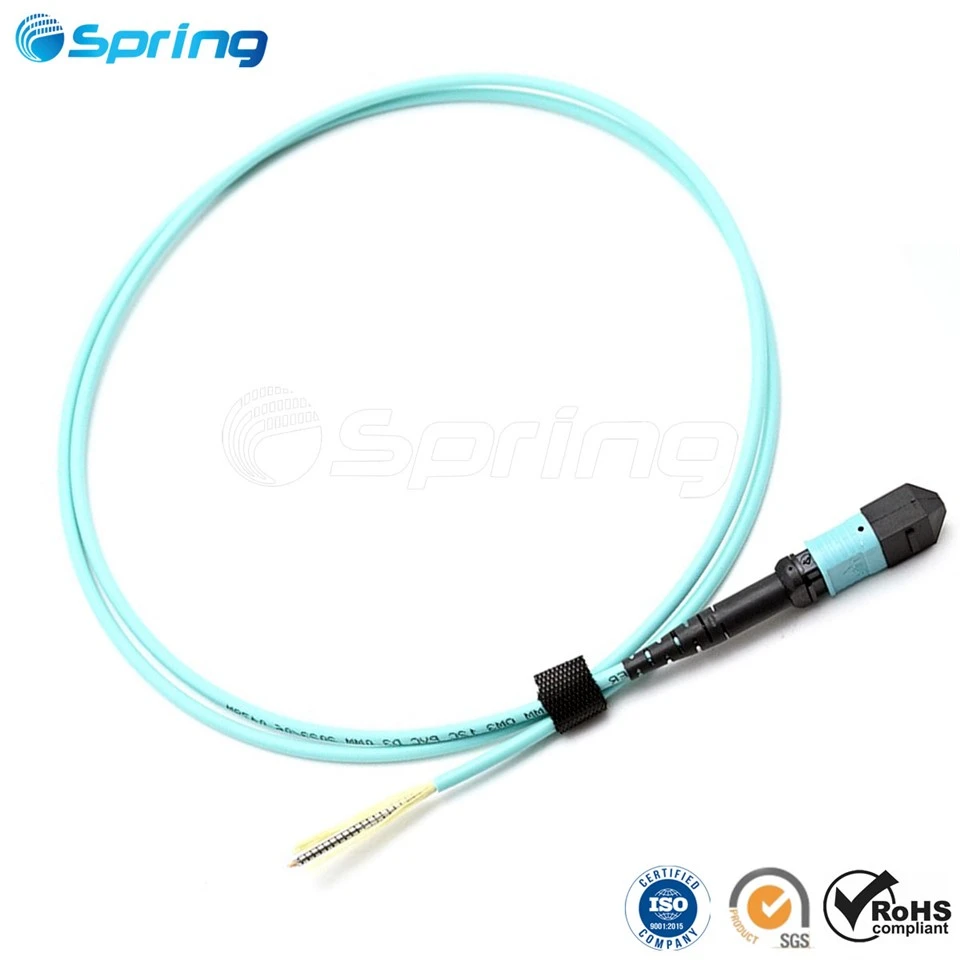
Air-Blown Micro Cable is a specialty optical fiber cable with an outer diameter less than half that of a Standard Fiber Cable. Due to its small diameter and relatively poor mechanical properties, Air-Blown Micro Cable cannot be deployed using traditional manual installation methods; it must be installed via air-blown deployment inside a slightly larger Microduct.
Currently, underground duct space is extremely limited for both Backbone Network and Metropolitan Network deployment. Compared with standard cables, using Air-Blown Micro Cable can save nearly 50% of duct space. This raises the question: is Air-Blown Micro Cable technology worth promoting?
2. Overview of Air-Blown Micro Cable Technology
2.1 Micro Cables
Micro cables are commonly available in Central Tube and Stranded structures.
Central Tube Micro Cable offers better temperature performance but has a maximum fiber count of 24, with a typical type designation of GYCFXTY.

Stranded Micro Cable can support up to 576 fibers, but has poorer temperature characteristics. For long-distance air-blown installation, extra cable length must be reserved at the start and end of each section to accommodate thermal expansion. Stranded micro cables have a relatively thin protective layer; if filled with grease, long-term storage may cause grease leakage, affecting air-blown performance. Therefore, stranded micro cables typically use dry or semi-dry designs, with type designation GCYFY.

The comparison of outer diameter and cross-sectional area between commonly used micro cables and standard fiber cables (e.g., GYTA) is shown in the following table:
|
Fiber Count |
Outer Diameter (mm) – Micro Cable |
Outer Diameter (mm) – Standard Fiber Cable |
Cross-Section Area Ratio |
|
6, 12 |
2.3 (*) |
9.2 |
6% |
|
24 |
2.6 (*) |
9.2 |
8% |
|
12, 24 |
4.5 |
9.2 |
24% |
|
36 |
4.5 |
10.2 |
19% |
|
48 |
5.4 |
10.4 |
27% |
|
72 |
5.4 |
11.4 |
22% |
|
96 |
6.1 |
13.6 |
20% |
|
144–216 |
7.9 |
16.4 |
23% |
Note: Micro cables marked with "" are central tube designs; all others are stranded designs.*
The allowable tensile strength of a fiber optic cable generally scales with its cross-sectional area. Therefore, micro cables have significantly lower tensile strength than standard fiber cables. Specifically, the long-term and short-term allowable crush force for micro cables are 150 N / 450 N, less than half that of standard fiber cables (300 N / 1000 N).
2.2 Microducts

A Microduct is a flexible, circular plastic tube with a maximum outer diameter of 16 mm. It is made of a silicone-plastic composite material, usually with a bright, easily distinguishable color. The outer wall is typically high-density polyethylene (HDPE), and the inner wall is coated with a permanent solid lubricant layer (silicone core), sometimes with airflow channels.
Depending on installation requirements, microducts are classified into standard and reinforced types:
Standard Microducts have thin walls and are mainly used for air-blown deployment inside existing silicone-core ducts, or can be manually installed in empty ducts.
Reinforced Microducts have thicker walls to resist tensile or compressive forces, suitable for ducts already containing cables or for protection inside handholes.
The table below summarizes the applicable microduct specifications for different micro cable types:
|
Cable Type |
Fiber Count |
Outer Diameter (mm) |
Applicable Duct Size – Air-Blown |
Applicable Duct Size – Pulled Installation |
|
Central Tube |
6, 12 |
2.3 |
5 / 3.5 |
7 / 3.5 |
|
Central Tube |
24 |
2.6 |
5 / 3.5 |
7 / 3.5 |
|
Stranded |
12, 24, 36 |
4.5 |
6 / 8 |
- |
|
Stranded |
48, 72 |
5.4 |
8 / 10 |
8 / 12 |
|
Stranded |
96 |
6.1 |
8 / 10 |
- |
|
Stranded |
144–216 |
7.9 |
10 / 12 |
10 / 14 |
Newly installed microduct systems typically use bundle microducts (also called "duct-cable"), which contain one or more color-coded microducts. The outer sheath is usually HDPE in a single color.
In China, bundle microducts are widely used along expressway communication corridors, commonly containing seven 12/9 microducts.
2.3 Air-Blown Micro Cable
Air-Blown Micro Cable is installed using a mechanical feeder that pushes the cable forward while an air compressor injects high-speed airflow into the microduct. The airflow generates forward thrust along the cable surface, enabling rapid air-blown deployment. A single air-blown section can exceed 1,000 meters. This principle also applies when microducts are air-blown inside silicone-core ducts.

3. Impact of Micro Cables on Duct Capacity
3.1 Backbone Network Ducts

Backbone ducts typically use 40/33 silicone-core ducts, where one standard fiber cable is installed per duct using air-blown or pulled methods. With microducts, four 12/10 or five 12/8 microducts can first be blown into the 40/33 duct, each carrying one Air-Blown Micro Cable. Even if a standard cable is already deployed in the duct, at least one microduct can still be air-blown inside.
Using Air-Blown Micro Cable technology can more than double the duct capacity in terms of the number of cables deployed.
3.2 Metropolitan Network Ducts

Metropolitan ducts mainly consist of:
Plum-pipe (7-hole) ducts with 32 mm inner diameter.
Single-hole plastic ducts with 100 mm inner diameter.
A single sub-duct in a plum-pipe can accommodate 1–3 standard fiber cables of different diameters; each plum-pipe can deploy more than 10 standard fiber cables.
By combining different microduct sizes, multiple microducts can be manually installed in one sub-duct. Since high fiber-count ribbons are unsuitable for micro cable structures, some duct space must be reserved for large-fiber standard cables.
Overall, using Air-Blown Micro Cables in metropolitan ducts can allow over 20 cables per plum-pipe, nearly doubling the capacity compared to standard fiber cables.
For single-hole ducts, deploying microducts (e.g., 40/33 silicone-core ducts) allows one duct to carry roughly 10 standard fiber cables or 20 cables if using both micro and standard cables.
In practice, to maximize standard cable deployment, some single-hole ducts are directly filled with standard cables without sub-ducts, achieving 20+ cables per duct, but this leads to entangled cables that are prone to sheath damage during installation and complicates future replacement, making direct comparison with air-blown micro cables invalid.
4. Cost Comparison Between Micro and Standard Fiber Cables
4.1 Backbone Network Duct Installation
When duct space is limited, expanding duct capacity without microducts requires new route construction. Building a backbone duct can cost 70,000–100,000 RMB/km (for 3 silicone-core ducts). In contrast, expanding existing ducts using air-blown micro cable technology costs less than 2,000 RMB/km (accounting for microduct and micro cable minus equivalent standard cable).
Thus, air-blown micro cable technology offers significant cost advantages for backbone ducts.
4.2 Metropolitan Network Duct Installation
Micro cable costs consider both duct occupation and cable construction. In many cities, ducts are purchased, with plum-pipe prices ranging 40,000–100,000 RMB/km. If a single plum-pipe accommodates 10 cables, the duct cost per cable is 4,000–10,000 RMB/km.
Using a 48-fiber cable as an example, the estimated costs are:
|
Fiber Cable Type |
Micro Cable |
Standard Fiber Cable |
|
Duct Occupation Cost |
2,000–5,000 RMB/km |
4,000–10,000 RMB/km |
|
Cable Laying Cost |
9,450 RMB/km |
7,500 RMB/km |
|
Total Cost |
11,450–13,450 RMB/km |
11,500–17,500 RMB/km |
Although Air-Blown Micro Cables are priced higher than standard fiber cables and require pre-installation of microducts, the overall cost-especially when accounting for duct occupation-is lower than that of standard fiber cables, particularly in metropolitan networks with high duct acquisition or construction costs.
5. Conclusion
Air-Blown Micro Cables offer a significant advantage in backbone networks. On expressway corridors with bundle microducts, micro cables are a natural choice.
In metropolitan ducts, micro cables still have a cost advantage over standard fiber cables but require specialized air-blowing equipment, and their weaker mechanical properties pose safety considerations in handholes. This explains the currently lower adoption rate.
However, air-blown micro cables dramatically reduce labor requirements and multiply duct capacity. As labor costs rise and duct space becomes scarcer, the advantages of air-blown micro cable technology will become increasingly evident.