

Author: Hayden
About the Author
This article is written by a fiber optic connectivity specialist with hands-on experience in MPO/MTP-based data center cabling systems, including structured cabling design, polarity planning, and high-density backbone deployment for 40G to 400G Ethernet networks.
The content is intended for educational and engineering reference purposes and reflects common industry practices aligned with TIA and ISO/IEC standards.
Standards & Technical References
The technical concepts discussed in this article reference commonly accepted industry standards and practices, including TIA polarity definitions and ISO/IEC TR 11801-9908 guidelines for multimode fiber cabling systems.
Introduction: Why MPO Polarity Matters in Modern Fiber Networks
As data centers continue to migrate toward 40G, 100G, 200G, and 400G Ethernet, MPO-based connectivity has become the backbone of high-density fiber infrastructure.
However, one of the most common causes of link failure in MPO deployments is incorrect polarity management.
This article explains how trunk fiber connects to MPO connectors, how MPO polarity works, and how to select the correct MPO trunk and breakout solutions in real-world deployments.
What Is an MPO Connector?

An MPO (Multi-fiber Push-On) fiber optic connector is designed to terminate multiple fibers in a single, compact interface.
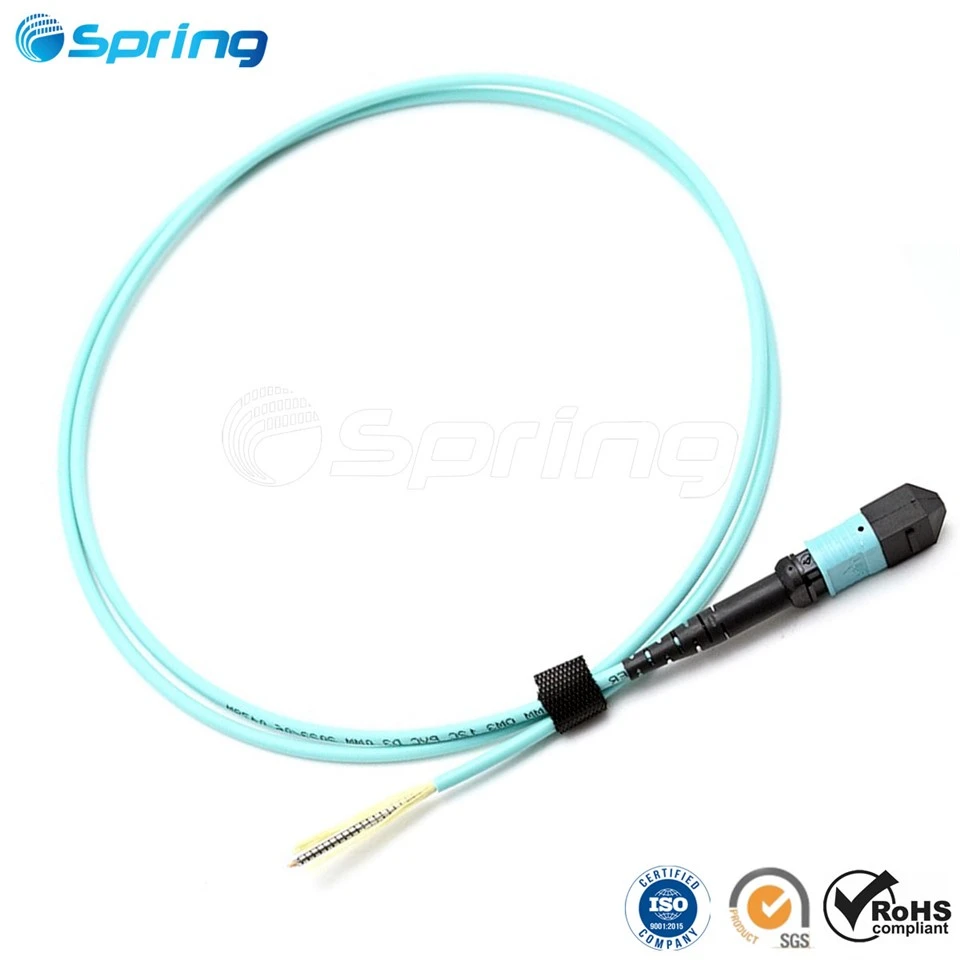
An MPO fiber patch cord consists of both connectors and fiber cable assemblies, integrating:
Optical fibers
Outer cable jacket
Coupling mechanism
Metal ferrule ring
Alignment pins
Protective dust caps
This design enables high-density, parallel optical transmission, making MPO connectors essential for modern data center backbone cabling.
MPO Male vs Female Connectors: Pin Configuration Explained
MPO connectors are classified by guide pin configuration:
Male MPO connector: Equipped with two alignment pins
Female MPO connector: No alignment pins
The alignment pins ensure precise fiber-to-fiber mating, reduce insertion loss, and maintain accurate optical alignment during connection.
In any MPO link, male and female connectors must be correctly paired to avoid physical damage and signal degradation.
Duplex Transmission and the Concept of MPO Polarity
In optical communication, a complete transmission path requires two fibers:
One fiber for Transmit (Tx)
One fiber for Receive (Rx)
For this reason, all Ethernet optical links rely on duplex transmission, even when using parallel optics.
Because duplex communication depends on two fibers forming a complete optical path, MPO polarity management ensures that the Tx port on one end always connects to the Rx port on the other end.
According to TIA standards, end-to-end duplex connectivity is achieved using two LC or SC duplex patch cord types:
Type A-B Duplex Patch Cord (Straight-Through)
Type A-A Duplex Patch Cord (Crossover)

MPO Trunk Cable Polarity Types
Different polarity methods require different MPO trunk cable configurations.
However, all polarity methods ultimately rely on duplex patch cords to complete the optical link.
MPO–MPO Straight-Through Cable (Type A)

Type A (Straight-Through) MPO trunk cables maintain identical fiber positions on both ends:
Fiber 1 → Fiber 1
Fiber 12 → Fiber 12
Key orientation is opposite on each end:
Key-Up ↔ Key-Down
This method preserves fiber order and is commonly used in structured cabling systems.
MPO–MPO Full Crossover Cable (Type B)

Type B (Full Crossover) MPO trunk cables completely reverse fiber positions:
Fiber 1 → Fiber 12
Fiber 12 → Fiber 1
Key orientation is the same on both ends:
Key-Up → Key-Up
Key-Down → Key-Down
Type B polarity is widely used in 40G / 100G / 400G parallel optic links.
MPO–MPO Pairwise Crossover Cable (Type C)

Type C (Pairwise Crossover) MPO trunk cables swap fibers in adjacent pairs:
Fiber 1 → Fiber 2
Fiber 12 → Fiber 11
Key orientation is opposite (Key-Up ↔ Key-Down).
This method is typically used in 10G and 25G duplex breakout applications.
Practical MPO Connectivity Scenarios
In real data center and enterprise deployments, pre-terminated MPO solutions are widely used to reduce installation time and minimize field errors.
MPO-to-MPO Link

An MPO-to-MPO link supports high-speed parallel Ethernet applications, including:
40GBASE-SR4
100GBASE-SR4
200GBASE-SR4
400GBASE-SR8
400GBASE-SR16
400G BiDi
This configuration is commonly used in data center backbone cabling and spine-leaf architectures.
LC-to-LC Link

An LC-to-LC link uses LC duplex connectors on both ends and supports:
10GBASE-SR
25GBASE-SR
40G-SWDM4
100G-BiDi
100G-SWDM4
Common configurations include Type 1, Type 2, and Type 3, depending on polarity and transceiver requirements.
MPO-to-LC Breakout Link

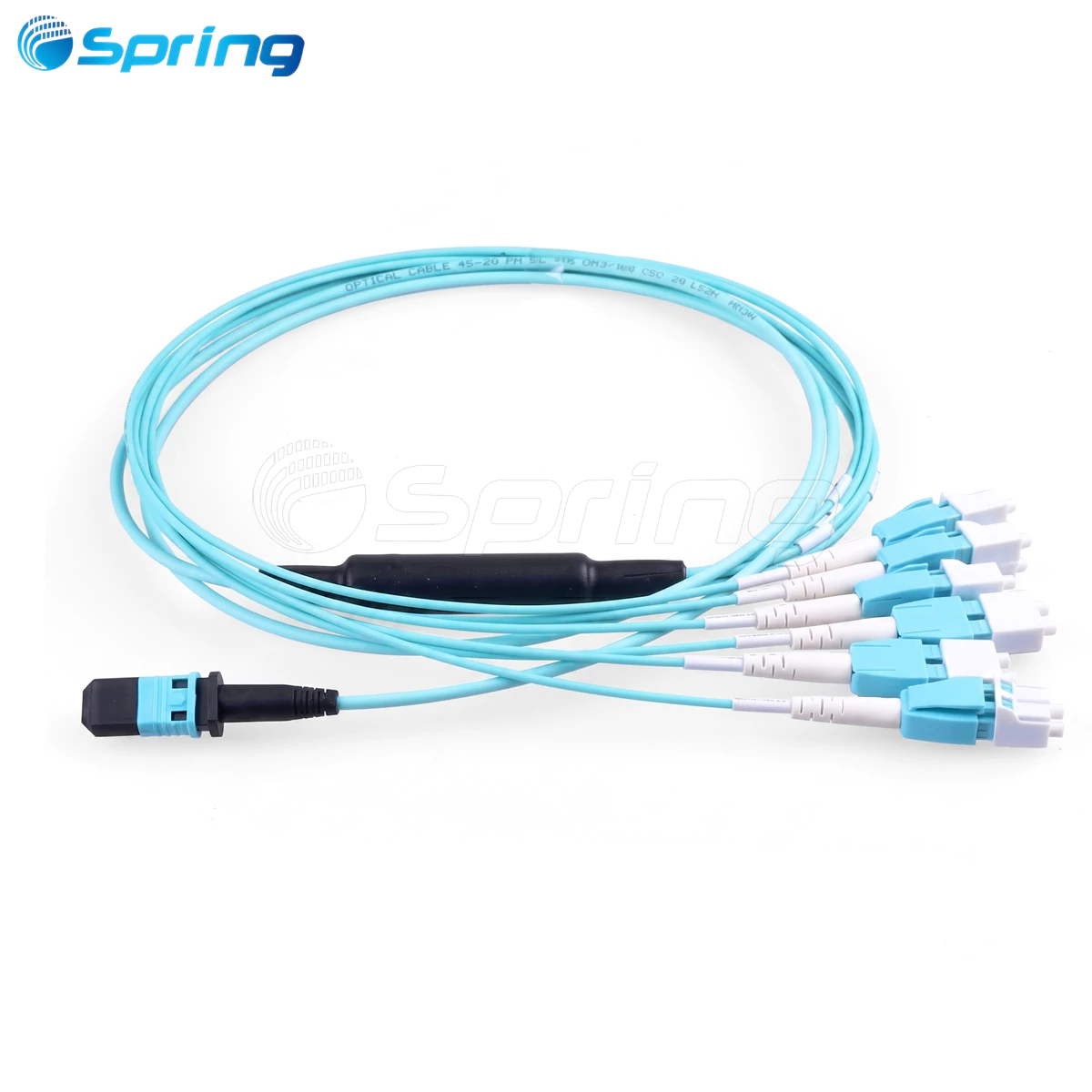
An MPO-to-LC breakout cable connects an MPO interface to multiple LC duplex connectors, enabling migration from parallel optics to duplex optics.
Typical use cases include:
40GBASE-SR4 → 10GBASE-SRx4
100GBASE-SR4 → 25GBASE-SRx4
100GBASE-SR10 → 10GBASE-SRx10
Ethernet Application Reference
LC-Based Applications
|
Application |
10GBASE-SR |
25GBASE-SR |
50GBASE-SR4 |
40G-SWDM4 |
100G-SWDM4 |
|
Rate |
10 Gbps |
25 Gbps |
50 Gbps |
40 Gbps |
100 Gbps |
|
Standard |
IEEE 802.3 |
IEEE 802.3 |
IEEE 802.3 |
MSA |
MSA |
|
Fiber |
OM3 / OM4 / OM5 |
OM3 / OM4 / OM5 |
OM3 / OM4 / OM5 |
OM3 / OM4 / OM5 |
OM3 / OM4 / OM5 |
|
Distance |
300 / 400 m |
70 / 100 m |
70 / 100 m |
240 / 440 m |
75 / 150 m |
|
Core Count |
2 |
2 |
2 |
2 |
2 |
|
Connector |
LC Duplex |
LC Duplex |
LC Duplex |
LC Duplex |
LC Duplex |
MPO-Based Applications
|
Application |
40GBASE-SR4 |
100GBASE-SR10 |
200GBASE-SR4 |
400GBASE-SR8 |
400G-BiDi |
|
Rate |
40 Gbps |
100 Gbps |
200 Gbps |
400 Gbps |
400 Gbps |
|
Standard |
IEEE 802.3 |
IEEE 802.3 |
IEEE 802.3 |
IEEE 802.3 |
MSA |
|
Fiber |
OM3 / OM4 / OM5 |
OM3 / OM4 / OM5 |
OM3 / OM4 / OM5 |
OM3 / OM4 / OM5 |
OM3 / OM4 / OM5 |
|
Distance |
100 / 150 m |
100 / 150 m |
70 / 100 m |
70 / 100 m |
70 / 150 m |
|
Core Count |
12 (use 8) |
24 (use 20) |
12 (use 8) |
24 (use 16) |
12 (use 8) |
|
Connector |
MPO/MTP |
MPO/MTP |
MPO/MTP |
MPO/MTP |
MPO/MTP |
How to Choose the Right MPO Cabling Solution
When selecting an MPO cabling solution, consider:
Network architecture (spine-leaf, access, aggregation)
Required transmission speed
MPO polarity type (A / B / C)
MPO male or female connector configuration
The standard ISO/IEC TR 11801-9908 provides guidance for multimode fiber cabling selection based on application type and link length.
OM3 and OM4 support all common 10G / 40G / 100G / 200G / 400G applications
OM5, when used with SWDM technologies such as 400G SR4.2, enables extended reach
Conclusion
Understanding MPO connector structure, polarity methods, and link configurations is essential for building reliable high-speed fiber networks.
By selecting the correct MPO trunk cable type and matching polarity scheme, network designers can ensure accurate Tx/Rx alignment, simplify deployment, and future-proof their infrastructure for higher data rates.
FAQ
Q: What is MPO cable polarity and why is it important?
A: MPO cable polarity ensures the correct alignment of transmit (Tx) and receive (Rx) fibers between devices. Proper polarity prevents network link failure and reduces installation errors in high-speed data centers.
Q: What are the different MPO polarity types?
A: There are three main MPO polarity types: Type A (Straight-Through), Type B (Full Crossover), and Type C (Pairwise Crossover). Each type defines how fibers are mapped between connector ends.
Q: How do I choose the right MPO polarity for my network?
A: Select polarity based on your network architecture (spine-leaf, access), transmission speed, and device requirements. Use Type A for structured cabling, Type B for parallel optics, and Type C for breakout links.
Q: What is the difference between MPO male and female connectors?
A: Male MPO connectors have guide pins for alignment, while female connectors do not. Correct male-female pairing is essential to reduce insertion loss and prevent physical damage.
Q: Can MPO trunk cables be used for 40G–400G networks?
A: Yes. Pre-terminated MPO trunk cables support high-speed parallel optics like 40GBASE-SR4, 100GBASE-SR4, 200GBASE-SR4, and 400GBASE-SR8/SR16. Proper polarity ensures reliable performance.
Q: What is the difference between an MPO-to-MPO link and an MPO-to-LC breakout link?
A: MPO-to-MPO links connect parallel optics directly for high-speed Ethernet, while MPO-to-LC breakout links convert parallel MPO connections into multiple LC duplex fibers for lower-speed duplex optics like 10G or 25G.
Related Technical Resources
• MPO vs MTP Connectors: What's the Difference?
• MPO Polarity Methods Explained (Type A, B, C)
• Pre-Terminated MPO Trunk Cables for Data Centers
• MPO to LC Breakout Cables for 10G / 25G Migration