

Author: Hayden

How Deep is Fiber Optic Cable Buried: Insights to Enhance Network Durability
In an increasingly interconnected world, fiber optic cables underpin the high-speed internet we've come to depend on, powering telecommuting, web streaming, smart cities, and much more. With international fiber networks predicted to grow to over 1.8 million km in scope by 2025 (per TeleGeography), burying these cords of light comes with the benefits of avoiding cable damage, decreasing downtime, and extending their operational lifetime. But how deep is fiber optic cable buried? The depth can vary from location to location, based on a number of different environmental influences. In this guide, we'll break down depths commonly used, influencing factors, best practices, challenges, and discuss emerging trends. That way you'll have the knowledge you need to ensure an effective installation that saves you headaches (and cash) down the road.
Standard Depths for Buried Fiber Optic Cable Placement by Location and Need
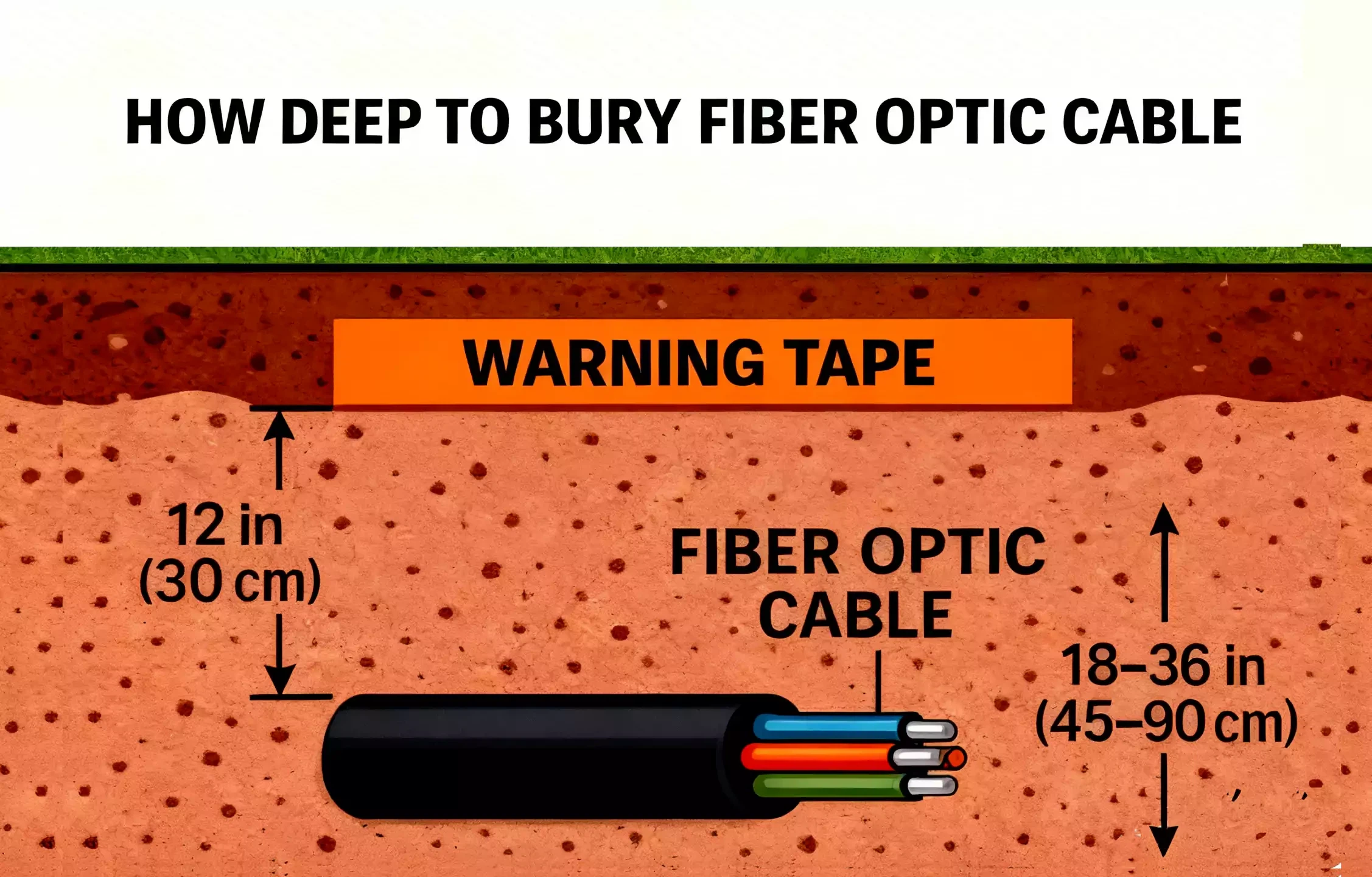
Standards, including National Electrical Code (NEC) in the US, the European Telecommunications Standards Institute (ETSI), and International Telecommunication Union (ITU), set recommendations or requirements for how deep to bury fiber optic cables. Depths are established based on principles of protecting cables from physical impact and dispersing adverse weather effects should they encounter water, frozen temps, etc. Shallower depths are permissible when individual lengths are placed within conduits. Here is a look at depths commonly found in deployments.
Urban & Residential Neighborhoods: Buried Fiber Optic Cable Depths
Bury cables from 12-36 inches (or 30-90 cm) deep. Where plant life, sidewalks, and other utilities already disrupt earth, it's safer to bury at as little as 24 inches or 60 cm, using protective conduits to limit the likelihood of damaged cables by inexperienced maintenance or gardeners. This prepares systems for the occasional dig without disrupting service.
Rural and Agricultural Areas: Underground Optical Fiber Burial
Depths in the range of 24-48 inches (60-120 cm) are typical to protect against plows and wildlife. In less dense areas and in the presence of loose soil or tractors, shoot for a cable burial depth closer to 48 inches (120 cm) to prevent your cabling from being slowly shifted by erosion or aggressive, deep tilling, as folk on Reddit shared in stories about accidentally cutting through shallowly-buried fiber in the yard with a yard trimmer, etc.
High Traffic Areas: Buried Fiber Optic Cable Considerations
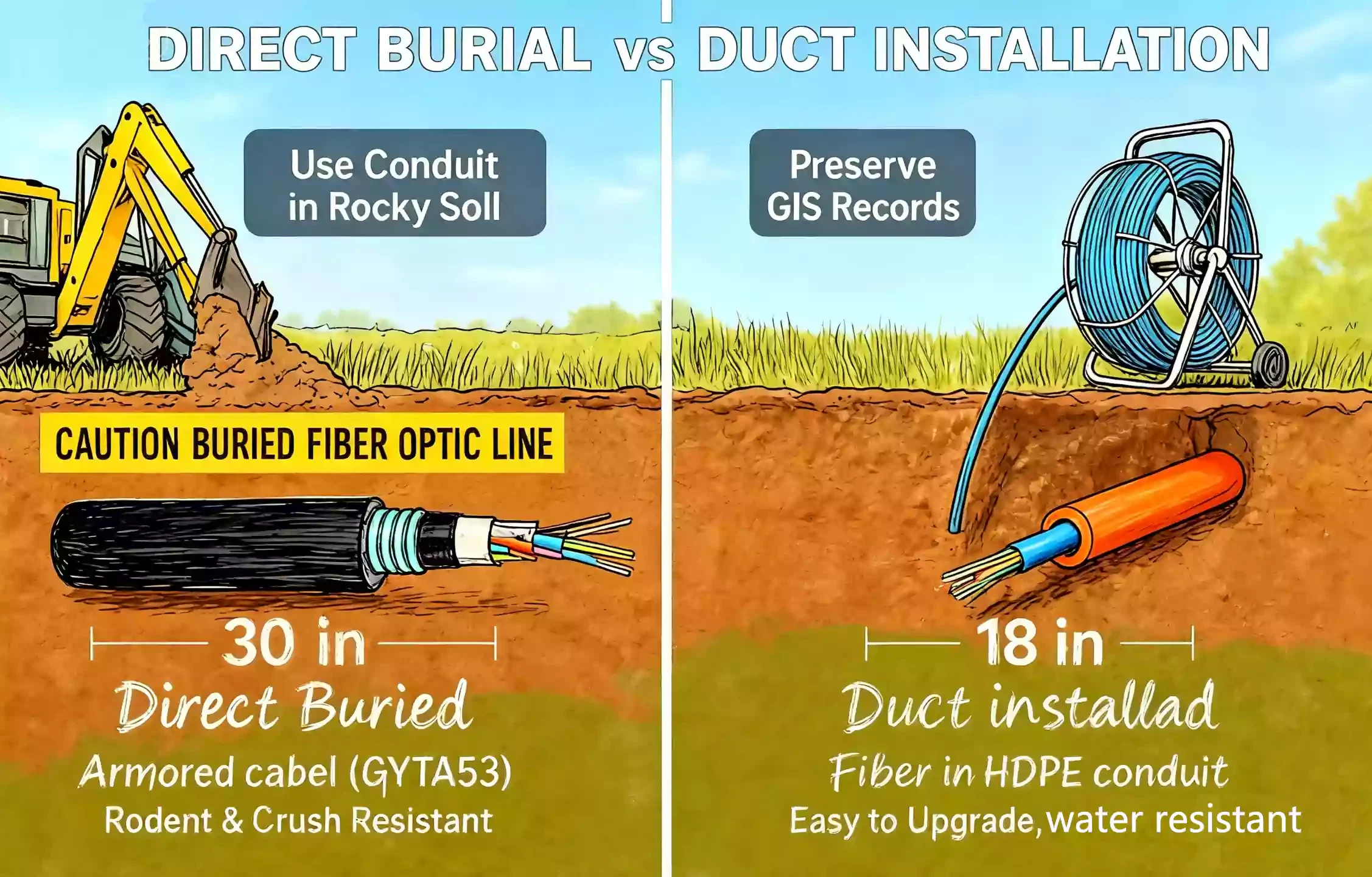
Expect cable burial depths of 36-48 inches (90-120 cm) or more. If you're dropping off a fiber span along the road, or in places where vehicle traffic occurs, such as parking lots, be sure the cable is installed at least 42 inches (107 cm) deep to withstand roads and roadwork/trenching, not to mention the daily vibrations of heavy traffic that exert pressures of about 2000 N/cm. Commercial and industrial sites will also generally use this same minimum depth to ensure your cable is not interrupted during building work.
Underwater and River Crossings: Underground Optical Fiber Challenges
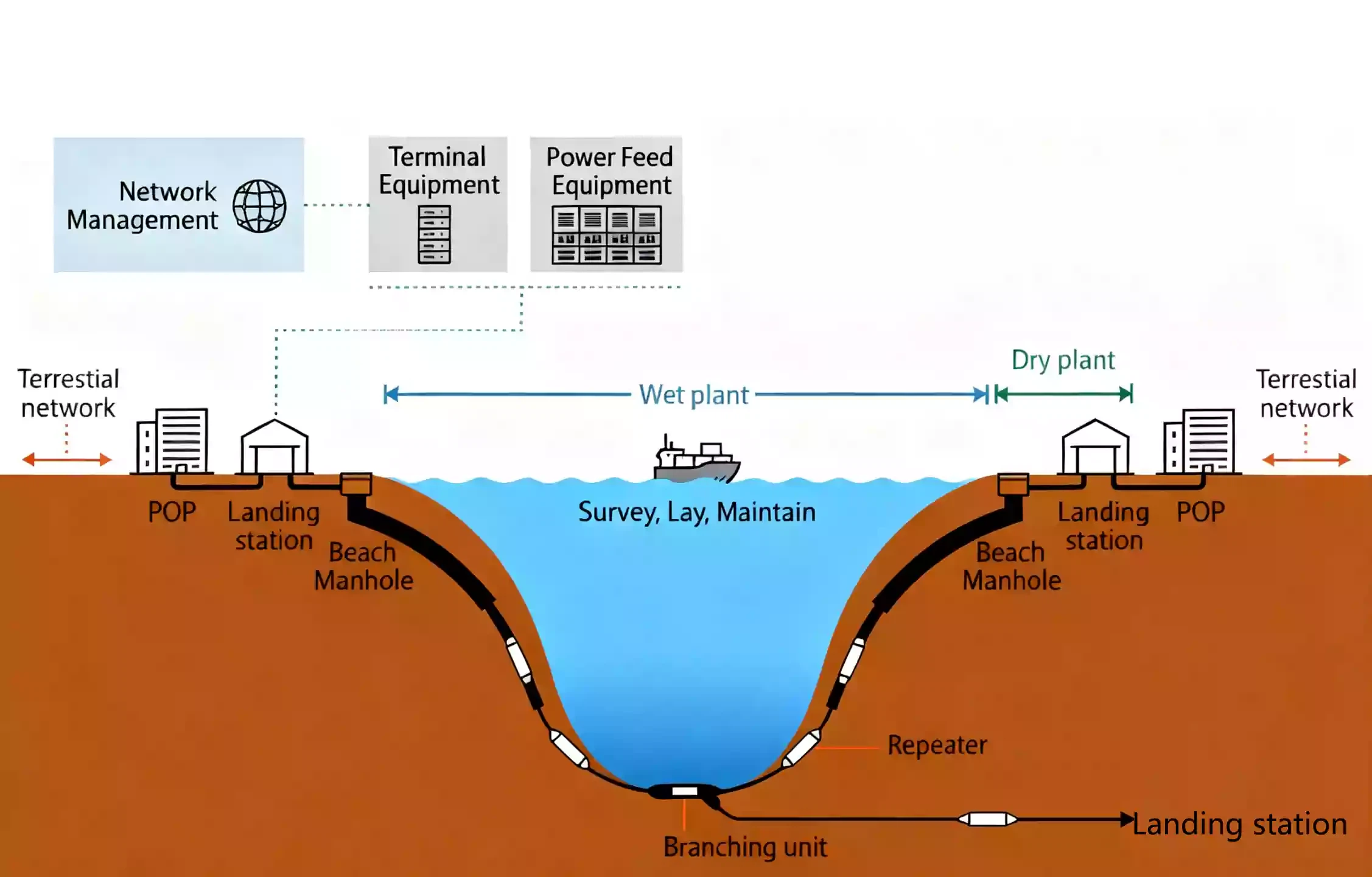
Expect anywhere between three to ten feet (1-3 meters) of bury to withstand such natural scour, or to sink below wave agitation notably caused by tidal amplification, given anchoring usually takes place in shallow water at some interval with much resting below bedrock. In many cases, especially for deep ocean situations, cables rest upon the bed of the sea, not buried at all, with many cables armored to withstand pressures of up to 300 Mpa.
Summary Table: Typical Buried Fiber Optic Cable Depths
| Location | Typical Depth | Key Reason for the Depth |
|---|---|---|
| Urban | 12-36 inches (30-90cm) | Utility interference, pedestrian activity |
| Rural | 24-48 inches (60-120cm) | Farm equipment, soil erosion |
| High traffic | 36-48 inches (90-120cm) | Vehicle loads |
| Underwater | 3-10 feet (1-3 meters) | Currents, anchors; marine hazards |
These distances are seldom arbitrary, as they are typically set to withstand a given load. For example, armouring of fiber optic cables provides approximately 500-2000 N/cm crush resistance (depending on the specific cable), with a loss of signal transmission power typically less than 0.2 dB/km.
Key Variables That Affect How Deep is Fiber Optic Cable Buried
No two sites are the same, therefore burial must be tuned for local conditions. When planning the burial of cables, consider these factors:
Soil Type and Terrain for Buried Fiber Optic Cable
In rocky or sandy soils, deeper burial would be required (up to 48 inches [120 cm]) to avoid cables shifting or being abraded, causing unintentional attenuation of signal of up to 0.1 dB. In stable clay soils, further depth would be permitted, but always lay cables in sand to cushion them from pressure of 50 kN/m².
Climate and Weather Patterns for Underground Optical Fiber
In colder places, bury below the frost line (typically 24-48 inches [60-120 cm]) or risk ice forcing its way in and snapping cables under expanding pressure of up to 10 kN/m². In humid, flood-prone areas (e.g., Southeast Asia during monsoons), 48 inches [120 cm] or beyond may be required to withstand water entering the casing at 0.1 MPa.
Local Regulations and Standards: How Deep is Fiber Optic Cable Buried
Not all national bodies allow discretion. National organizations like NEC (24-48" in the U.S.) or ETSI (0.8-1.0 metres in Europe) must be adhered to. Failure to comply may lead to fines or digging up and redoing cables. Cables laid near highways or heavy civil sites in the U.S. have to be at least 36" [90 cm] due to strict federal laws demanding thicker capping of cables.
Cable Type and Design Considerations
Armoured types with steel tape resist intrusion of up to 1000-2000 N/cm and can be laid shallower in low-risk areas. Unarmoured types have to be laid deeper unless adequately protected in conduits and ducts. Multi-core designs for 5G (upwards of 144 cores per cable!) may require 48" [120 cm] or more to withstand tensile forces during installation.
Tip: For IoT and smart grids, leaving an extra 6-12" (15-30cm) of potential expansion depth can minimize EMI risk to below 0.1 dB. Failure to do so has been associated with 15% outages in urban areas.
Best Practices: Safe and Effective Buried Fiber Optic Cable Installation
Trenching Techniques
Open trenching is advised for urban areas (dig trench, drop ribbon, cover), while directional boring ensures roads remain undisturbed. For rural runs, ploughing is fast; laser guidance ensures drills deviate no more than ±2" (5cm).
Cable Placement and Protection
Drop ribbon in conduit to avoid moisture and mechanical contact; minimum bend radius must be 10-30mm to avoid light loss. Place cable at least 12"(30cm) from power lines to avoid cross talk.
Marking, Backfill, and Monitoring
Place warning tape 8" (20cm) over cable, compact backfill to about 50kN/m², and run OTDR testing to ensure minimal light loss (<0.2 dB/km @ 1310, 1550nm).
Tip: GPS mapping with AI apps provides real-time route visualization and can save 25% of maintenance time, avoiding errors such as accidental dig-ups, which still affect 20% of networks older than 20 years.
Common Obstacles for Buried Fiber Optic Cable
Nature's Wrath: Frost heave or erosion exposing cables; buffer with insulation or bury deeper.
Human Interference: Utility contractors digging; pre-mark cable routes.
Costly Excavation: Digging 200%-300% deeper increases cost but reduces yearly maintenance by 50%; balance with micro-trenching in cities to save 30% on labor.
Case Examples: How Deep is Fiber Optic Cable Buried
Verizon's 10U rollout in rural US: burying at 40-48 inches (100-120 cm) reduced failure rates by 15%.
Vodafone's duct method in Europe: burying 5G/LTE in ducts at 24-36 inches achieved 99.9% uptime.
The Expense of Different Burial Depths
| Depth | Cost per meter | Installation Cost | Annual Maintenance |
|---|---|---|---|
| Shallow 12-24 inches (30-60 cm) | $0.30-$1 | $200-$500/km | 10% outages |
| Deep 36-48 inches (90-120 cm) | $0.80-$3 | $600-$1,200/km | 5-10% outages |
In 5G-heavy locations, armored buried fiber optic cable can see ROI in 2-3 years with outages reduced at bandwidths up to 400 Gbps.
Emerging Trends in Underground Optical Fiber Installation
Advanced Materials: Self-healing fabrics and composites reduce maintenance by 20%.
Automated Trenching: Robotic trenchers achieve 50m/h with precision ±15 cm.
Biodegradable Bedding: Energy-saving materials reduce excavation energy use by 40%.
Hybrid Air-to-Underground Networks: Optimized high-speed connectivity at 48" (1.2 m) depth.
Conclusion: How Deep is Fiber Optic Cable Buried?
Fiber optic cable burial depth typically ranges from 12-48 inches (30-120 cm) depending on soil, climate, cable type, and installation method. Properly following these guidelines ensures reliable, safe, and durable network performance, minimizing the risk of outages and reducing long-term maintenance costs.