

As 5G technology expands and high-density, high-bandwidth applications become the norm, the demand for faster, more reliable data transmission is increasing rapidly. In this shift toward fiber-based infrastructure, understanding the differences between a Fiber Patch Panel and an ODF (Optical Distribution Frame) is essential for designing efficient, scalable, and future-proof networks.
Both devices are critical in fiber optic cable management, but they differ in capacity, protection level, and deployment scope. Choosing the right one can improve network performance, simplify maintenance, and reduce long-term operational costs.
Fiber Patch Panel – Compact and Efficient Cable Termination
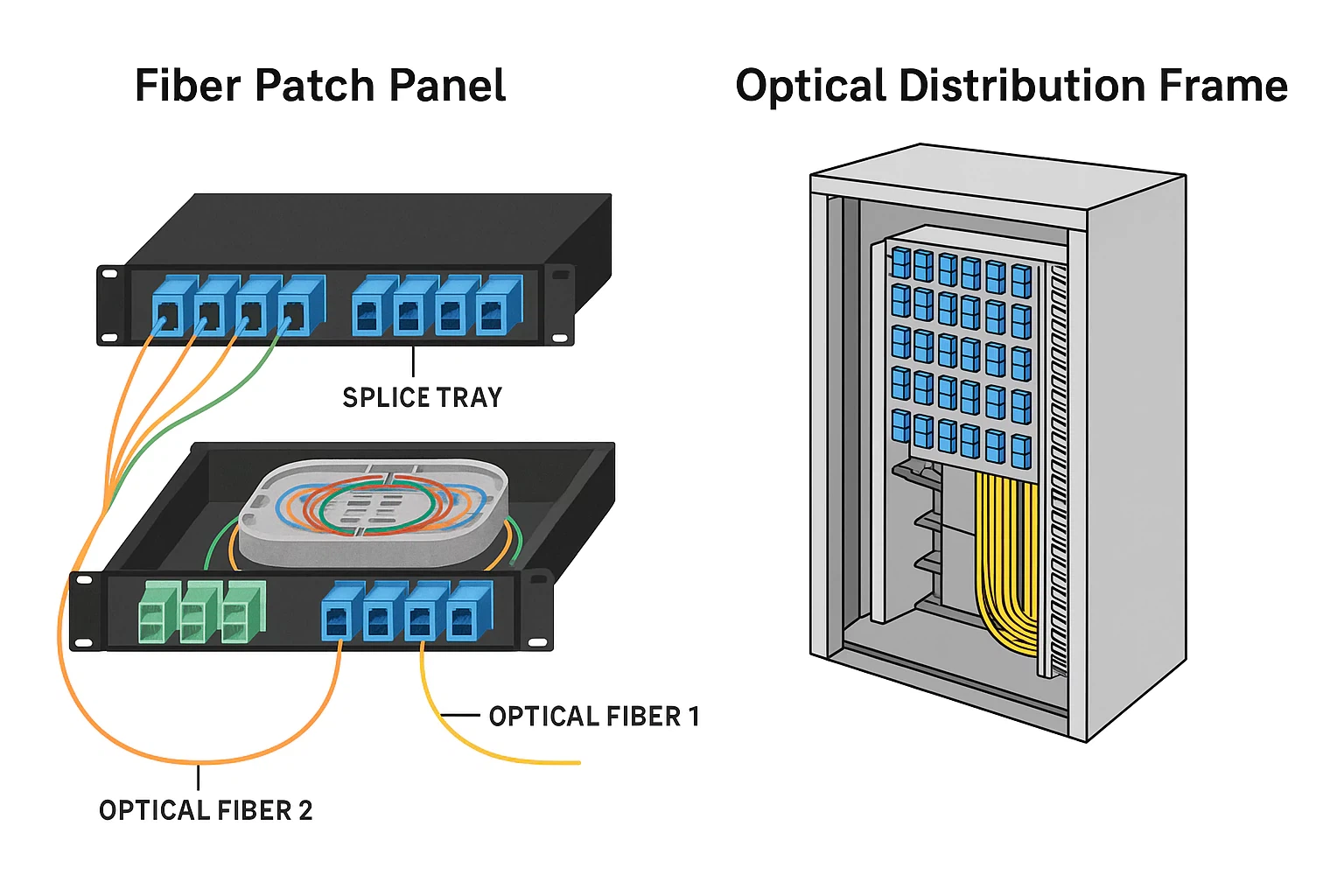
A Fiber Patch Panel is a centralized device for terminating, organizing, and connecting fiber optic cables. It provides a neat, structured way to route and label fiber lines, simplifying both installation and future reconfigurations.
Key Characteristics:
Port Options: Available in 12, 24, 48, and 96-core versions, supporting various connector types.
Mounting Styles: Rack-mounted (standard 19-inch) for data center fiber management solutions, or wall-mounted for building entry points and small-scale applications.
Applications: Enterprise networks, telecom rooms, and FTTB (Fiber to the Building) projects.
Functions: Supports cross-connection, easy cable tracing, and rapid reconfiguration without affecting main cable runs.
Due to its compact design, a Fiber Patch Panel is best suited for short-to-medium distance fiber networks, such as office buildings, data centers, and equipment rooms.
Spring offers high-quality Fiber Patch Panels at competitive prices. Manufactured in China with flexible customization options to meet your specific needs. Reliable performance, fast delivery, and excellent value - perfect for your fiber optic network projects. Contact us at sales@springoptic.com today for a quote!
ODF – Large-Scale Fiber Management and Protection
An ODF is a more comprehensive fiber management system, typically used in large-scale telecom and backbone infrastructures. While it also organizes and terminates fibers, it provides enhanced protection and distribution capabilities.
Key Characteristics:
High Capacity: Can accommodate hundreds or thousands of fibers-common configurations include 96, 144, 288, or more cores.
Modular Structure: Includes adapter panels, splice trays, cable guides, and protective enclosures.
Enhanced Protection: Safeguards delicate fiber cores, pigtails, and splices from dust, bending damage, and mechanical stress.
Deployment Scenarios: Common in central offices, metropolitan networks, FTTH (Fiber to the Home) distribution hubs, and long-haul communication systems.
ODFs can be floor-mounted, rack-mounted, or wall-mounted, offering scalable configurations for network growth.
Fiber Patch Panel vs ODF – Main Differences
| Feature | Fiber Patch Panel | Optical Distribution Frame (ODF) |
|---|---|---|
Primary Function |
Termination and organization of fiber lines | Termination, protection, distribution, and routing |
Capacity |
12–96 cores (typical) | Hundreds to thousands of cores |
Design Complexity |
Simple panel with adapters and splice trays | Modular frame with protective and distribution units |
Deployment Scope |
Local networks, data centers, small telecom rooms | Long-distance telecom, metro networks, FTTH hubs |
Protection Level |
Basic physical protection | Advanced protection for fiber cores and splices |
Choosing the Right Solution
Choose a Fiber Patch Panel if your network is small to medium-sized, requires easy maintenance, and has moderate fiber counts. Ideal for rack-mounted fiber distribution panel installations in data centers or enterprise environments.
Choose an ODF if your network involves large-scale telecom projects, requires long-term scalability, and needs higher protection standards-such as in ODF in fiber optic communication or FTTH distribution hubs.
Final Thoughts
Both Fiber Patch Panels and ODFs are indispensable for modern fiber optic networks. The decision should be based on network size, expansion plans, and required protection levels. A well-chosen solution not only optimizes cable management but also enhances reliability and minimizes downtime.
If you need expert advice or high-quality products, our team can recommend the best FTTH optical distribution frame or fiber patch panel installation guide for your specific deployment needs.