



Overview of FTTA Solution
FTTA Solution (Fiber to the Antenna) is advanced fiber-based radio access network architectures designed to connect BBU and RRU in modern wireless base stations.
By replacing all or part of traditional RF coaxial feeder networks with optical fiber, FTTA Solutions significantly improve transmission bandwidth and distance while reducing signal loss and site complexity. Compared with conventional coax-based architectures, FTTA Solutions enable higher data rates, more flexible network layouts, and centralized cabling management.
Through the use of FTTA Fiber Cable Assembly, CPRI Patch Cord, and Outdoor FTTA Cable, FTTA Solutions provide a future-ready foundation for 4G, 5G macro base stations, small cells, and C-RAN deployments. This architecture effectively shortens installation time, lowers deployment costs, and reduces long-term operation and maintenance expenses.
FTTA technology represents an innovative, flexible, and future-oriented wireless network deployment model.

SPRING FTTA Solutions Capabilities
SPRING provides a complete FTTA Solutions portfolio based on fiber remote (CPRI / eCPRI) technology, supporting manufacturer-specific RRU port configurations and fronthaul interface requirements.
Our FTTA Solutions include:
Standard GYFJH remote fiber optic cables and FTTA Fiber Cable Assembly
Vendor-compatible CPRI Patch Cord solutions
Waterproof Outdoor FTTA Cable assemblies matched to RRU ports, including:
ODC, ODVA, PDLC, and vendor-compatible FTTA connectors
(Ericsson FullAXS interface, Nokia NSN interface)
FTTA cabling system architecture design and engineering support
Custom development of specialized FTTA products, such as:
·Multiport service terminal (FTTA terminal box /MST Box), tower-top multifunction waterproof splice closures
·Waterproof Outdoor FTTA Fiber Cable Assembly
SPRING FTTA Solutions are designed to ensure full compatibility with major telecom equipment vendors while supporting both standardized and customized deployment scenarios.
FTTA Fiber Cable Assembly Portfolio
Connector Type Options
Standard FTTA Fiber Cable Assembly products are available with multiple connector interfaces, including:
FC / SC / LC / ST
These FTTA fiber cable assemblies and CPRI patch cords are widely used in BBU-to-RRU optical transmission links within FTTA Solutions.


Fiber Type Options
SPRING FTTA Fiber Cable Assembly supports both fiber categories required by modern wireless networks:
Single Mode FTTA Fiber Cable Assembly
Multimode FTTA Fiber Cable Assembly

Fiber Core Count Options
Depending on site requirements, FTTA Solutions can be deployed using:
2-core FTTA Fiber Cable Assembly
4-core FTTA Fiber Cable Assembly

Packing Options
To support efficient transportation and site installation, FTTA Fiber Cable Assembly is supplied with:
Standard packing
Reel packing

Standard FTTA Fiber Cable Assembly – Order Information
| Item | Sub-item | Specification / Description |
|---|---|---|
| Connector Type |
A Connector | FC, SC, LC, ST, MU, DIN, D4, E2000, LX.5 |
| B Connector | FC, SC, LC, ST, MU, DIN, D4, E2000, LX.5 | |
| Fiber Type |
Single Mode (SM) | G.652D, G.657A1, G.657A2, G.657B3, G.655 |
| Multimode (MM) | OM1, OM2, OM3-150, OM3-300, OM4-550, OM5 | |
| Fiber Count | Core Number | Duplex (2 Core), 4 Core, Multi-core |
| Cable Diameter | Outer Diameter | 4.8 mm, 7.0 mm, 8.3 mm, or customized |
| Cable Length |
Standard Length | 1 m, 2 m, 3 m, 5 m, 10 m, or customized |
| Branch Length | 0.03 m, 0.34 m, or customized | |
| Packing Method | Packaging | Standard packing or reel packing |
This section demonstrates SPRING's standardized delivery capability and supports rapid project quotation and deployment.
Outdoor FTTA Cable & Waterproof Connector Solutions
Outdoor environments such as tower tops and rooftops require high-reliability connectivity. SPRING provides a complete range of Outdoor FTTA Cable and waterproof connector solutions to ensure long-term network stability.

FullAXS series FTTA Fiber Cable Assembly features an integrated overmolded strain relief design, delivering high tensile strength and IP68 waterproof performance.
It is fully compatible with Ericsson RRU fiber ports.
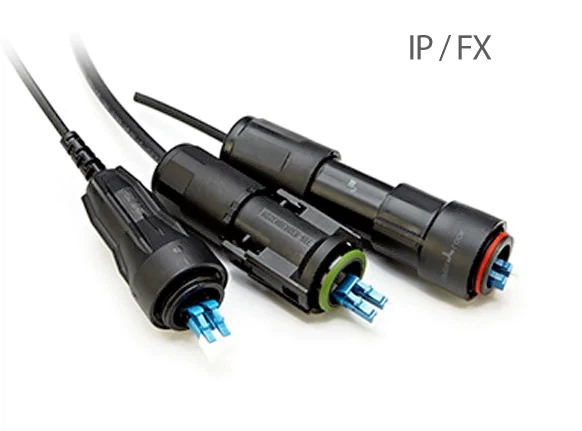
IP / FX
IP/FX series Outdoor FTTA Cable uses PG waterproof gland technology, allowing waterproof connectors to be installed on pre-terminated cables.
This design provides flexible installation and is compatible with Ericsson RRU interfaces.

ODVA waterproof connectors are available in SC, LC, and MPO versions and achieve IP67 protection.
They are widely used in multi-vendor FTTA Solutions.

NSN waterproof connector housings support 90°, 45°, and adjustable bend boots.
With an IP65 rating, they are compatible with Nokia RRU ports.

PDLC series CPRI Patch Cord and Outdoor FTTA Cable assemblies offer IP67 waterproof performance and are compatible with Huawei and ZTE RRU interfaces.

Metal HDC
Metal HDC waterproof connectors include industry-standard types such as:
Amphenol AARC
Rosenberger RDC / RQC, AVIC GYE,HS ODC
Available in 2–4 core, MT multi-fiber, and Q-series quick-lock designs, all rated IP67, these connectors are widely used in high-reliability FTTA Solutions.
FTTA Network Architecture and Cabling System
In a typical FTTA deployment, signal transmission from the BBU (4G/5G base station) to the antenna follows these stages:
| Network Segment | Function | Key Products |
|---|---|---|
| BBU Room | Baseband signal processing and RRU control | BBU, slidable patch panels |
| Outdoor Transmission | Long-distance optical transmission | Outdoor FTTA Cable |
| BBU–RRU Link | Optical baseband signal transport | FTTA Fiber Cable Assembly, CPRI Patch Cord, FTTA terminal boxes |
| RRU | Optical-to-RF signal conversion | RRU, mounting brackets |
| RRU–Antenna | RF signal transmission | Feeder cables, jumpers |
| Antenna | Wireless signal transmission | Antennas, surge protectors |
FTTA Solutions in 4G vs 5G Networks
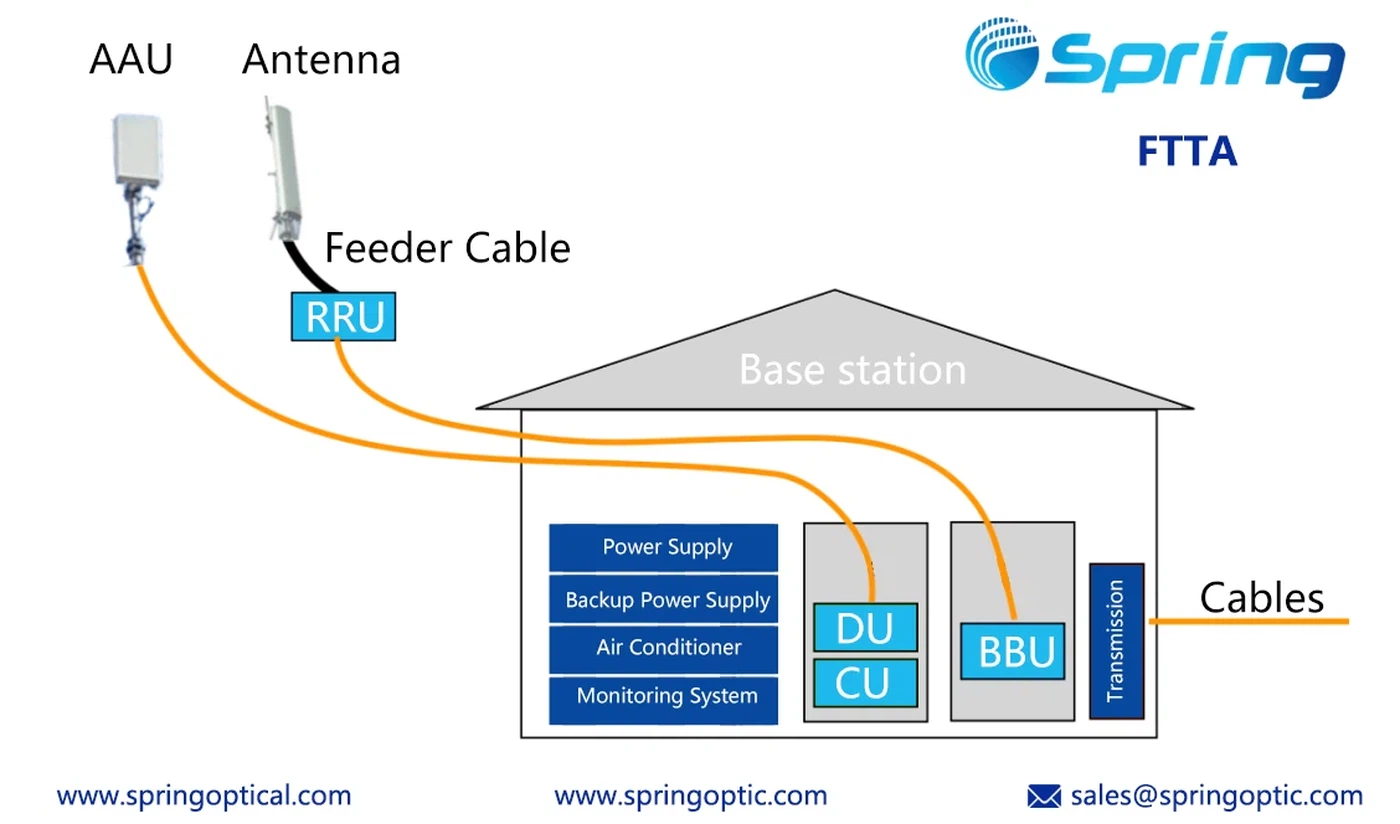
4G Base Stations
FTTA Solutions use fiber to connect BBU and RRU, while RF feeders connect RRU to antennas.
5G AAU Architecture
BBU, RRU, and antenna are integrated into AAU / DU units, using full fiber connectivity to minimize RF loss and maximize performance.
Fiber Cable Types Used in FTTA Solutions
Different fiber cable types play specific roles within FTTA Solutions:
Outdoor FTTA Cable
Used for long-distance transmission from BBU room to tower base.
BS Remote FTTA Fiber Cable Assembly
Plug-and-play connection between tower base and tower top or RRU.
Multi-core IP67 Outdoor FTTA Cable
Supports multiple RRUs while reducing fiber count and simplifying installation.
FTTA Terminal Box Deployment Options
Tower Base Deployment
Scenario: When the fiber distance between BBU and RRU is long.
FTTA terminal boxes are installed at the tower base, with BS remote FTTA Fiber Cable Assembly connecting to tower-top RRUs.
Benefits:
Reduced tower-top equipment
Easier ground-level maintenance
Lower O&M cost
Tower-Top Deployment (Near RRU)
Scenario: When multiple RRUs are installed at the tower top.
FTTA terminal boxes are deployed near RRUs for centralized fiber distribution.
Benefits:
Reduced cable congestion
Faster RRU replacement
Improved maintenance efficiency
Key Advantages of SPRING FTTA Solutions
Lower signal loss and longer transmission distance
Reduced installation and maintenance cost
Improved network reliability
Full compatibility with 4G and 5G evolution
Vendor-neutral FTTA Fiber Cable Assembly and CPRI Patch Cord solutions
Why Choose SPRING FTTA Solutions?
SPRING combines fiber manufacturing expertise, FTTA system engineering, and customized product development to deliver reliable, scalable, and future-proof FTTA Solutions.
From Outdoor FTTA Cable to CPRI Patch Cord and FTTA Fiber Cable Assembly, SPRING provides end-to-end FTTA connectivity that simplifies deployment and protects long-term network investment.