

1. Scope of application
This Installation Manual is suitable for the Fiber Optic Splice Closure (Hereafter abbreviated as FOSC), as guidance for proper installation.
The scope of application is: aerial, underground, wall-mounting, duct-mounting, and handhole mounting. The ambient temperature ranges from –40 °C to +65 °C.
2. Basic structure and configuration
2.1 Dimension and capacity
| Outside dimension (Height x Diameter) |
435mm×190mm |
|
Weight (excluding outside box) |
2350 g- 2600g |
|
Number of inlet/outlet ports |
6 pieces in general |
|
Diameter of fiber cable |
Φ8mm~Φ25 mm |
|
Capacity of FOSC |
Bunchy: 12-96 (cores), Ribbon: up to 288 (cores) |
2.2 Main components
| No. |
Name of components |
Quantity |
Usage |
Remarks |
|
1 |
FOSC cover |
1 piece |
Protecting fiber cable splices in the whole |
Height x Diameter |
|
2 |
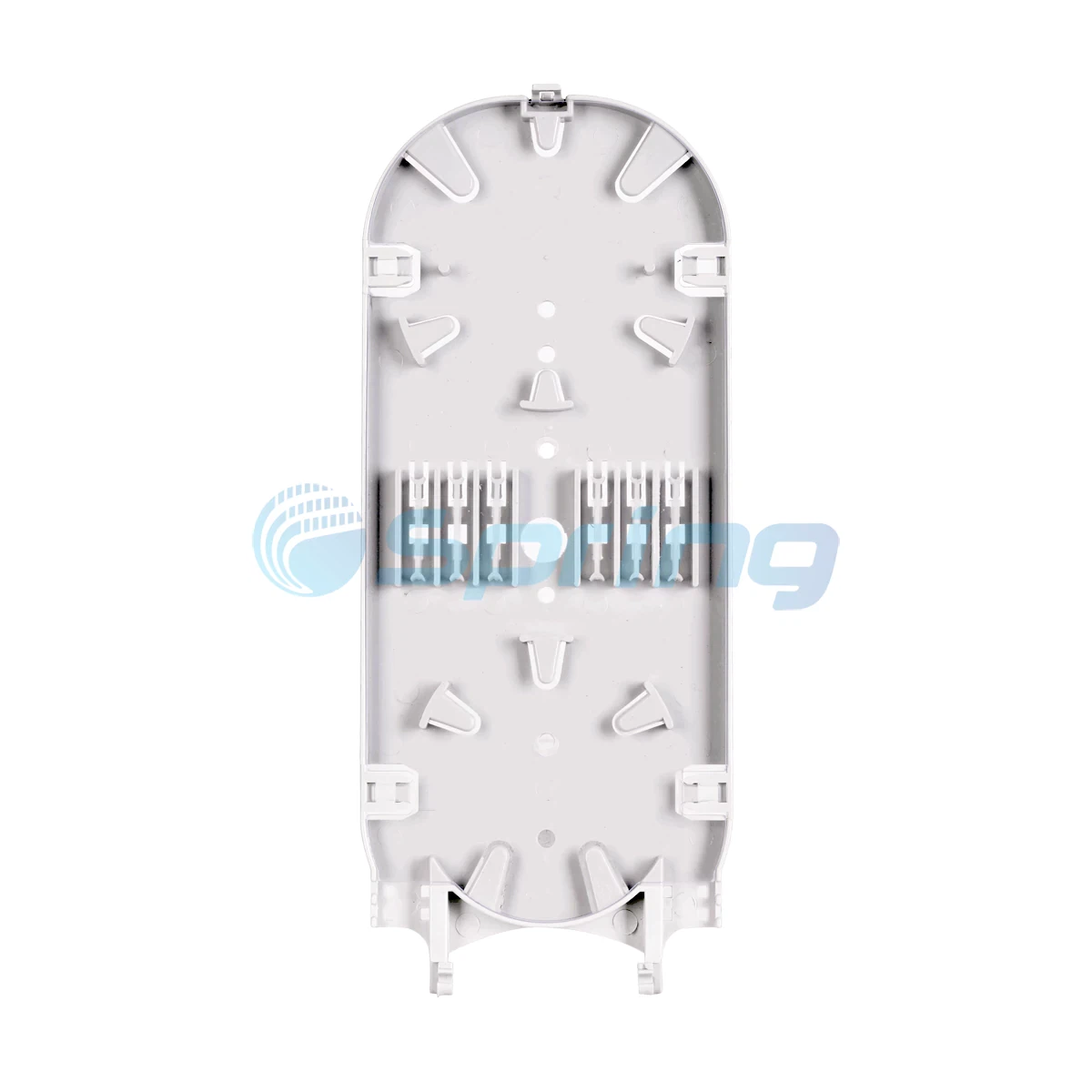
Fiber optic splice tray (FOST) |
Max. 6 trays (bunchy) |
Fixing heat heat-shrinkable protective sleeve and holding fibers |
Suitable for: Bunchy:12,24(cores) Ribbon:6 (pieces) |
|
3 |
Fiber holding tray |
1 pcs |
Holding fibers with a protective coat |
|
|
4 |
Base |
1set |
Fixing internal and external structure |
|
|
5 |
Plastic hoop |
1 set |
Fixing between the FOSC cover and base |
|
|
6 |
Seal fitting |
1 piece |
Sealing between the FOSC cover and base |
|
|
7 |
Pressure testing the valve |
1 set |
After injecting air, it is used for pressure testing and sealing testing |
Configuration as per the requirement |
|
8 |
Earthing deriving device |
1 set |
Deriving metal parts of fiber cables in FOSC for earthing connection |
Configuration as per the requirement |
2.3 Main accessories and special tools
| No. |
Name of accessories |
Quantity |
Usage |
Remarks |
|
1 |
Heat-shrinkable protective sleeve |
|
Protecting fiber splices |
Configuration as per capacity |
|
2 |
Nylon tie |
|
Fixing fiber with a protective coat |
Configuration as per capacity |
|
3 |
Heat shrinkable fixing sleeve (single) |
|
Fixing and sealing a single fiber cable |
Configuration as per the requirement |
|
4 |
Heat shrinkable fixing sleeve (mass) |
|
Fixing and sealing the mass of fiber cable |
Configuration as per the requirement |
|
5 |
Branching clip |
|
Branching fiber cables |
Configuration as per the requirement |
|
6 |
Earthing wire |
1 piece |
Putting through between the earthing devices |
|
|
7 |
Desiccant |
1 bag |
Put into FOSC before sealing for desiccating air |
|
|
8 |
Labeling paper |
1 piece |
Labeling fibers |
|
|
9 |
Special wrench |
1 piece |
Tightening the nut of the reinforced core |
|
|
10 |
Metal hoop |
1 set |
For wall mounting and pole hugging |
|
|
11 |
Buffer tube |
decided by customers |
Hitched to fibers and fixed with FOST, managing buffer. |
Configuration as per the requirement |
|
12 |
Aluminum-foil paper |
1 piece |
Protect the bottom of FOSC |
|
3. Necessary tools for installation
3.1 Supplementary materials (to be provided by the operator)
|
Name of materials |
Usage |
|
Scotch tape |
Labeling, temporarily fixing |
|
Ethyl alcohol |
Cleaning |
|
Gauze |
Cleaning |
3.2 Special tools (to be provided by the operator)
|
Name of tools |
Usage |
|
Fiber cutter |
Cutting off the fiber cable |
|
Fiber stripper |
Strip off the protective coat of the fiber cable |
|
Combo tools |
Assembling FOSC |
3.3 Universal tools(to be provided by operator)
|
Name of tools |
Usage and specification |
|
Band tape |
Measuring fiber cable |
|
Pipe cutter |
Cutting fiber cable |
|
Electrical cutter |
Take off the protective coat of the fiber cable |
|
Combination pliers |
Cutting off the reinforced core |
|
Screwdriver |
Crossing/Paralleling screwdriver |
|
Scissor |
|
|
Waterproof cover |
Waterproof, dustproof |
|
Metal wrench |
Tightening the nut of the reinforced core |
3.4 Splicing and testing instruments (to be provided by the operator)
|
Name of instruments |
Usage and specification |
|
Fusion Splicing Machine |
Fiber splicing |
|
OT DR |
Splicing testing |
|
Provisional splicing tools |
Provisional testing |
|
Fire sprayer |
Sealing heat heat-shrinkable fixing sleeve |
Notice: The above-mentioned tools and testing instruments should be provided by the operators themselves.
4. Installation flow chart
1. Open the closure
2. Determine the length of fiber cable to be fixed and stripped inside FOSC
3. Strip off protective coats of fiber cable and fiber
4. Separate fiber cores and prepare work before fixing the fiber cable
5. Fix reinforced core, and pyrocondense, fix, and seal fiber cable
6. Splice fibers
7. Install a heat-shrinkable protective sleeve and house fibers
8. Check up comprehensively
9. Assemble the FOSC housing and fix the FOSC
5. The process of installing FOSC.
5.1 Step One - Open the closure
5.1.1 Cleaning the locale and determining where to install the FOSC, and then placing the fiber cables required.
5.1.2 Check whether the main components and accessories have been well prepared inside the package.
5.1.3 Open the closure
01. Demount the hoop fixing bolt and pull the hoop locking system out, then proceed with demounting the hoop.
02. Pull the FOSC cover upwards, and installation can begin.
5.1.4 See Drawing 1
Important issues: If the weather conditions are not good enough, then a tent must be pitched for waterproof and dustproof.

5.2 Step Two -Determine the length of fiber cable to be fixed and stripped inside FOSC
5.2.1 If all fibers are for branch splicing, please refer to Drawing 2(A) for stripping length.
5.2.2 If some fibers are for straight-through, while others are for branch splicing, please refer to Drawing 2(B) for stripping length.
5.2.3 See Drawing 2.
Important issues:1. Reserve enough length of fiber cable to be spliced.
2. Stripping length could also be decided by customers according to the installation requirement

5.3 Step Three –Strip off the protective coat of the fiber cable and fiber
5.3.1 Strip off the protective coat of fiber cable from the temp. Locating the mark with the cutter and
the stripper, please refer to Drawing 2 for the stripping length. Stripping length could also
be decided according to the installation requirement
5.3.2 See Drawing 3.
Important issues: If it is difficult to pull all the protective coating of fiber cable at one time, strip
it off sections by section to avoid fiber breakage.
2. The specification of the bolt for fixing the bracket is M8.

5.4 Step Four – Separate fiber cores and prepare work prior to fixing the fiber cable.
Wind 2 layers of insulation tape on a protective coat of fiber core for protection.
Meanwhile, get rid of the stuffing to separate the fiber core and clean it. Form a ring
with a diameter of 100mm or so and fix it on the fiber temporarily with adhesive tape.
Depending on the fiber cable stripped, the following two cases are available.
① All fibers are to be branched after being spliced completely.
② Some of the fibers are for straight-through after being wound, while the others are for
branch splicing.
The FOSC is provided with 3 single-entry/exit tubes, which are suitable for single fiber
cables with a maximum. diameter ф16mm and 1 mass entry/exit tube, which is suitable for 1
piece of fiber cable with max. diameter ф 25mm or 2 pieces of fiber cables with max.
diameter ф 21mm or multi-pieces of fiber cables with short diameter.
5.4.4 A mass entry/exit tube is required if some fibers are for straight-through
5.4.5 The corresponding entry/exit tube cover could be slightly knocked out with a screwdriver from inside to outside, according to the number and diameter of the fiber cable required.
5.4.6 Reserve reinforced core in 70mm length and cut off the unnecessary ones.
5.4.7 See Drawing 4 and Drawing 5.
Important Issues: Entry/exit tubes are to be selected accurately to make it easy for splicing and sealing.

5.5 Fix reinforced core, and pyrocondense, fix and seal fiber cable.
5.5.1 Insert the fiber cable into the corresponding heat-shrinkable fixing tube, further insert the
them into the entry/exit tube at the bottom of FOSC.
5.5.2 Demount fixing nut of reinforced core with a special wrench (plastic one), which is to be inserted into the fixing slot afterward, and tighten it. Then retighten it with a metal wrench (the metal wrench is to be provided by the operator).
5.5.3 Hitch the heat shrinkable fixing sleeve to the fiber cable till its root by hand.
5.5.4 Please refer to Drawing 5 for installing the branching clip.
5.5.5 Heat shrinkable fixing sleeve with fire sprayer to make it hug the entry/exit tube
and fiber cable to reach complete sealing.
5.5.6 See Drawing 5
important issue: 1. Fixing the nut of the reinforced core should be tightened.
2. While heating, the heat-shrinkable fixing tube should shrink evenly, and there should be no bubbles, pores, or other defects inside the tube.

5.6 Step Six - Splice fibers
5.6.1 Follow the user manual of the fusion splicing machine to splice fiber.
Important issue: pay attention to the twist and bend of the fiber
5.7 Step Seven -Install heat-shrinkable protective sleeve and house fibers.
5.7.1 When having completed splicing the fibers, the first fiber ring should be housed
on the farthest side of FOST, the remaining fiber optic should be winded, forming a ring
with a diameter not less than 80mm. Then put it into FOST (Fiber Optic Splice Tray)
together with heat heat-shrinkable protective sleeve.
( Firstly, fix the heat-shrinkable protective sleeve into the slot, then enlarge the diameter of
fiber ring properly.)
5.7.2 see Drawing 6
Important issue: pay attention to the twist and bend of the fiber.

5.8 Step Eight - Check up comprehensively
To ensure the technical requirements, the following instructions must be followed:
5.8.1 Fibers with protective coats are fixed with a nylon tie at the entrance of FOST.
5.8.2 Grommet should be pressed from inside to outside in order to properly install FOST.
5.8.3 Straight-through and reserved fibers with protective coats should be wound to the fiber holding tray.
5.8.4 Check whether the internal tighteners and fixing nut of the reinforced core are well tightened.
5.8.5 Check whether the seal fitting is installed neatly and smoothly.
5.8.6 Check whether the heat shrinkable fixing sleeve is reliable and sealing completely.
5.8.7 See Drawing 7.
Important issues: If any problems occur, they should be solved right away.

5.9 Step Nine – Assemble FOSC housing and fix FOSC
5.9.1 Put desiccant into FOSC.
5.9.2 Put the FOSC cover on the base directly.
5.9.3 Install the plastic hoop between the FOSC cover and base, tighten the hoop locking system,
which is to be fixed by the hoop fixing bolt.
FOSC installation
① Aerial application: Fix the metal hoop and transom to the pole. Please refer to Drawing 8
② Wall mounting application: fix the bracket on the wall with the bolt. (Metal hoop is not
required.)
③ Underground application: a metal hoop is not required.
5.9.5 See drawing 8
Important issues: 1. Pay attention while installing the plastic hoop.
2. The specification of bolt for fixing the bracket is M8.

6. Fiber Optic Splice Closures (FOSC) inspection and testing items
|
Inspecting item |
Technical Requirements |
Inspecting type |
|
|
Routine test (Before leaving the factory) |
Type test |
||
|
Package |
Each small package contains one fiber optic splice closure, together with its accessories, tools, installation manual, and packing list. |
full |
At least 3 sets sampled each time |
|
Appearance |
Intact in shape, no burrs, bubbles, chaps, pores, warps, impurities and other defects, all background colors should be even and continual. |
||
|
Sign |
There is a clear sign on the housing, such as the name and model of the product etc. |
||
|
Fiber storage device |
The fibers reserved are to be wound in a fiber optic splice tray (FOST), the length of fibers housed in FOST is >1.6m, and the curved radius is >30mm. During the installation and maintenance, there should be no attenuation on fibers. |
At least 3 sets sampled each time |
|
|
Electrical jointing device |
Inside FOSC, metallic components of fiber cables have the functions of electrical transmission, earthing connection, and disconnecting. It is possible to install an earthing deriving device outside the housing |
||
|
Sealing performance |
After sealing according to the stipulated operation procedures, the injected air pressure is 100KPa±5Kpa. When immersed in clean water of normal temperature for 15 minutes, there should be no air bubbles, then observed for 24 hours, there should be no change in air pressure. |
||
|
Re-sealing performance |
After reopening and resealing according to the stipulated operation procedures, the injected air pressure is 100KPa±5Kpa. When immersed in clean water of normal temperature for 15 minutes, there should be no air bubbles, then observed for 24 hours, there should be no change in air pressure. |
||
|
Pull |
Bearing pull is ≧ 800N at axle orientation, there should be no breakage on the housing. |
||
|
Punching |
Bearing pressure of 2000N/10cm for 1 minute, there should be no breakage on the housing |
||
|
Impact |
Bearing impact energy of 16N•m, 3 times of impacts, there should be no breakage on the housing |
||
|
Bending |
The spot between the FOSC and seal fitting can bear bending tension of 150N at a bending angle of ±450 for 10 circles, and there should be no breakage on the housing |
||
|
Torsion |
Bearing torsion 50N•m, 10 circle at torsion angle±900, There should be no breakage on the housing. |
||
|
Temperature circle |
Injected air pressure of 60KPa±5 KPa, the temperature circle ranging from -40℃~+65℃, 10 times of the circular tests (one circular consists of high temperature for 2 hours + indoor temperature for 2 hours + low temperature for 2 hours + indoor temperature for 2 hours ) when the pressure declines, the amplitude is ≦5Kpa, immerse the swatch in clean water of normal temperature for 15 minutes, there should be no air bubbles. |
||
|
Voltage resistance strength |
After sealing the FOSC according to the stipulated operation procedures, immerse it in clean water of normal temperature in 1.5m for 24 hours, there should be no breakdown or arc over between the metallic components of the FOSC, between metallic components and the ground at DC 15KV for 1 minute. |
||
|
Isolating resistance |
After sealing the FOSC according to the stipulated operation procedure, immerse it in clean water at 1.5m for 24h; the isolating resistance between the metallic components of the FOSC, between the metallic components and the ground should be ≧ 2×10⁴MΩ. |
||
Spring Optical Communication is one of the largest and best gjs-d003 fiber optical vertical joint splice closure box manufacturers and suppliers with rich experience. Welcome to buy our high-quality products or wholesale our customized GJS-D003 fiber optical vertical joint splice closure box in stock from our factory. Also, a free sample is available if necessary.
Hot Tags: fiber optic splice closure, dome heat shrinkable closure, GJS-D003, fiber optic sealing, fiber cable protection, fiber optic closure installation